
Generative AI has changed how enterprises create content, analyze information, and assist employees. The next shift is toward systems that can act on that information – planning tasks, calling tools, making decisions, and executing workflows. This is where agentic AI enters the picture.
Traditional software follows strict rules. Modern software predicts or acts. Generative models create rich text, code, or images. Agentic systems can execute multi-step workflows with limited human intervention, operating within predefined permissions and guardrails. Understanding agentic AI vs generative AI helps leaders plan digital workflows.
What you will learn in this article:
- Core Operational Differences: How content creation models contrast with goal-driven autonomous systems.
- Underlying Architecture: Key mechanics behind generative prompts versus multi-step cognitive decision loops.
- Side-by-Side Comparison: A clear matrix comparing autonomy, human involvement, and tool integration.
- Real-World Applications: Distinct agentic AI vs generative AI use cases across core enterprise sectors.
- Strategic Architecture Choice: Practical framework to select the right AI paradigm for your business needs.
What is the primary operational focus when comparing Agentic AI vs Generative AI?
Generative models focus on content creation, while agentic systems focus on goal execution and task orchestration.
The primary focus centers on action versus creation. Generative systems produce high-quality output from prompts. They synthesize text, audio, images, and code instantly. They act as creative partners for human users.
Conversely, agentic AI act as digital project managers that plan, execute, and monitor complex tasks dynamically. Modern business process automation services rely on these multi-agent frameworks to optimize complex operational workflows.
Evaluating real-world agentic AI vs generative AI use cases highlights deep operational synergy. Partnering with an experienced IT solutions company allows businesses to implement customized Enterprise AI solutions that combine both paradigms effectively.
Think of generative AI as an expert copywriter. It drafts brilliant articles quickly. Think of AI agents as project managers. They assign work, review output, and meet deadlines. This fundamental distinction changes enterprise software design.
How do generative AI models create content and insights?
Generative models analyze massive datasets to predict patterns and synthesize original text, images, code, and audio based on user prompts.
Generative AI relies on neural network architectures. Transformer models process vast human knowledge. They identify probabilistic patterns across text and code. When prompted, they predict the next logical token.
These systems excel at summarization. They assist programmers with code completion. They draft complex customer responses. However, they remain mostly reactive tools. They wait for human instructions continuously.
Key traits of generative tools include:
- Pattern recognition across unstructured media datasets.
- Instant response generation based on input context.
- High linguistic fluidity and creative output capacity.
- Human dependency for task workflow orchestration.
Users refine prompts to get better outputs. The human remains the central orchestrator.

What makes autonomous AI capable of independent decision-making?
Autonomous AI uses feedback loops, planning modules, memory systems, and tool interfaces to act independently without step-by-step human intervention.
Goal orientation enables true independence. An autonomous AI receives high-level objectives from users. It breaks big objectives into small tasks. It evaluates available digital tools independently.
These intelligent systems feature four key capabilities:
- Planning: Breaking goals into ordered logical sub-tasks.
- Memory: Storing operational history for adaptive continuous learning.
- Tool Integration: Calling APIs, running scripts, and searching databases.
- Reflection: Checking results and correcting errors self-sufficiently.
Deployment of AI agents transforms basic productivity. They execute end-to-end operational routines. They make dynamic choices when encountering unexpected edge cases.
According to research, enterprise adoption of autonomous AI agents is gaining momentum, with more than 60% of organizations expected to deploy AI agents within the next two years.
What is the difference between agentic AI and generative AI?
The main difference between agentic AI and generative AI lies in autonomy, workflow execution, tool usage, and goal-directed decision loops.
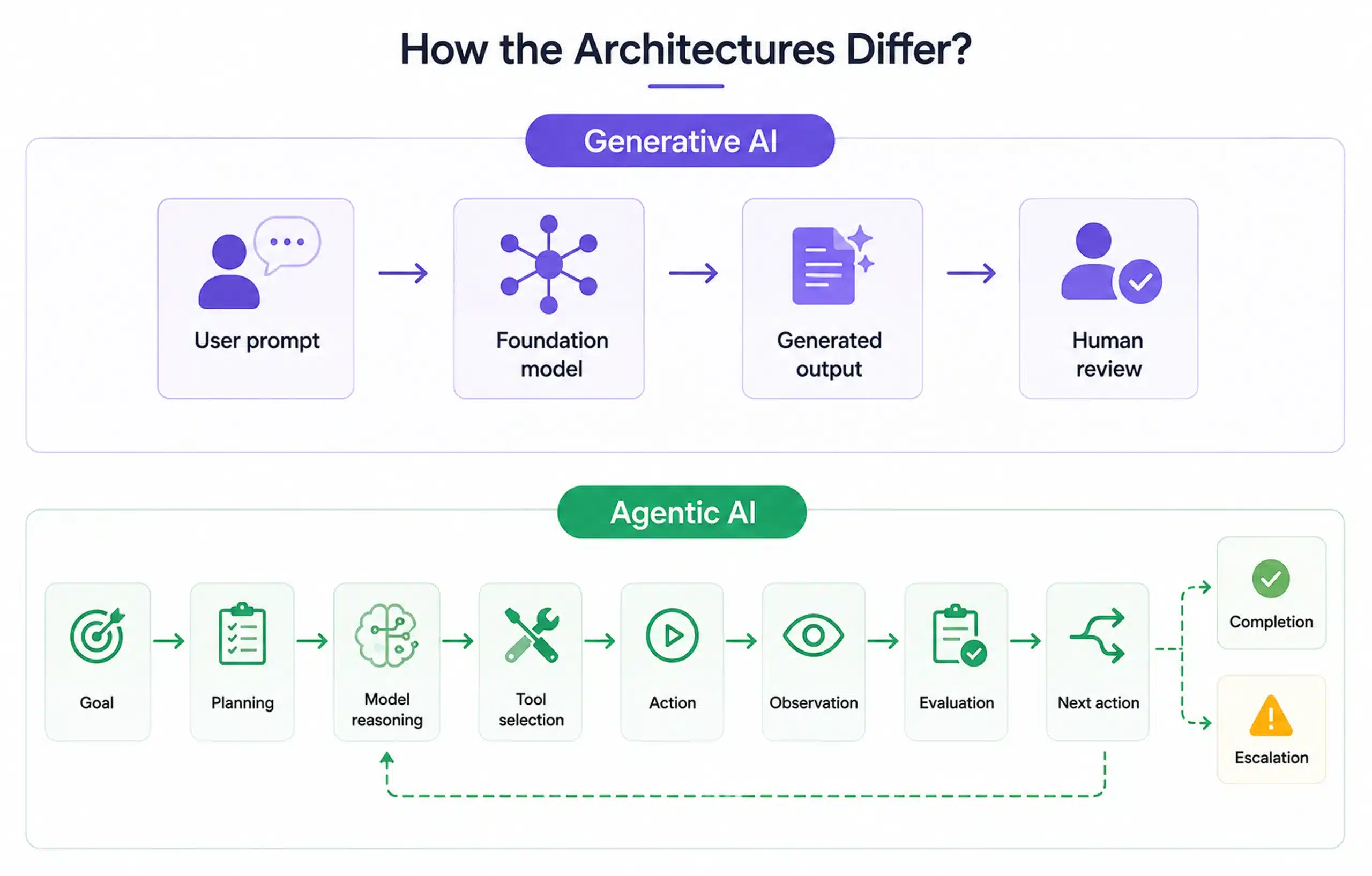
Understanding the difference between agentic AI and generative AI requires evaluating architecture. Generative tools operate in isolated single turns. You send a prompt. You get an immediate answer. The cycle ends completely.
Agentic models run continuous cognitive feedback loops. They analyze intermediate results. They correct the course when errors occur. They query external web APIs directly. They read local database tables automatically.
Evaluating agentic AI vs generative AI highlights clear execution boundaries. Generative models supply information. Agentic systems perform actions. One generates content ideas. The other executes end-to-end operational workflows.
Here is a direct side-by-side technical comparison:
| Comparison Dimension | Generative AI | Agentic AI |
| Core Goal | Produce high-quality creative text, image, or code artifacts. | Achieve specified end-to-end business objectives autonomously. |
| Human Involvement | Requires step-by-step prompts and continuous supervision. | Requires high-level goal setting with minimal supervision. |
| Operational Loop | Single turn request and response execution pattern. | Multi-turn planning, execution, evaluation, and correction. |
| Tool Capabilities | Limited mostly to internal parametric knowledge systems. | Connects actively with APIs, databases, and software applications. |
| System Behavior | Reactive output producer based on direct prompt input. | Proactive problem solver driving systemic digital workflows. |
Where are agentic AI vs generative AI use cases transforming industry?
Generative AI transforms content creation, design, and code drafting, whereas agentic AI automates supply chain routing, clinical triage, financial reconciliation, and procurement.
Real-world deployment demonstrates unique value across sectors. Evaluating agentic AI vs generative AI use cases shows complementary business impact. Enterprise leaders combine both technologies for maximum operational efficiency.
Generative AI Enterprise Applications
Generative tools optimize creative manual labor across departments:
- Marketing teams generate personalized campaign copy at scale.
- Software engineers draft code boilerplates and debug functions.
- Customer service teams draft contextual email responses fast.
- Product designers synthesize visual concept sketches efficiently.
Agentic AI Enterprise Applications
Autonomous systems automate multi-step operational chains seamlessly:
- Supply chain systems reroute shipments during weather delays automatically.
- Financial tools reconcile vendor invoices across ERP systems independently.
- Healthcare systems schedule patients and manage lab orders proactively.
- Retail systems adjust inventory replenishment across global warehouses dynamically.
Comparing agentic AI vs generative AI use cases reveals deep organizational synergy. Generative tools craft precise user communications. AI agents execute backend operational processes efficiently.
McKinsey Global Institute estimates that autonomous workflows and multi-agent AI architectures can reduce enterprise operational obstacles costs by up to 30%.
Why Are Enterprises Moving from AI Assistance to AI Powered Execution?
Enterprise demand is shifting because content generation alone does not solve operational complexity, requiring systems that can act, integrate, and execute.
Businesses face massive operational complexity today. Text creation alone cannot solve process constraints. Enterprise leaders demand automated execution across fragmented legacy systems. They want systems that move data to decisions seamlessly.
This market shift highlights the evolution of agentic AI vs generative AI. Generative outputs still require human action. Someone must copy text into systems. Someone must click the submit buttons manually.
An autonomous AI eliminates these manual friction points. It bridges isolated enterprise applications without custom code. It operates digital tools like human knowledge workers. It accelerates business velocity while reducing human errors significantly.

How do you choose between Agentic AI vs Generative AI for your tech architecture?
Choosing the right technology depends on explicit operational requirements. Evaluate whether your workflows need creative augmentation or end-to-end task automation. Engaging expert AI consulting services helps technical leaders assess infrastructure readiness and avoid costly integration missteps.
Many enterprise architectures integrate both paradigms strategically. Generative models provide natural language understanding, while agentic frameworks manage planning, memory, and tool integration. Leveraging end-to-end AI development services ensures your underlying enterprise software solutions remain scalable, secure, and future proof.
Selecting the right technology depends on explicit business goals. Carefully evaluate your organizational operational requirements. Assess whether you need creative synthesis or automated task execution.
Key Evaluation Criteria for Architecture Selection
Ask these fundamental questions during technical evaluation:
- Generative AI: Do you need assistance writing, summarizing, or designing assets? Choose generative AI.
- Agentic AI: Do you need multi-step task execution across software platforms? Choose agentic AI.
- AI Agents: Does your workflow require real-time system calls and continuous monitoring? Deploy AI agents.
Strategic Integration of Both AI Paradigms
Many modern architectures integrate both technologies strategically. Generative models form the linguistic reasoning engine. Agentic frameworks manage operational planning, tool usage, and execution of loops. Analyzing agentic AI vs generative AI ensures optimal return on technology investments.
A complete assessment of agentic AI vs generative AI use cases helps prevent modern architecture missteps. Selecting properly speeds digital transformation across every operational division.
What are the primary implementation challenges for both paradigms?
Generative AI struggles with hallucinations and accuracy, while agentic AI faces complex challenges around safety, governance, authorization limits, and looping control.
Deploying advanced enterprise intelligence introduces distinct technical hurdles. Generative models struggle with factual hallucinations. They produce confident yet incorrect statements occasionally. Guardrails must enforce factual reliability consistently.
Conversely, autonomous execution carries operational risks. An autonomous AI interacts directly with live software environments. Uncontrolled action loops can create corrupted data records. Systems can trigger improper system API calls without oversight.
Addressing the technical difference between agentic AI and generative AI requires strict security architecture. Autonomous systems require clear authorization limits. They need sandbox testing environments and robust human-in-the-loop controls. Safe deployment models protect enterprise integrity continuously.
What is the future for Agentic AI vs Generative AI integration?
The future lies in hybrid architectures where generative models act as natural language interfaces, and agentic loops manage autonomous enterprise orchestration.
The debate around agentic AI vs generative AI is not black and white. The future belongs to integrated, hybrid enterprise architectures. Language models will provide human-like reasoning and communication capabilities.
Simultaneously, autonomous multi-agent networks will handle background operational orchestrations. Intelligent systems will process unstructured data instantly. They will make complex data-driven decisions autonomously. They will manage operational routines across global enterprise networks.
Analyzing agentic AI vs generative AI reveals an exciting paradigm of evolution. Technology transitions from simple digital assistance to dynamic, self-driving business infrastructure. Early adoption creates sustainable market advantages for forward-thinking enterprises.
Conclusion
Coping with the rapid evolution of modern enterprise intelligence requires a trusted technology partner. Katalyst Software Services Limited serves as the foundation for an enterprise’s technology strategy and implementation roadmap. Katalyst is committed to building Intelligent Enterprises with technology, taking robust technology partner offerings to the rest of the globe.
By navigating complex digital challenges, Katalyst helps global organizations accelerate their data-to-decision roadmap. Katalyst offers comprehensive, end-to-end technology solutions including:
- Digital E-commerce and Enterprise Application Integration
- Supply Chain and Logistics Management Solutions
- Engineering and Manufacturing Solutions
- Artificial Intelligence and Advanced Autonomous Systems
- Professional Services and High-Caliber Developer Hiring
Katalyst empowers leading enterprises across diverse industries, including Consumer Packaged Goods, Life Sciences, Manufacturing, Retail, and Wholesale Distribution. Partner with Katalyst Software Services Limited to transform modern software capabilities into sustainable business performance.