
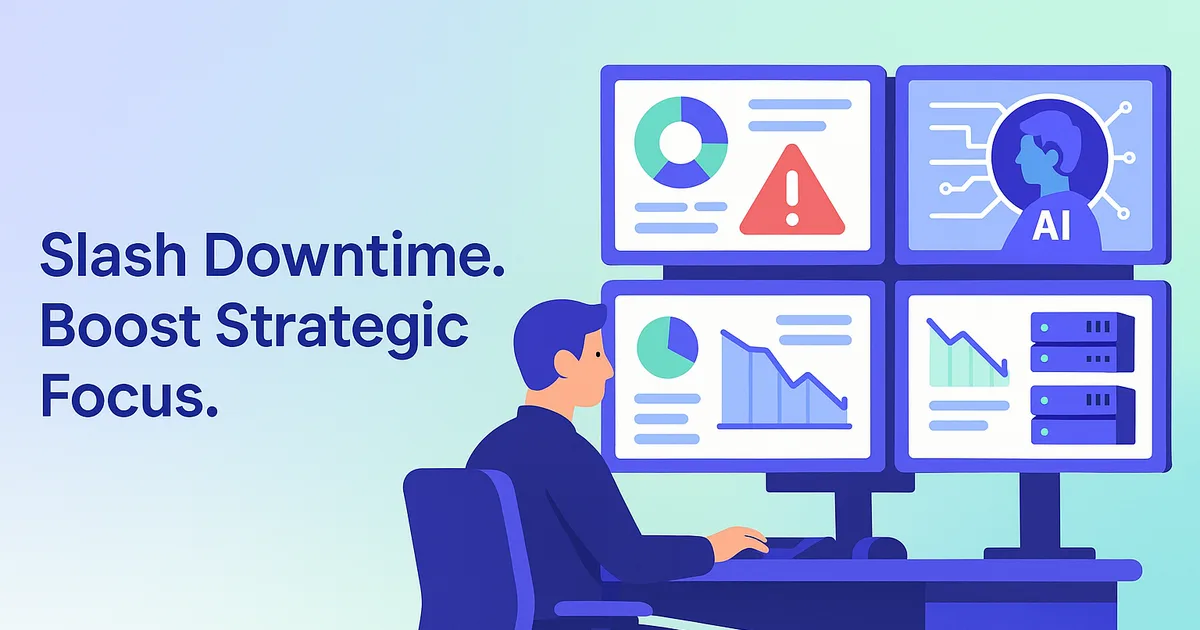
Every week, IT leaders pour hours of human effort into juggling tickets, hunting for root causes, and patching systems; friction that bleeds budget and saps morale. Yet there’s a smarter future where autonomous AI agents for IT operations handle those chores, letting teams focus on innovation. McKinsey found that AI-driven IT operations leveraging predictive maintenance can cut unplanned downtime by up to 30 percent, proving that autonomous support is no longer a theory. In the next ten minutes, you’ll see how agentic AI in enterprise settings turns repetitive tasks into self-optimizing workflows, what agentic AI use cases in enterprises deliver the fastest wins, and a pragmatic roadmap to deploy at a fraction of the cost of traditional automation programs.
Why Traditional IT Operations Hit a Wall
Legacy systems, fragmented data silos, and a multi-vendor ecosystem generate endless hand-offs. Even the best-intentioned teams face:
- Projects running over time and budget because every integration feels “custom.”
- Skills gaps that force specialists to firefight instead of architecting long-term fixes.
- Calendar-based maintenance that misses subtle failure signals, triggering unexpected downtime and lost production.
If the goal is to stay agile while controlling overhead, yesterday’s manual runbooks won’t scale.
What Is Agentic AI and Why Now?
Generative AI in enterprises introduced large language models that draft code and craft reports. Agentic AI takes the next logical step: enterprise AI agents that can perceive context, decide, and act across enterprise-spanning environments without waiting for human prompts.
Unlike static scripts, autonomous AI agents for IT operations:
- Observe: Continuously ingest logs, metrics, and topology changes.
- Plan: Create multi-step action plans aligned to policy and service-level objectives.
- Act: Execute remediations, open change requests, and even negotiate resource allocations.
- Learn: Reinforce successful patterns to refine future actions.
Gartner predicts that 80 percent of routine IT operations tasks will be handled by autonomous enterprise AI by 2030. Forward-looking CIOs are laying the groundwork today.

Core Agentic AI Use Cases in Enterprise IT
Below are agentic AI use cases in enterprises that deliver tangible value quickly:
- Proactive Incident Response: Enterprise AI agents correlate events across monitoring tools, isolate probable root causes, and roll out hot fixes, slashing mean-time-to-resolution while preventing scope creep in war-room meetings.
- Predictive Maintenance over Calendar Schedules: AI-driven IT operations leverage vibration data, power consumption, and firmware logs to predict component failure, transforming maintenance from calendar-based to needs-based and reducing spare-parts inventory.
- Intelligent Change Management: Autonomous AI agents for IT operations simulate impact graphs, flag conflicting windows, and draft approval tickets automatically, securing executive buy-in for smoother releases.
- Capacity Optimization: Generative policy models spin up or down resources in hybrid clouds, ensuring SLA compliance and cost control, a must-have when ROI timelines are under scrutiny.
- Security Autopilot: Agents triangulate threat intel feeds with endpoint telemetry, quarantine assets, and open service tickets, bridging the skills gap without sacrificing compliance.
From Generative to Agentic: Evolving the AI Maturity Curve
Stage 1: Task Automation
Chat-based scripts write configs but rely on people to push changes, often leading to shadow IT.
Stage 2: Orchestrated Workflows
Robotic process automation stitches together tools but still follows rigid paths that crumble when data formats shift.
Stage 3: Autonomous Decisioning
Agentic AI solutions for digital businesses introduce feedback loops, allowing systems to adapt to novel events and learn from outcomes, finally taming the complexity of a multi-vendor ecosystem.
Building Blocks: Best-in-Class Platforms and Ecosystem Integration
Choosing the best AI platforms for enterprise automation hinges on openness and extensibility.
| Capability | Why It Matters | Platform Traits to Verify |
|---|---|---|
| Real-time Data Fabric | Eliminates data silos, fuels fast decisions | Native connectors, CDC support |
| Policy Engine | Aligns actions with governance | Low-code rule editor, version control |
| Autonomous Execution Layer | Removes manual runbooks | Secure remote execution, rollback |
| Learning Feedback Loop | Drives continuous improvement | Embedded reinforcement learning APIs |
Note: Adopt vendors with API-first design to avoid lock-in and protect against runaway licensing costs.
Implementation Roadmap: Five Practical Steps
- Define High-Impact Domains: Start where unplanned downtime hurts most often, monitoring, patching, or asset health. We help you quantify downtime cost and set targets.
- Audit Data Availability: Map data flows across legacy systems and new cloud services. Our hybrid delivery model brings data engineers on-site to unblock sources fast.
- Select and Pilot: Stand up a sandbox with one or two enterprise AI agents. Measure KPIs, validate governance, and secure executive buy-in with early wins.
- Scale Through Federated Governance: As agents proliferate, embed policy checks and cross-domain approvals to contain scope creep and security risk.
- Optimize and Iterate: Capture lessons, retrain models, and light up adjacent processes, ensuring ROI grows quarter after quarter.
Risk Management: Security, Skills, and Change Fatigue
- Security Concerns: Agentic AI in enterprise touches production systems. Enforce principle-of-least-privilege and audit trails to appease CISOs wary of multi-system environments.
- Skills Gap: Upskill existing staff through joint-delivery sprints. By pairing them with AI engineers, you bridge resource constraints while building internal champions.
- Employee Resistance: Frame agents as copilots, not replacements. Demonstrate how they kill repetitive tasks so experts can tackle higher-value challenges.
Pro Tip: Run regular tabletop exercises where teams watch an agent handle an outage end-to-end. Seeing is believing defuses skepticism.

Measuring Tangible Value
Executives fund programs that move the bottom line. Capture:
- Mean-time-to-detect and mean-time-to-resolve before vs after deployment
- Downtime hours avoided and corresponding cost savings
- Labor hours redirected from routine tasks to innovation projects
Tie these metrics to quarterly reports to silence doubts about slow return on investment.
The Katalyst Difference: Strategic Partnership, Not Just Tools
Katalyst brings 18 years of digital transformation experience. We help you unify agentic AI solutions for digital businesses through:
- Hybrid delivery model, on-site architects plus remote AI labs, for speed without overhead bloat.
- Library of pre-trained enterprise AI agents tuned for manufacturing MES, ERP, and OT networks, accelerating time-to-value.
- Vendor-agnostic integration that preserves existing investments while simplifying a complex multi-vendor ecosystem.
We make sure you see tangible value fast, and at a fraction of the cost of rip-and-replace overhauls.
Conclusion
Agentic AI in enterprise contexts is no longer futuristic hype. By shifting from calendar-based maintenance to predictive interventions, from manual ticket queues to self-healing systems, you unlock capacity, resilience, and competitive advantage. Whether you start with one pilot or a portfolio of AI-driven IT operations initiatives, the path is clear and field-tested.
Ready to cut downtime, tame complexity, and free your team for strategic work? We make sure you make the right choice. Connect with a Katalyst advisor to explore a best-in-class roadmap tailored to your environment.
The surge of autonomous AI agents for IT operations is here; let’s turn it into a sustained advantage with agentic AI solutions for digital businesses.