
Introduction
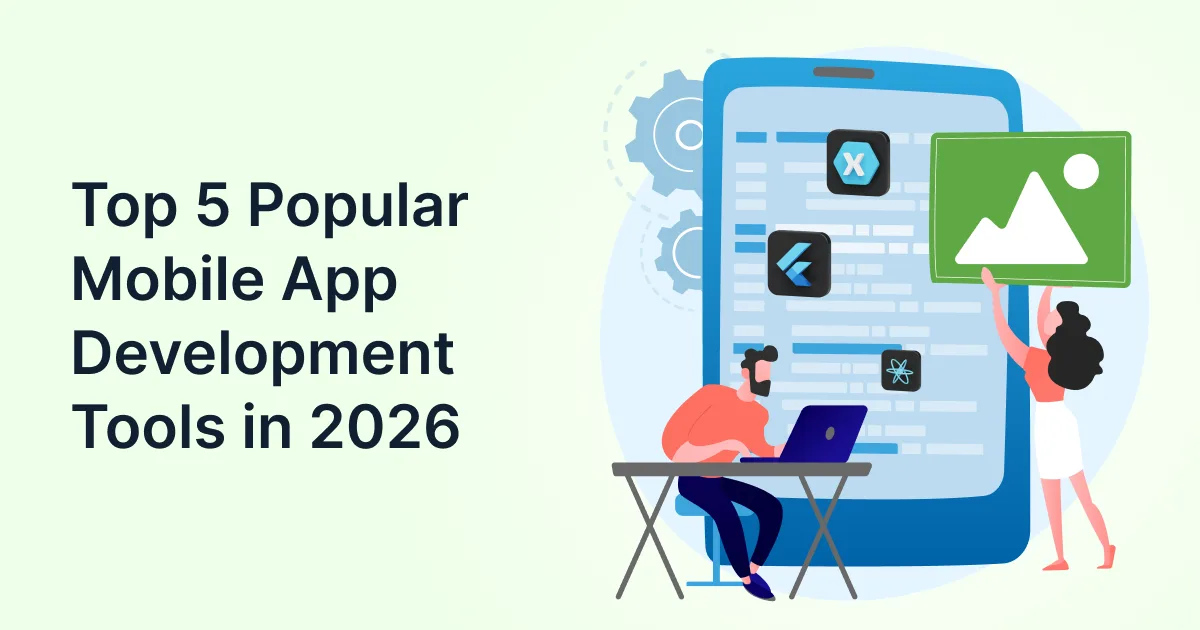
To build scalable and high-performing apps in 2026, you need tools for mobile app development that balance speed, flexibility & scalability. The best mobile app development tools 2026 combine cross-platform efficiency, low-code capabilities & seamless integration with Digital Transformation Services and Custom Software Development.
Mobile apps are now central to business growth, from eCommerce to enterprise operations. Choosing the right tools to develop mobile app solutions directly impacts project timelines, costs & user experience. Businesses investing in Digital Transformation Services and Custom Software Development are increasingly turning to platforms that enable faster innovation, better integration & scalable architectures.
For instance, platforms aligned with Digital Commerce Solutions help businesses build seamless digital ecosystems and accelerate go-to-market strategies.
| 💡 Did You Know? “The global mobile app market is expected to generate over $935 billion in revenue by 2026.” Source: https://www.statista.com/statistics/269025/worldwide-mobile-app-revenue-forecast/ |
What Are the Best Tools for Mobile App Development in 2026?
To select the best mobile app development software, you need tools that support scalability, performance & rapid deployment. The best tools for mobile app development today integrate automation, cloud capabilities & Digital Transformation Services to accelerate delivery and ensure long-term growth.
1. Flutter:Why Is It a Leading Cross-Platform Tool?
To build visually consistent apps faster, you need a framework like Flutter that enables a single codebase for multiple platforms while maintaining native-like performance.
Key Features –
- Single codebase architecture: Write once and deploy across Android, iOS & web, significantly cutting development time
- Rich widget library: Pre-built, customisable UI components for consistent design across devices
- Hot reload functionality: Allows developers to instantly see code changes without restarting the app
- High-performance rendering engine: Uses Skia for smooth animations and responsive interfaces
Why Choose Flutter?
Flutter is ideal for organisations investing in Custom Software Development because it reduces time-to-market while maintaining UI quality. It’s especially useful for startups and growing businesses aligned with Digital Transformation Services, as it enables rapid prototyping and frequent updates.
3. React Native:How Does It Accelerate Development?
To develop flexible and scalable applications quickly, React Native provides a powerful JavaScript-based approach that allows code reuse across platforms.
Key Features –
- Reusable components: Build once and reuse across multiple app screens and platforms
- Large ecosystem: Strong developer community with extensive third-party libraries
- Fast refresh capability: Speeds up debugging and iteration cycles
- Integration flexibility: Easily integrates with existing native apps
Why Choose React Native?
React Native is perfect for businesses scaling rapidly, especially those expanding digital commerce platforms, as highlighted in Shopify growth strategies. It aligns well with Digital Transformation Services, enabling faster feature rollouts and consistent user experiences.
3. OutSystems:Is Low-Code the Future of App Development?
To build enterprise-grade apps with minimal coding, you need low-code platforms like OutSystems that streamline development and reduce complexity.
Key Features-
- Visual development environment: Drag-and-drop interface for faster development
- AI-assisted automation: Automates repetitive tasks and improves productivity
- Enterprise scalability: Supports complex workflows and integrations
- Built-in security & governance: Ensures compliance and reliability for large-scale apps
Why Choose OutSystems?
OutSystems is a gamechanger for enterprises adopting Digital Transformation Services, as it accelerates application delivery while reducing operational costs. Following insights from OutSystems scalability best practices, organisations can build highly scalable apps without large teams.
4. Xamarin – Why Is It Ideal for Microsoft Ecosystems?
To leverage a robust enterprise-grade framework with Microsoft integration, Xamarin enables shared code development while maintaining native performance.
Key Features –
- C# and .NET support: Ideal for Microsoft-based development teams
- Shared business logic: Reduces redundancy by reusing backend code
- Native API access: Enables full functionality across platforms
- Strong security architecture: Ensures enterprise-grade application protection
Why Choose Xamarin?
Xamarin is highly suitable for enterprises already using Microsoft technologies. It supports Custom Software Development initiatives where security, integration & scalability are priorities, making it a strong contender among tools for mobile app development.
5. Swift & Kotlin:Are Native Tools Still Relevant?
To achieve superior performance and complete hardware control, native tools like Swift and Kotlin remain essential for platform-specific development.
Key Features –
- Optimised performance: Direct interaction with device hardware ensures faster execution
- Enhanced UI customisation: Enables highly tailored user interfaces
- Better security control: Ideal for sensitive applications like banking
- Platform-specific optimisation: Improves overall app stability and responsiveness
Why Choose Native Development?
For performance-intensive apps such as gaming, AR/VR, or fintech, native tools remain unmatched. Businesses leveraging Custom Software Development often prefer native apps for high-end experiences that align with advanced Digital Transformation Services.
Key Statistics
- 70% of developers prefer cross-platform tools (Stack Overflow)
- 85% of businesses invest in Custom Software Development (McKinsey)
- Mobile apps drive 60%+ of global digital interactions (Statista)
Comparison Table: Best Mobile App Development Tools 2026
| Tool | Type | Best For | Key Advantage |
| Flutter | Cross-platform | UI-rich apps | Fast development & visuals |
| React Native | Cross-platform | Scalable apps | Code reusability |
| OutSystems | Low-code | Enterprises | Rapid deployment |
| Xamarin | Hybrid | Microsoft ecosystem | Strong integration |
| Swift/Kotlin | Native | High-performance apps | Maximum control |
How to Choose the Best Mobile App Development Software?
To select the right tools to develop mobile app solutions, you need to evaluate your technical, business & scalability requirements aligned with Digital Transformation Services.
Factors to Consider –
- Development speed vs complexity: Choose low-code tools for quick delivery and flexible frameworks for complex builds
- Budget and total cost of ownership: Consider licensing, maintenance & scaling costs, not just development
- Team expertise and learning curve: Align tools with your team’s existing skills for faster adoption
- Scalability and future growth: Ensure the tool supports increasing users and feature expansion
- Integration capabilities: Check compatibility with APIs, cloud platforms & enterprise systems
- Security and compliance requirements: Critical for industries like fintech, healthcare & eCommerce
Why Are Mobile App Development Tools Critical for Business Growth?
To stay competitive in a digital-first world, businesses must rely on advanced tools for mobile app development that enable innovation, efficiency & scalability.
Detailed Benefits –
- Faster time-to-market: Modern tools reduce development cycles, allowing businesses to launch products quickly and respond to market changes
- Enhanced user experience: Advanced frameworks ensure responsive, intuitive, and engaging app interfaces
- Operational efficiency: Automation and low-code platforms streamline workflows and reduce dependency on large teams
- Scalable business models: Supports growth without requiring complete system overhauls
- Higher ROI: Efficient development and maintenance lead to long-term cost savings
Businesses leveraging Custom Software Development and Digital Transformation Services consistently outperform competitors in delivering seamless customer experiences.
Conclusion
The choice of tools to develop mobile app solutions in 2026 is no longer just a technical decision, it’s a strategic business move. From cross-platform frameworks like Flutter and React Native to low-code platforms like OutSystems and powerful native tools, each option serves a unique purpose.
The key is aligning your selection with business goals, scalability needs & long-term digital strategies. Organisations that invest in the right mix of Digital Transformation Services and Custom Software Development not only accelerate app development but also create sustainable competitive advantages.
Ready to build your next mobile app with the right tools? Connect with our experts to get started today.
Key Takeaways
- Cross-platform tools dominate app development trends
- Low-code platforms accelerate enterprise adoption
- Native tools remain critical for performance-driven apps
- Tool selection directly impacts scalability and ROI