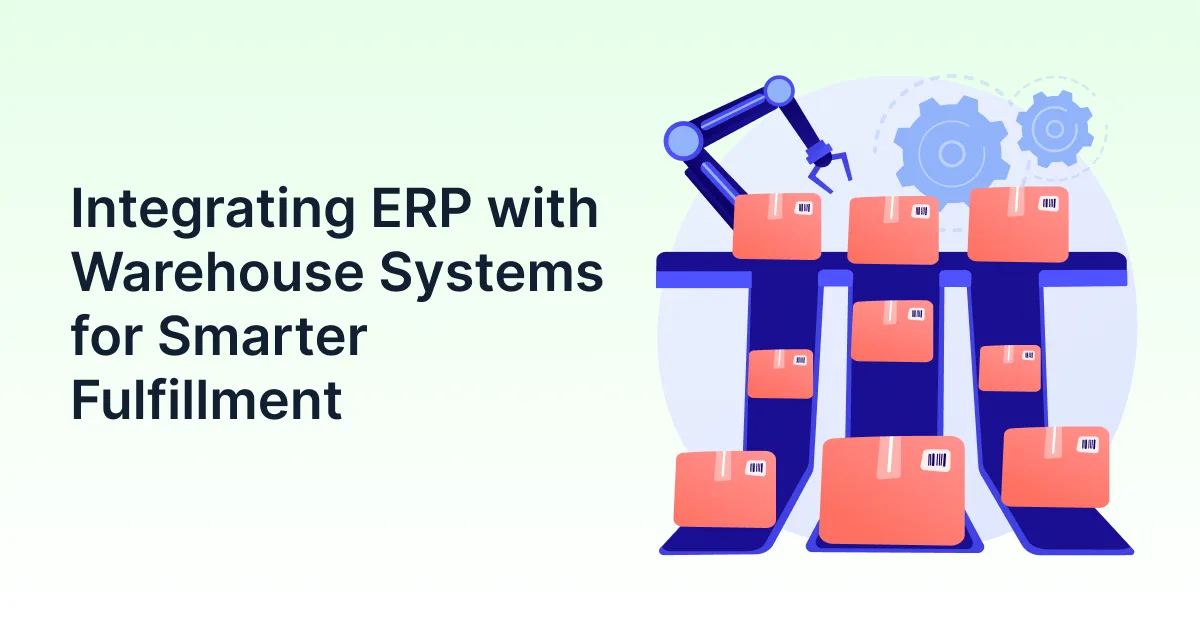
Warehouses operating in silos from the rest of the enterprise bleed margin on every single order. When daily floor operations lack real-time visibility, the entire order-to-cash process suffers from delays, inaccuracies, and compliance risks. By aligning backend financials with floor-level fulfillment automation, companies can turn their supply chain into a measurable competitive advantage. For a comprehensive digital solution, the Grexpro ERP platform directly addresses these disconnects, simplifying complex IT ecosystems to accelerate your data-to-decision timelines.
Disconnected systems cost your business money every time an item is picked, packed, or shipped. An efficient supply chain requires seamless ERP WMS integration to eliminate the blind spots between the back office and the warehouse floor. If your customer service team is constantly apologizing for unexpected stockouts while the finance department scrambles to reconcile inventory numbers, your current technological setup is failing the business. This guide details how combining warehouse inventory management software with your core financial systems acts as a catalyst for complete fulfillment automation. By understanding these concepts, you will uncover the essential ERP warehouse integration benefits and exactly how to architect a digital transformation erp strategy that actively protects your margins.

The Hidden Costs of a Fragmented Order-to-Cash Process
When you run standalone warehouse management software, your floor inventory data is inherently out of sync with your corporate financials. This fundamental disconnect shatters the efficiency of the order-to-cash process. Operations leaders often assume their manual data workarounds are sufficient until a sudden surge in consumer demand causes their fulfillment automation workflows to collapse entirely. Without proper ERP WMS integration, your highly capable warehouse inventory management software becomes just another isolated, inaccessible database. Ultimately, you end up relying on delayed batch uploads rather than achieving true, instantaneous data synchronization.
A recent survey of 65 top logistics and supply chain executives revealed that 70% plan to invest approximately $100 million in automation over the next five years, prioritizing speed, process stability, and reduced labor dependency. If enterprise leaders are spending heavily on localized fulfillment automation, ignoring the foundational ERP WMS integration means that major capital investment will severely underperform.
Lack of continuous data synchronization means the finance team cannot see what is actually happening on the warehouse floor. When critical enterprise systems do not communicate fluidly with specialized warehouse management software, you suffer from poor cash flow visibility. Consequently, the order-to-cash process slows down to a crawl, and broader digital transformation of ERP initiatives stall before they can deliver ROI.
Strategic ERP Warehouse Integration Benefits for Mid-Market Enterprises
Achieving seamless ERP WMS integration delivers immediate, tangible improvements to your daily operations. The primary ERP warehouse integration benefits revolve around unprecedented speed and transactional accuracy. When your warehouse inventory management software talks directly to your central ERP, you permanently eliminate the need for manual data entry. This seamless communication is the true essence of scalable fulfillment automation.
To ensure your system implementation does not stall, understanding your foundational gaps is critical. Evaluating your current state is just as important as selecting the right warehouse management software for your facility. To avoid common enterprise project pitfalls, it helps to review a comprehensive checklist for reducing ERP implementation risks before drafting your vendor shortlist.
| Operational Area | Siloed Warehouse Management Software | Unified ERP WMS Integration |
| Data Synchronization | Batch updates at end-of-day, high error rate | Real-time visibility across all departments |
| Order-to-Cash Process | Delayed invoicing, constant manual reconciliation | Automated billing triggered upon shipment |
| Fulfillment Automation | Limited to physical routing, isolated from sales | End-to-end automation from order to delivery |
| Inventory Accuracy | Prone to stockouts and phantom inventory | Precise, dynamic allocation preventing shortages |
| 💡 Did You Know? Despite the proven operational advantages of connected systems, only about 20 percent of warehouses in North America have adopted any form of automation as of 2024. (Source: McKinsey & Company — Navigating warehouse automation strategy for the distributor market — 2024) [2] |
Core Architecture for Flawless Data Synchronization
Building an effective ERP WMS integration requires much more than simply connecting a few basic APIs. The system architecture must prioritize continuous, real-time data synchronization above all else. Your warehouse inventory management software must fundamentally function as a natural extension of your enterprise financials. A highly successful digital transformation erp project maps every single data touchpoint embedded within the order-to-cash process.
Many modern enterprise systems offer built-in modules designed to handle these complex connections out of the box. When evaluating infrastructure options, you should prioritize solutions that natively support your unique operational workflows. For example, understanding the key features of a modern manufacturing ERP can directly guide you in selecting a system robust enough for high-volume fulfillment automation.
Illustrative Example (based on documented enterprise patterns):
A mid-sized consumer packaged goods distributor struggled endlessly with their order-to-cash process due to aging, legacy warehouse management software. Their ambitious digital transformation erp strategy involved replacing manual batch uploads with live data synchronization between their ERP and WMS. By focusing intensely on their ERP WMS integration, they achieved a 50 percent reduction in cycle time and created a zero-defect picking environment, maximizing their ERP warehouse integration benefits.
Scaling Your Business with Fulfillment Automation
When ERP WMS integration is executed correctly, your business scales efficiently without proportionally increasing your operational headcount. Advanced fulfillment automation seamlessly takes over the highly repetitive, error-prone tasks. Your warehouse inventory management software dictates the physical movements of goods, while the digital transformation erp backbone simultaneously handles the complex accounting and compliance requirements.
Data shows that 51% of medium-sized businesses list moving key data into a business application such as an ERP as a top technology investment priority for the next 12 months. This massive industry shift is primarily driven by the urgent need for better data synchronization across the entire organization.
The concrete ERP warehouse integration benefits become incredibly obvious during peak seasonal rushes. Your warehouse management software communicates instantly with your procurement desk to manage stock. The order-to-cash process flows without manual interruption, conclusively proving the financial value of your ERP WMS integration.
Driving Growth Through Connected Systems
Ultimately, ERP WMS integration is not just a routine IT upgrade; it is a fundamental shift in how your entire business operates and scales. By bridging the critical gap between your enterprise system and your warehouse inventory management software, you establish the flawless data synchronization necessary to permanently repair a fractured order-to-cash process. Securing these vital ERP warehouse integration benefits allows mid-market enterprises to deploy genuine fulfillment automation and scale confidently without constant manual intervention.
A successful digital transformation erp initiative requires a unified approach to your architecture. If your internal teams are spending more time patching broken connections than building new capabilities, it is time to schedule a no-cost consultation with our integration specialists and design a unified architecture that accelerates your growth.
Frequently Asked Questions
Your most common questions, answered with precision and insight