
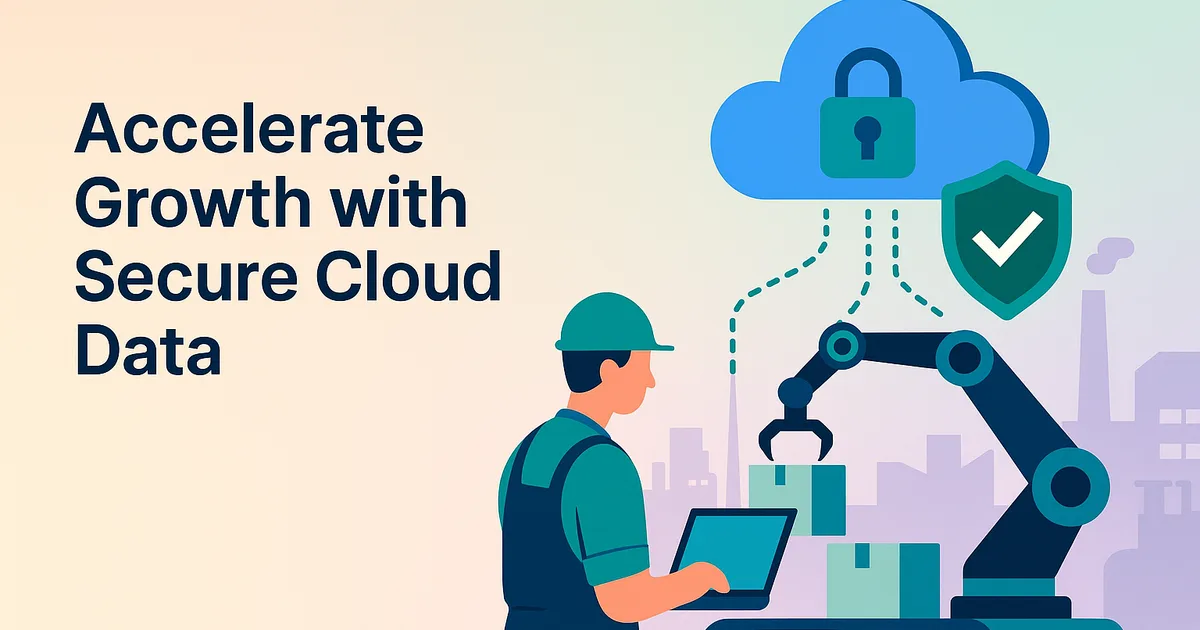
Cloud adoption has become the fastest route to agility, but the journey isn’t risk-free. One misconfigured storage bucket or an overlooked API key can shut down a production line, expose regulated data, and erode customer trust overnight. For manufacturing and enterprise leaders already juggling legacy systems, data silos, and tight margins, a single breach is more than an IT headache; it’s unplanned downtime that stops revenue cold.
That’s why cloud data security has moved from “nice to have” to a board-level mandate. As a digital transformation partner with 18+ years of experience, Katalyst Technologies sees the same pattern across industries: tight project timelines, complex multi-vendor ecosystems, and a skills gap that leaves teams stretched thin. Yet, with the right strategy, security becomes a growth accelerator, not a cost center.
The New Reality of Cloud Data Security
Threat actors no longer attack only the network edge; they hunt misconfigurations, weak identities, and forgotten test environments inside your multi-cloud footprint. Meanwhile, business units keep spinning up new workloads without looping in security teams. The result? Shadow IT, fragmented policies, and rising compliance exposure.
Add legacy OT networks, plant-floor PLCs, and regional data regulations to the mix, and “simple” cloud projects suddenly feel overwhelming. The good news: best-in-class security frameworks now blend automation, AI, and zero-trust principles to simplify the complexity, often at a fraction of the cost of manual controls.
What’s at Stake: Numbers You Can’t Ignore
Below is a snapshot of why proactive cloud data security matters:
| Impact Area | Average Cost Per Incident | Hidden Business Toll |
| Production downtime due to a data breach | $260,000 per hour (Ponemon, 2024) | Missed delivery SLAs, lost overtime, line re-starts |
| Regulatory fines (GDPR/HIPAA/CCPA) | Up to 4% of annual revenue | Brand damage and legal fees |
| Multi-cloud misconfiguration breaches | 40% of all cloud incidents (IBM X-Force) | Emergency remediation, overtime costs |
| Customer churn post-breach | 21% within 6 months (Forrester) | Future revenue loss |
Bottom line: Reactive security puts both OPEX and market share at risk.

Six Cloud Data Security Best Practices That Deliver Tangible Value
Each practice below solves a specific pain point for enterprises managing multi-vendor environments and legacy integrations.
1. Adopt a Zero Trust, Identity-First Model
- Treat every user, device, and service call as untrusted until verified.
- Enforce least-privilege access with role-based policies and step-up MFA.
- Integrate identity feeds across ERP, MES, and cloud IAM to break data silos.
Benefit: Stops lateral movement inside hybrid networks and limits blast radius.
2. Encrypt Everything and Govern the Keys
- Apply AES-256 encryption for data at rest and TLS 1.3 for data in transit.
- Use hardware security modules (HSMs) or distributed key systems for critical workloads.
- Rotate keys automatically and federate key management across clouds.
Benefit: Keeps sensitive IP and PII unreadable even if storage layers are compromised.
3. Gain Continuous Visibility with AI-Driven Monitoring
- Deploy cloud-native SIEM and behavior analytics to spot anomalies in minutes, not days.
- Automate ticketing and remediation to cut incident response time by up to 55%.
- Feed OT sensor data into the same platform to correlate plant events with cloud logs.
Pro Tip: Train AI models on both IT and OT datasets to avoid false positives that stall production.
4. Classify Data and Enforce DLP at the Source
- Tag datasets by sensitivity (public, internal, confidential, regulated).
- Apply Data Loss Prevention (DLP) policies directly on storage buckets and API gateways.
- Block or redact sensitive payloads in real time when apps access restricted data.
Benefit: Prevents accidental leaks from development teams and third-party contractors.
5. Secure Integration Points and APIs
- Use gateway-level authentication, schema validation, and rate limiting.
- Monitor for “zombie” APIs left behind after version upgrades.
- Map dependencies across SAP, Salesforce, and homegrown apps to avoid blind spots.
Benefit: Reduces the attack surface in complex, multi-vendor workflows.
6. Automate Compliance and Governance
- Embed policy-as-code so new resources inherit the right controls.
- Generate on-demand audit reports for GDPR, HIPAA, or CMMC with one click.
- Schedule continuous compliance scans to avoid quarter-end fire drills.
Benefit: Slashes manual audit prep and builds executive buy-in through transparent KPIs.
Bridging the Gap Between Legacy Systems and Modern Cloud
Many guides stop at theory; real life means mixing on-prem MES servers, decades-old PLCs, and SaaS analytics, all under tight uptime SLAs.
- Network segmentation keeps OT traffic separate while enabling secure data ingestion to the cloud.
- Edge gateways perform local encryption and protocol translation for Modbus, OPC UA, and other plant protocols.
- Hybrid delivery models allow phased migration, start with non-critical analytics, then move core apps once controls are proven.
Watch Out: Lifting-and-shifting legacy workloads without re-architecting security often reproduces the same vulnerabilities at scale.

Calculating ROI: Security as a Growth Enabler
Security spend rarely gets the same enthusiasm as revenue-generating projects, yet the payback is measurable.
- Reduced downtime: AI-based controls free 2-3 production days per year, worth $500K+ for a mid-size manufacturer.
- Audit efficiency: Automated evidence collection cuts compliance prep by 60%, saving both labor and consulting fees.
- Accelerated time-to-market: Faster risk approvals mean new digital services launch weeks earlier, capturing revenue sooner.
When modeled over a three-year horizon, best-in-class cloud data security programs deliver a 3-5× ROI, often paid back within 14 months.
Putting It All Together: A Phased Roadmap
- Assess Current State Map data flows, classify assets, and benchmark against frameworks like NIST CSF.
- Prioritize High-Impact Gaps. Focus first on identities, misconfigurations, and unencrypted data stores.
- Deploy Quick-Win Controls. MFA, encryption, and automated posture management often go live in weeks.
- Integrate Continuous Monitoring Feed logs to a centralized SOC or managed detection service.
- Optimize and Scale. Extend zero trust and automation to additional sites, then revisit policies quarterly.
Katalyst’s enterprise-spanning solutions follow this phased approach, ensuring scope creep is minimized while value is captured early.
Partnering with Katalyst for Best-in-Class Protection
We make sure you:
- Simplify multi-vendor security with one governance layer.
- Secure data across cloud, edge, and plant networks without disrupting operations.
- Save time and budget by automating 70% of manual tasks at a fraction of the cost of building in-house.
Our experts have guided Fortune 500 manufacturers, global CPG brands, and fast-growing e-commerce firms through secure cloud adoption, delivering tangible value in under six months.
Let’s explore how this applies to your operations.
Cloud Data Security FAQ
How do I start securing data already in the cloud?
Begin with an automated posture scan to find misconfigurations, enable encryption, and lock down identities. Then roll out continuous monitoring.
What cloud data security best practices apply to multi-cloud environments?
Zero trust identity, unified key management, AI-driven visibility, and policy-as-code work across AWS, Azure, and GCP.
Can I achieve compliance without slowing development?
Yes. Embedding guardrails in CI/CD pipelines enforces controls automatically, letting teams deploy code faster and safer.
How often should security policies be reviewed?
Quarterly for high-risk assets, annually for lower-risk workloads, or immediately after regulatory changes.
What’s the biggest hidden risk?
Unmonitored APIs connecting legacy systems to the cloud often lack modern authentication and are easy entry points for attackers.
Ready to turn cloud security into a competitive advantage?
Let’s map a roadmap tailored to your exact environment, so you innovate with confidence, not fear.