
Modern enterprises generate massive amounts of unstructured data daily. Traditional systems struggle to process this information efficiently. Basic models often output inaccurate or hallucinated answers. Enterprise leaders need reliable intelligence for daily operational choices.
Retrieval-augmented Generation (RAG) changed how systems fetch external document knowledge. However, standard setups follow rigid and single-pass steps. They pull text once and generate an answer immediately. If initial search results miss key details, the output fails.
This is where Agentic RAG can extend the traditional RAG architecture with iterative retrieval, planning, and tool use. This advanced solution adds dynamic reasoning to standard framework loops. Autonomous agents analyze queries, run multi-step searches, and correct errors.
What is the Traditional Retrieval Augmented Generation (RAG)?
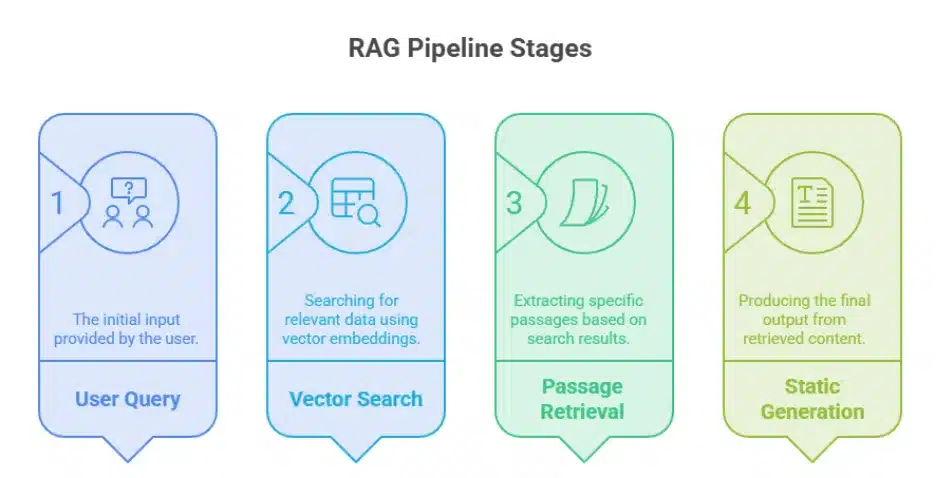
Traditional Retrieval-augmented Generation (RAG) connects language models to private databases. It converts raw documents into numeric vector embeddings. When users ask questions, the system fetches matching text chunks. It sends these passages to the model for final synthesis.
In a basic RAG implementation, retrieval and generation often follow a relatively fixed pipeline. More advanced RAG architectures can add query rewriting, reranking, retrieval evaluation, and other control mechanisms. Agentic RAG takes this further by allowing an AI agent to dynamically plan retrieval steps, select tools, evaluate intermediate results, and iterate when the available context is insufficient.
Modern artificial intelligence demands dynamic context evaluation. Linear pipelines cannot adapt when initial searches return incomplete records.
Key Enterprise Market Insights
The adoption of autonomous retrieval systems is growing rapidly across global industries. Enterprise leaders rely on real-time data integration to maintain operational efficiency and precision.
| Metric | Industry Statistic | Source |
| Projected RAG Market Value by 2035 | USD 40.34 Billion | Roots Analysis Report |
| Global Agentic Artificial Intelligence Market (2026) | USD 9.14 Billion | Fortune Business Insights Report |
| Enterprise AI Executive Adoption Rate | 79% of Senior Executives | Globe Market Research Insights |
| Operational Productivity Gain Reported | 66% of Adopting Companies | Globe Market Research Insights |

What makes Agentic Retrieval-augmented Generation (RAG) different?
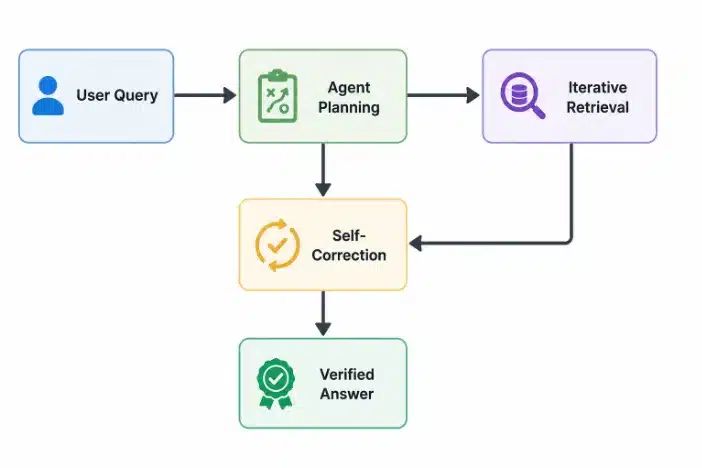
Agentic Retrieval-augmented Generation (RAG) replaces simple lookup chains with smart autonomous agents. These agents use advanced artificial intelligence to plan complex search actions. They inspect retrieved data, evaluate gaps, and perform follow-up searches independently.
Core Components of Agentic Workflows
- Autonomous Planning: Agents break broad enterprise queries into small research steps.
- Dynamic Routing: Systems choose between vector databases, SQL tables, or live APIs.
- Iterative Reflection: The agent checks if retrieved context answers the question fully.
- Self-Correction: Bad search queries get rewritten automatically before final text output generation.
How does Agentic Retrieval Augmented Generation (RAG) work?
Agentic Retrieval-augmented Generation (RAG) follows an active, self-correcting execution loop.
- Query Deconstruction: The system receives a complex user request. The main agent splits the request into logical sub-questions.
- Tool Selection: The agent picks the best data source for each sub-question. It queries structured databases, vector stores, or external web tools.
- Context Evaluation: Advanced artificial intelligence scores the relevance of fetched text passages.
- Query Reformulation: If information is missing, the agent rewrites its search terms. It fetches extra records until context requirements are fully satisfied.
- Grounded Synthesis: The model compiles verified facts into a concise answer. It provides source citations for complete enterprise transparency.
Why do enterprises need Agentic Retrieval-augmented Generation (RAG)?
Modern businesses manage complex, fragmented data across multiple legacy platforms. Standard search tools fail to cross-reference distinct enterprise systems effectively. Agentic Retrieval-augmented Generation (RAG) solves critical operational constraints across key sectors.
| Feature Comparison | Standard RAG | Agentic RAG |
| Search Approach | Single-pass vector lookup | Multi-step iterative search |
| Error Handling | Accepts wrong data | Self-corrects and rewrites queries |
| Tool Usage | Vector index only | SQL, APIs, Vector, Web tools |
| Response Accuracy | Prone to hallucinations | Highly grounded and verified |
Enterprise Use Cases by Industry
Consumer Packaged Goods (CPG)
CPG firms track shifting consumer demand and supply disruptions daily. Agentic Retrieval-augmented Generation (RAG) queries sales databases and logistics logs together. It delivers real-time stock insights directly to operational managers.
Life Sciences
R&D teams must scan thousands of clinical trial documents. Autonomous artificial intelligence agents cross-reference research papers, regulatory filings, and lab notes safely. This speeds up drug discovery compliance while maintaining high accuracy.
Manufacturing
Engineers require quick access to complex machinery manuals and incident logs. Agentic Retrieval-augmented Generation (RAG) pulls schematics, reads maintenance records, and suggests clear repair steps.
Retail & Wholesale Distribution
Inventory managers balance global supply chains across regions. Smart agents analyze supplier contracts, track shipping delays, and update stock forecasts autonomously.
What are the main benefits of Agentic Retrieval-augmented Generation (RAG)?
Implementing agentic Retrieval-augmented Generation (RAG) brings massive operational improvements.
- Higher Accuracy: Multi-step verification drastically reduces false answers.
- Complex Reasoning: Systems handle multi-part questions effortlessly.
- Automated Workflows: Agents trigger downstream business actions using external enterprise tools.
- Data Integration: The framework links structured databases effortlessly with unstructured files.
Advanced artificial intelligence empowers teams to make faster decisions. It removes manual data collection steps across departments.

How can Katalyst Software Services Limited transform your enterprise?
Building advanced operational tools requires deep domain expertise and robust software engineering. Katalyst Software Services Limited helps global organizations modernize legacy infrastructure. We step over challenges to accelerate your data to decision roadmap.
Our expertise covers comprehensive technical services designed for scale:
- Digital Ecommerce: Unified customer experiences backed by smart search.
- Enterprise Applications: Scalable ERP and CRM integration services.
- Professional Services: Strategic tech advisory and custom software development.
- Supply Chain and Logistics Management Solutions: End-to-end visibility across global trade routes.
- Engineering and Manufacturing Solutions: IoT and smart industrial automation tools.
- Artificial Intelligence: Enterprise agentic deployments and custom model integration.
- Hiring Developers: Specialized tech talent dedicated to your project needs.
We empower global businesses by delivering reliable enterprise applications. Our solutions connect fragmented data streams into actionable operational insights.
How to implement Agentic Retrieval Augmented Generation (RAG)?
Deploying agentic Retrieval-augmented Generation (RAG) requires clear technical milestones.
Implementation Checklist
- Audit Data Sources: Map vector indexes, SQL databases, and internal APIs.
- Select Frameworks: Deploy agent orchestrators like LangGraph or LlamaIndex.
- Define Agent Roles: Assign specific retrieval, reasoning, and validation of tasks.
- Establish Security: Implement role-based access controls across search indices.
- Monitor Performance: Track retrieval of recall, answer faithfulness, and latency.
Enterprise artificial intelligence solution demands a careful system of orchestration. Partnering with experts guarantees rapid deployment without security risks.
What is the future of Agentic Retrieval Augmented Generation (RAG)?
Agentic Retrieval-augmented Generation (RAG) is redefining enterprise software architectures. Single-shot search pipelines are quickly becoming obsolete. Future systems will feature multi-agent teams working together across company divisions.
Modern day artificial intelligence will predict information needs before users type queries. Continuous learning loops will refine database searches automatically over time. Early enterprise adopters will gain massive speed and efficiency advantages.
At Katalyst Software Services Limited, we build Intelligent Enterprises with technology that promotes global growth. We act as the lynchpin for an enterprise’s tech-aligned service route. Our team steps over challenges to accelerate your data to decision roadmap. We take robust technology partner offerings to the rest of the globe.