Summary:
The enterprise e-commerce landscape in 2026 requires systems that can handle complex B2B buying cycles, omnichannel distribution, and massive SKU catalogs without breaking under pressure. While lightweight platforms work for basic retail, mid-to-large manufacturers and distributors are hitting the operational ceiling of SaaS out-of-the-box tools. This is driving a massive spike in demand for specialized Magento developers who understand how to architect Adobe Commerce for deep backend integration and custom workflows. This guide breaks down why technical expertise in Magento remains the deciding factor between a platform that limits growth and one that accelerates it.
A mid-market distributor trying to run a 250,000-SKU catalog with custom B2B pricing tiers on a lightweight SaaS platform is a recipe for system crashes and missed sales. Buyers expect consumer-grade performance, while back-end operations demand rigid compliance, multi-warehouse routing, and real-time inventory synchronization.
You aren’t just building a website; you are architecting a digital supply chain. That is why the demand for expert Magento developers (now engineering for Adobe Commerce) is surging across the enterprise sector.
In this post, you will understand exactly why specialized Magento development is non-negotiable for enterprise scale. You will learn how these experts bridge the gap between digital storefronts and legacy systems, and how to evaluate whether your operation requires this level of technical intervention. 
The Evolving Role in Enterprise Architecture
The definition of a Magento developer has shifted dramatically. They are no longer just web developers tweaking frontend templates. Today, they are data orchestration specialists.
Enterprise digital commerce requires a unified flow of data across systems that were never originally designed to talk to each other. A customer placing a bulk order online triggers a chain reaction that hits the ERP, updates inventory and pings the warehouse floor.
Without a developer who understands the deep, API-first architecture of Adobe Commerce, these systems remain siloed. A critical part of this architecture is understanding how a modern WMS syncs with your storefront. When Magento is correctly integrated with your WMS and ERP, the result is a touchless order cycle that protects your margins.
Why B2B Complexity Breaks Basic Platforms
Consumer retail is straightforward: one price, one item, one buyer. B2B e-commerce is a tangled web of negotiated contracts, dynamic pricing tiers, requisition approvals, and net-30 payment terms.
Off-the-shelf e-commerce platforms force businesses to change their operational workflows to fit the software. Adobe Commerce, customized by an experienced Magento developer, bends the software to fit the business.
U.S. B2B e-commerce sales will reach an estimated $3.0 trillion by 2027. Operations leaders must deploy platforms capable of handling high-volume, multi-stakeholder transactions, or risk losing market share to digitally mature competitors.
Adobe Commerce was named a Leader in the 2025 Gartner Magic Quadrant for Digital Commerce. Mid-to-large enterprises are leaning heavily on proven, composable architectures rather than unproven new entrants to secure their supply chain visibility.
When to Bring in the Heavyweights
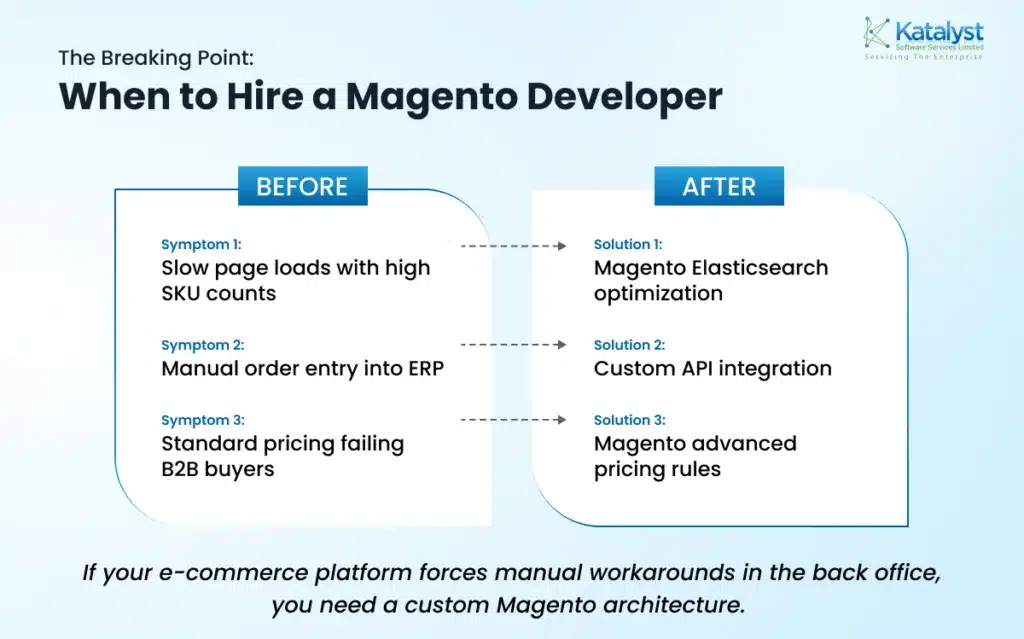
How do you know if your organization has outgrown its current digital commerce setup? It usually comes down to transaction volume, integration depth, and catalog complexity.
The table below breaks down when out-of-the-box platforms fail, and when custom Magento development becomes a necessity.
| Evaluation Criteria | Lightweight SaaS Platform | Custom Magento (Adobe Commerce) |
| Catalog Size | Struggles past 50,000 SKUs; search indexing slows down. | Easily scales to 250,000+ SKUs with high-speed Elasticsearch. |
| Pricing Rules | Global discounts, basic group tiers. | Highly complex, contract-specific pricing and quote-to-cash workflows. |
| System Integration | Basic API hooks; relies on third-party middleware apps. | Deep, bi-directional data syncing with ERP, WMS, and legacy systems. |
| Hosting & Control | Vendor-locked; you do not own the core infrastructure. | Full ownership of code; flexible cloud or on-premise deployment. |
The Hidden Cost of Off-the-Shelf Workarounds
Trying to force a lightweight platform to do enterprise work is an expensive mistake. IT teams end up writing fragile scripts to bridge gaps between the storefront and the ERP.
When these scripts break during peak order volume, the business grinds to a halt. You are left paying for manual data entry just to keep orders flowing.
| 💡 Did You Know? In 2026, 67% of B2B buyers explicitly prefer a rep-free, entirely digital buying experience, shifting the burden of the sale entirely onto the e-commerce platform’s architecture and performance. (Source: Gartner, B2B Buyer Research 2026) |
If your platform cannot handle complex buyer demands autonomously, the buyer will simply move to a competitor who can. A specialized developer ensures the system handles the heavy lifting, not your sales team.
Future-Proofing Your Digital Commerce Strategy
By 2026, a static digital catalog is no longer enough. Businesses are expected to support headless commerce, where the frontend experience is decoupled from the backend logic.
A skilled Magento developer is essential for this transition. They can expose Adobe Commerce data via GraphQL to feed mobile apps, IoT devices, or custom B2B portals, future-proofing your digital footprint.
For leaders mapping out their next technology investment, it is crucial to evaluate Magento against alternatives to ensure your chosen platform aligns with your five-year growth trajectory.
Making the Decision to Modernize
The decision to hire a Magento developer for your enterprise e-commerce development is ultimately a decision about control. It is about taking ownership of your digital supply chain rather than renting a generic storefront.
Katalyst Software Services Limited has guided hundreds of enterprises through this exact modernization journey. By treating your e-commerce platform as an integrated extension of your ERP, you eliminate data silos and accelerate the path from order to revenue.
Stop forcing enterprise processes into basic software, and start building digital commerce that actually works for your business.
If your team is evaluating the resource requirements and timeline for a system modernization, an architectural review can help identify integration risks before they impact your operations. Connect with our consulting team to map out a phased approach for your specific ecosystem.
Frequently Asked Questions
Your most common questions, answered with precision and insight