
Summary:
For mid-to-large enterprises, managing cloud infrastructure has shifted from a provisioning challenge to an optimization crisis. This post breaks down how the integration of AI in cloud computing 2026 is moving teams past manual dashboards and into autonomous operations. You will learn how AIOps, predictive scaling, and automated infrastructure controls are actively eliminating the “shadow IT” bleed and turning complex environments into self-healing, cost-efficient engines.
A surprise $50,000 spike in monthly cloud spend used to trigger a full-scale boardroom audit. Today, it simply means your development teams are scaling workloads faster than your manual governance can track. The era of logging into static dashboards to find last month’s inactive compute instances is over.
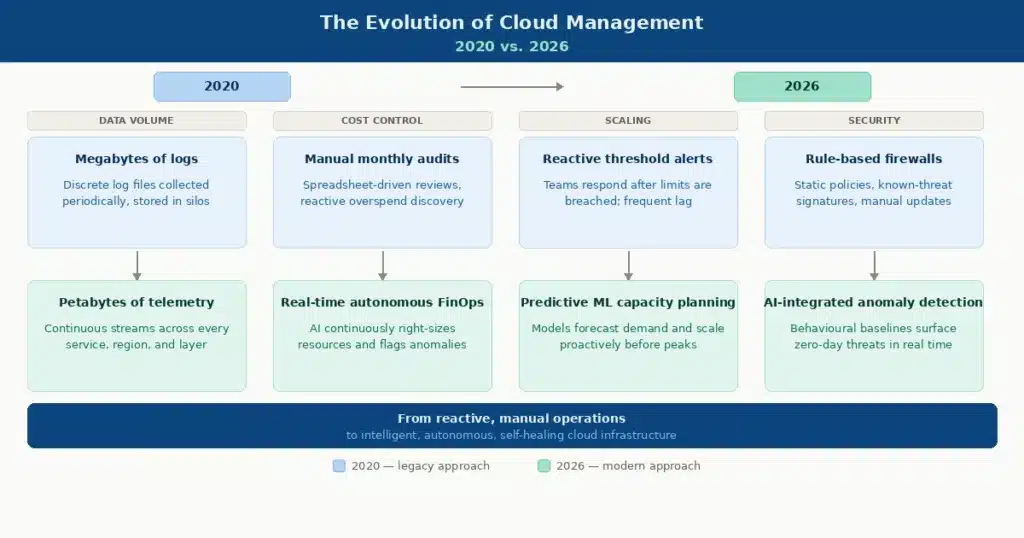
You cannot manage 2026 infrastructure with 2020 monitoring tools. As enterprise application environments sprawl across hybrid and multi-cloud architectures, the telemetry data generated far exceeds human capacity to analyze.
To regain control over margins, uptime, and operational bandwidth, IT leaders must transition from reactive monitoring to autonomous cloud automation. By embedding artificial intelligence directly into the infrastructure layer, you shift the burden of performance tuning, threat detection, and capacity planning from your engineering teams to the system itself.

The Shift from Manual Monitoring to Autonomous AIOps
Traditional alerting systems suffer from threshold fatigue. When an enterprise application experiences a latency spike, operations teams are often flooded with hundreds of redundant alerts across network, storage, and compute monitors. Finding the actual root cause takes hours of cross-referencing logs.
AIOps (Artificial Intelligence for IT Operations) changes this dynamic by acting as the intelligence layer above your observability data. Instead of firing an alert every time CPU utilization crosses 80%, AIOps establishes dynamic baselines. It analyzes telemetry in real time, correlates events across distributed microservices, and identifies the exact trigger before an outage occurs.
AI-Driven Predictive Rightsizing
In legacy autoscaling, resources are provisioned only after a threshold is breached. This leaves a critical gap where user performance suffers while new instances spin up. AI models reverse this reactive cycle. They analyze historical traffic patterns, seasonal trends, and upcoming batch jobs to scale infrastructure predictively.
According to Gartner, by 2028, over 95% of new digital workloads will be deployed on cloud-native platforms. Managing this volume requires moving beyond simple “if-then” autoscaling. Modern AIOps platforms automatically recommend precise configuration changes, shifting underutilized workloads to smaller instances without manual human intervention.
Cloud Cost Optimization: Stopping the 30% Bleed
Cloud bills often inflate subtly. A forgotten test environment here, an over-provisioned database there. When organizations rapidly scale generative AI experiments or robust digital commerce platforms, these unchecked resources quickly erode profit margins.
IDC research highlights a harsh reality for enterprise IT budgets: upto 30% of global public cloud spending is wasted due to inefficiencies, over-provisioning, and a lack of proper cloud governance. This means a company spending $10 million annually on cloud infrastructure is essentially setting $3 million on fire.
AI-powered cloud cost optimization stops this bleed by implementing automated attribution. Every compute cycle is tagged instantly. The system forecasts future resource demand and enforces strict governance policies before developers can spin up costly, unauthorized resources.
Did You Know?
Organizations with mature FinOps and AI-driven cloud optimization practices consistently reduce their cloud costs by an average of 25–30% while simultaneously increasing their actual workload output.
(Source: IDC: Control Cloud Costs and Expand Transparency with FinOp)

If your engineering team is spending more time tracking down rogue cloud instances than deploying new features, a 30-minute infrastructure assessment can help map the right automated governance framework for your environment.
Overcoming Complexity with Cloud Automation
Migrating to the cloud is only the first step; maintaining efficiency requires rigorous, ongoing automation. In a recent deployment, a US-based enterprise struggled with fragmented monitoring tools and highly unpredictable cloud infrastructure costs.
By optimizing IT operations with intelligent cloud and managed services, the organization successfully consolidated its observability data. This architectural shift enabled automated incident ticketing, proactive threat detection, and continuous cost-rightsizing. The result was a dramatic reduction in mean time to resolution (MTTR) and highly predictable monthly cloud spend, proving that structured automation directly impacts the bottom line.
The 2026 Cloud Automation Playbook
To understand why AIOps is replacing legacy monitoring, IT leaders must look at how daily operational tasks fundamentally shift when AI is introduced.
| Capability | Legacy Cloud Management | AI-Powered Cloud Computing (2026) |
| Incident Response | Manual log analysis taking hours to find root cause. | Automated event correlation; MTTR reduced by up to 40%. |
| Cost Management | End-of-month billing shocks and reactive downsizing. | Predictive forecasting and real-time anomaly blocking. |
| Resource Scaling | Rule-based autoscaling (causes application lag). | Predictive rightsizing based on learned historical patterns. |
| Security Profiling | Static rules that generate high false-positive rates. | Dynamic baseline behavioral monitoring. |
Integrating AI and Security Governance
As IT environments adopt advanced agentic capabilities, securing those ecosystems becomes increasingly complex. You cannot secure non-deterministic AI workloads with traditional, deterministic firewalls. AI must be deployed to monitor AI.
Intelligent cloud platforms now continuously analyze network traffic, detecting deviations from normal behavior in milliseconds. To learn more about structuring these advanced systems, explore our Agentic AI in Enterprise: Shaping AI-Driven IT Operations blog.
IDC also predicts, by 2027, more than 50% of enterprises will use AI agents to drive core workflows. This deep operational dependency requires secure, automated cloud architectures that can support massive model execution without compromising enterprise data sovereignty or strict regulatory compliance.
Conclusion
Treating cloud infrastructure as a static utility is a guaranteed way to erode enterprise margins. The integration of AI in cloud computing 2026 shifts the operational model from human-driven firefighting to autonomous, predictive efficiency.
By embracing AIOps and automated cost optimization, IT leaders can finally align cloud consumption directly with business value. Stop paying for idle capacity and manual log analysis. Katalyst Software Services can create an environment that brings costs down, and gives your engineering teams their valuable time back, contact us to explore more!
Frequently Asked Questions
Your most common questions, answered with precision and insight