
Counterfeit drugs and poor supply chain visibility remain major risks in pharma
The pharmaceutical supply chain involves multiple stakeholders—manufacturers, distributors, logistics providers, pharmacies, and regulators. Because these systems often operate in silos, it can be difficult to verify where a drug originated, how it moved across the supply chain, or whether it has been tampered with.
This lack of transparency creates serious risks, including counterfeit medicines, delayed recalls, and compliance challenges.
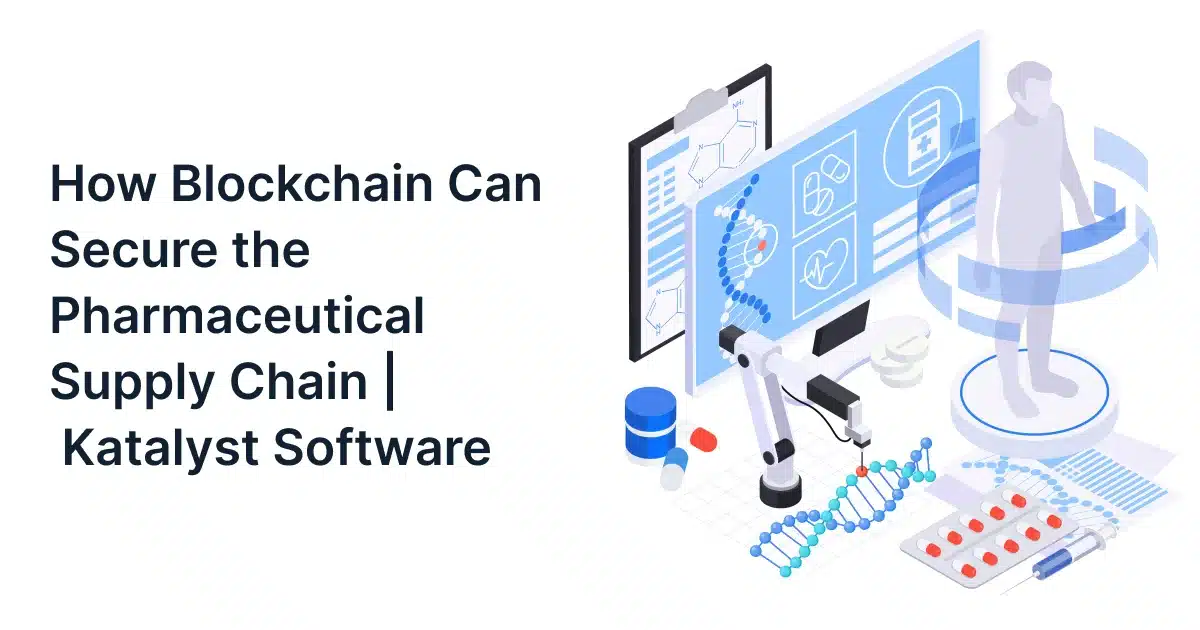
Blockchain technology can secure the pharmaceutical supply chain by creating a tamper-proof digital ledger that records every transaction from drug manufacturing to patient delivery. By ensuring that all stakeholders access the same verified data, blockchain improves supply chain transparency, drug traceability, and regulatory compliance.
When combined with AI in supply chain optimization, blockchain also enables companies to analyze supply chain data, predict disruptions, and improve operational efficiency across global pharmaceutical networks.

Why pharmaceutical supply chains struggle with transparency
Pharmaceutical supply chains are among the most complex in the world. A single drug may pass through:
- Raw material suppliers
- Manufacturing plants
- Packaging units
- Distributors and wholesalers
- Pharmacies and hospitals
Each stakeholder often uses separate systems and databases, making it difficult to maintain a unified record of product movement.
This lack of visibility can lead to serious challenges:
- Counterfeit drugs entering legitimate supply chains
- Delays in product recalls
- Inconsistent documentation across partners
- Difficulty verifying drug authenticity
| Insight |
According to the World Health Organization, about 1 in 10 medical products in low- and middle-income countries are substandard or falsified, posing serious public health risks. Source: World Health Organization |
These challenges highlight the need for technologies that can create end-to-end supply chain transparency.
Understanding blockchain in the pharmaceutical supply chain
Blockchain is a distributed digital ledger that records transactions across a network of computers. Once data is recorded, it cannot be altered without network consensus, making it highly secure and tamper-resistant.
In a blockchain pharma supply chain, every movement of a drug is recorded digitally:
- Manufacturing batch details
- Shipment updates
- Storage conditions
- Distributor transfers
- Pharmacy verification
Each entry becomes part of a permanent record that all authorized stakeholders can access.
This means every medicine has a traceable digital history, improving accountability across the entire supply chain.
Key benefits of blockchain for pharmaceutical supply chains
- End-to-end drug traceability
Blockchain enables pharmaceutical companies to track products from manufacturing to patient delivery, creating complete transparency across supply chain stages.
- Stronger protection againstcounterfeit drugs
Every product can be assigned a unique digital identity, making it easier to verify authenticity and detect fake medicines.
- Faster and more precise product recalls
If a defective or contaminated batch is identified, blockchain helps quickly locate and isolate affected products.
- Improved regulatorycompliance
Regulators can access secure and accurate records, simplifying compliance with global pharmaceutical regulations.
- Bettercollaboration across partners
A shared ledger allows manufacturers, distributors, and healthcare providers to access consistent real-time data.
Blockchain and AI in Supply Chain Optimization
While blockchain secures supply chain data, AI in supply chain optimization helps organizations analyze that data and make better decisions.
Together, they create a powerful digital ecosystem.
| Technology | Role in Pharma Supply Chain | Key Benefit |
| Blockchain | Immutable transaction records | Prevents data tampering |
| Artificial Intelligence | Predicts demand and supply risks | Reduces shortages |
| IoT Sensors | Monitor temperature and storage conditions | Protects drug quality |
| Smart Contracts | Automates compliance rules | Faster regulatory processes |
| Data Analytics | Converts supply chain data into insights | Improves operational efficiency |
By combining these technologies, pharmaceutical companies can build smarter, more resilient supply chains.
Growing adoption of blockchain in pharma
Blockchain is moving beyond pilot programs and into real-world deployments.
According to industry research, the blockchain market in pharmaceuticals is expected to grow significantly over the next few years, driven by increasing regulatory requirements and the need for better supply chain visibility.
Large pharmaceutical companies including Pfizer, Merck, and Novartis have already explored blockchain initiatives to improve drug traceability and data sharing across supply networks.
As digital transformation accelerates in healthcare, blockchain is likely to become a foundational technology for supply chain security.
| Did You Know? |
The global blockchain technology in healthcare market was estimated at USD 11.32 billion in 2024 and is projected to reach USD 214.86 billion by 2030. Within the market, supply chain management accounted for the largest share in 2023 and is expected to be the fastest-growing application segment. Source: Grand View Research |
This rapid growth reflects how blockchain is becoming a critical tool for combating counterfeit drugs and improving supply chain transparency.
What a blockchain-enabled pharma supply chain could look like
Imagine a medicine being produced in a manufacturing facility.
- The manufacturer records batch information on the blockchain.
- Each shipment update is automatically logged in the ledger.
- Distributors verify the product’s digital identity before receiving it.
- Pharmacies scan the medicine to confirm authenticity.
- Patients receive drugs whose full history can be verified instantly.
The result is a transparent, traceable, and trustworthy pharmaceutical supply chain.
Challenges in adopting blockchain in pharma
Despite its potential, implementing blockchain in pharmaceutical supply chains requires careful planning.
Key considerations include:
- Integration with existing enterprise systems
- Cross-border regulatory alignment
- Data privacy and security governance
- Collaboration among multiple supply chain partners
However, as digital infrastructure matures and industry standards evolve, these barriers are gradually being addressed.

Moving toward more trusted pharmaceutical supply chains
Pharmaceutical supply chains are becoming increasingly global, interconnected, and data-driven. Ensuring transparency and security across these networks is essential for protecting both patients and organizations.
Technologies like blockchain in pharma provide a reliable foundation for creating secure and transparent transaction records, while AI in supply chain optimization enables companies to anticipate risks, manage disruptions, and improve operational efficiency.
Together, these technologies are shaping the next generation of pharmaceutical supply chains systems that are more transparent, intelligent, and resilient, helping ensure that safe and authentic medicines reach patients when they need them most.
As pharmaceutical organizations explore these innovations, the focus is shifting from isolated technology pilots to integrated digital ecosystems that connect supply chain partners, data platforms, and analytics tools.
With deep expertise in enterprise data, AI, and emerging technologies, Katalyst Software Services Limited works with organizations to design and implement secure, scalable solutions that improve supply chain visibility, strengthen compliance, and support digital transformation across the healthcare and life sciences ecosystem.
Frequently Asked Questions
Your most common questions, answered with precision and insight