
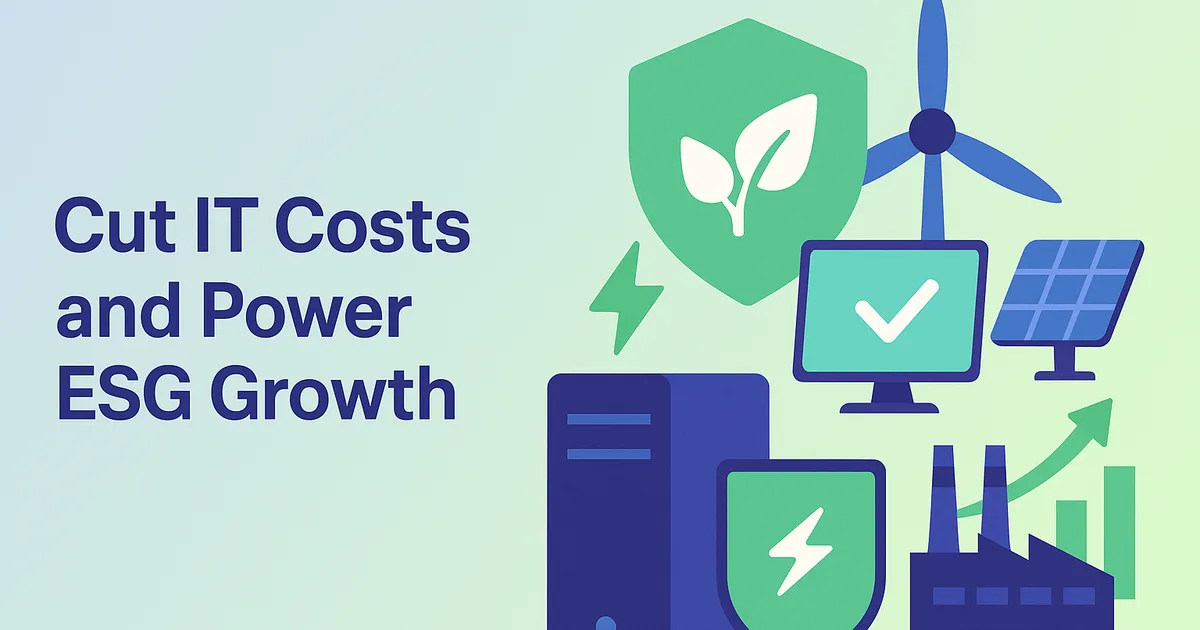
Costly delays in power-hungry servers, unplanned system downtime, and soaring utility bills can weigh down even the most advanced IT infrastructure. By transitioning to a sustainable IT infrastructure, you can reduce overhead, meet ESG commitments, and redirect budget towards true innovation. In fact, 79% of enterprises report increased pressure to improve infrastructure sustainability this year compared to last. In this guide, you’ll discover the green IT best practices that deliver measurable value, how leading enterprises seamlessly integrate them across multi-vendor ecosystems, and the step-by-step roadmap to transition successfully, without extending timelines or exceeding budgets.
Understanding the Hidden Costs of Unsustainable IT: Why Friction Persists
Legacy systems, fragmented data silos, and an assortment of vendors have developed organically over time. The resulting conflicts manifest as:
- Excess energy consumption, as outdated cooling systems and idle hardware inflate operational expenses.
- Projects exceeding allocated time-frames and budgets, where integrating new platforms with legacy code triggers scope creep in modern business operations.
- Unplanned downtime, since fixed maintenance schedules may miss early warning signs of failure, leading to disruptions in production and service level agreements.
- Security vulnerabilities, as multiple management consoles leave exploitable gaps for cyber-attacks.
- Delayed executive approval, as leadership hesitates when the return on investment is unclear or forecasts aren’t aligned with acceptable timelines.
These challenges quietly reduce profit margins and lower team morale. Implementing a sustainable IT infrastructure counters each of these factors by aligning technology upgrades with enhanced efficiency, increased resilience, and clear ESG outcomes.

Delivering Enterprise-Wide Value: Best Green IT Strategies for Modern Operations
Below are proven sustainable IT practices that reliably reduce costs and carbon emissions while improving agility in today’s competitive marketplace:
- Hardware Right-Sizing and Server Consolidation: Using virtualization, containerisation, and dynamic provisioning shrinks physical footprints and cuts idle power consumption, key elements of modern IT infrastructure.
- Renewable Power Purchase Agreements (PPAs): Securing clean energy rates protects against volatile utility costs and supports net-zero commitments.
- Efficient Cooling and Airflow Management: Hot/cold-aisle containment, AI-driven airflow, and liquid cooling reduce megawatt-hour consumption without risking overheating.
- Predictive Maintenance vs Calendar Maintenance: Using sensors and machine-learning to detect potential failures proactively prevents costly downtime and supports predictive maintenance automation.
- Modular Data Center Design: Using prefabricated, scalable data centre modules allows capacity to grow in line with demand, avoiding stranded assets.
- Circular IT Asset Management: Initiatives to refurbish, redeploy, or recycle expired hardware support end-of-life resource recovery, reduce e-waste, and reclaim residual value.
- Unified Observability Across Multi-Vendor Ecosystems: A centralised monitoring platform exposes cross-platform inefficiencies and security gaps that can delay digital transformation, important in enterprise automation solutions.
When systematically adopted, these green IT strategies create compound benefits that fund innovation and future-proof operations.
Introducing the Resilient Sustainability Framework: A Roadmap to Success
Over 18 years of transformation programmes, Katalyst has identified that initiatives often stall when enterprises lack a clear implementation sequence. Our five-step Resilient Sustainability Framework, proven across multi-site manufacturing roll-outs, maintains high agility while controlling costs.
1. Assessment & Benchmarking
Collect energy, carbon, and downtime data across facilities. Compare performance against industry benchmarks to gain executive alignment.
2. Identify High-Impact Quick Wins
Focus first on the top 20% of servers or HVAC units responsible for 80% of energy usage. Replace or virtualise these assets to fund later phases.
3. Deploy Predictive Maintenance
Implement IoT and AI analytics on critical assets to shift technicians’ roles from reactive fire-fighting to proactive maintenance, embedding true green computing strategies for smarter sustainability.
4. Expand Using a Modular and Hybrid Delivery Model
Incorporate scalable data-centre modules integrated with cloud services. This hybrid approach enables capacity scaling without costly brick-and-mortar expansions in your modern IT infrastructure.
5. Continuous Optimisation & Transparent ESG Reporting
Use KPI dashboards monitoring energy intensity, uptime, and carbon emissions. Incentivise teams by tying bonuses to sustainability milestones, this strengthens your sustainable IT practices.
Warning: Neglecting organisational change management can derail even the best technical strategy. Engaging frontline teams from the start is crucial to ensure smooth implementation and lasting success.
Maintenance Comparison: Traditional vs Predictive
The following table compares the key dimensions of calendar-based (traditional) maintenance with predictive maintenance, illustrating why predictive analytics is the backbone of green computing strategies and smarter sustainability programmes.
| Dimension | Calendar-Based Maintenance | Predictive Maintenance |
| Monitoring Trigger | Set time intervals | Real-time condition data |
| Impact on Downtime | Higher-unexpected failures | Lower -intervention before failure |
| Resource Utilisation | Servicing healthy systems unnecessarily | Focuses on high-risk equipment |
| Cost Over 3 Years | Growing due to emergency repairs | Up to 30% lower parts spend* |
| Fit for Green IT? | Limited | A Core Enabler |
*Based on aggregated client results in manufacturing who adopted predictive models under Katalyst’s guidance.

Proof Points Highlighting the Impact of Sustainable IT
The urgency for greener IT infrastructure is clear. The sustainable data-centre industry is projected to grow from US $43.6 B in 2024 to US $96.5 billion by 2030, at a compound annual growth rate (CAGR) of 14.2%. The energy consumption in data-centres reached 310.6 terawatt hours (TWh) in 2024, highlighting the critical importance of reducing consumption.
Clients implementing the framework share:
- 20-40% reductions in electricity costs within 18 months, releasing capital for research and development.
- A 25% decline in unplanned downtime due to predictive maintenance catching early anomalies.
- Faster executive approvals because real-time dashboards translate environmental and savings data into clear financial terms.
These results confirm that sustainable IT is not a cost centre but a core driver of profitability.
How to Transition Your Operations Without Breaking the Bank
Form a Cross-Functional Sustainability Task Force
Include representation from IT, finance, security, and facilities. Use shared KPIs to foster unity and break down silos.
Launch a 90-Day Diagnostic Sprint
Such as Katalyst’s Rapid Insight Accelerator, which uncovers no-regret optimisations without stopping ongoing operations.
Secure Flexible Funding
Use concepts like Energy-as-a-Service offerings or green bonds to cover CapEx without upfront budget strain.
Implement Pilot, Measure, Scale
Start small with one facility. Measure efficiency against baseline KPIs, then replicate success stories to build momentum across your enterprise workflow orchestration.
Embed Governance and Training Programs
Close skills gaps and transform employee resistance into ongoing engagement, this is critical for green IT best practices to succeed.
Tip: Calculate ROI in both financial and environmental metrics. Demonstrating a three-year pay-back alongside significant emissions cuts speaks directly to investors and executives.
Sequencing your steps systematically prevents over-engineering while improving present-day operations.
Conclusion: Next Steps for Green IT
Sustainable IT best practices empower enterprises to radically reduce emissions, improve uptime, and accelerate budget approvals. Implementing these green IT strategies systematically will transform your ageing data-centre into a resilient, efficient powerhouse.
Schedule a 30-minute strategy session with Katalyst to explore how our Resilient Sustainability Framework can cut your energy spend and unplanned downtime, without rebuilding your entire infrastructure.
Building a sustainable IT infrastructure isn’t a choice: it’s the foundation of modern business operations. Adopt the strategies outlined here and exit your next budget cycle with stronger margins, excited teams, and a positive impact on our planet.
Frequently Asked Questions About Green IT Strategy
Q: How can we justify sustainable infrastructure business value to executives?
A: Connect savings from energy, maintenance, and downtime to the budget for strategic initiatives. Leverage industry benchmarks, e.g., 20-40% energy savings, for clear pay-back periods.
Q: What distinguishes sustainable IT from traditional IT management?
A: Sustainable IT integrates efficiency and ESG as a priority across all decisions, from hardware refresh-cycles to resource allocation, while traditional IT may prioritise performance exclusively.
Q: How can manufacturers break down data silos for sustainable IT deployment?
A: Unified observability platforms that consolidate operations technology and IT data provide a comprehensive overview of inefficiencies and opportunities, perfect for enterprise automation solutions.
Q: What sustainability certifications should enterprises focus on?
A: Consider LEED or BREEAM for office buildings, ISO 50001 for energy systems, and TIA-942 for data centre sustainability. These certifications validate savings and ease audits.
Q: How does predictive maintenance cut unplanned downtime in a sustainable IT setup?
A: Using sensors to analyse vibration, power consumption, and temperature data, AI identifies malfunction risks days or weeks before failures occur, allowing pre-emptive repairs during low-demand periods and aligning with green computing strategies for smarter sustainability.