
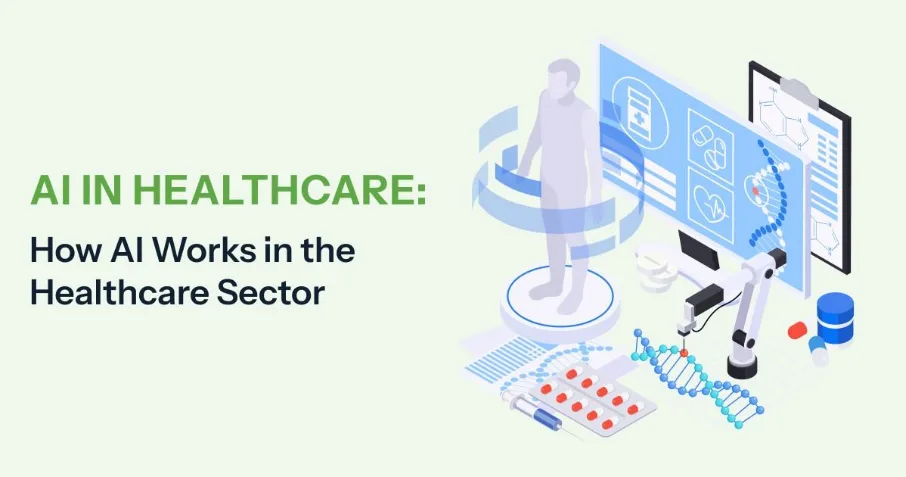
Healthcare is evolving fast. Rising patient demand, workforce shortages, and overwhelming data are pushing traditional systems to their limits. Today, technology isn’t just supporting; it’s essential for delivering faster, safer, and smarter care. AI in Healthcare turns complex data into actionable insights, transforming clinical decisions and operational efficiency across healthcare systems.
Healthcare organizations are facing more challenges because of patient needs and large amounts of data. Old methods can’t be kept up. Today’s modern healthcare systems use AI to handle big data, make better choices, and improve operations.AI helps in diagnosis, operations, and patient communication, leading to better results and lower costs.
In this blog, we’ll look at how AI works in healthcare, its effects on clinical and operational areas, and important trends for the future. We’ll also discuss ethical issues and how organizations can use AI responsibly to create strong and smart healthcare systems.
The Role of AI in Modern Healthcare Systems: Explained
In modern healthcare systems, artificial intelligence plays a pivotal role in analyzing both structured and unstructured medical data. This includes patient records, lab results, medical images, and physicians’ notes. AI-powered machine learning models learn from validated data, continuously improving over time with real-world feedback, enabling faster, more accurate diagnoses, and more efficient healthcare delivery.
AI in Healthcare uses natural language processing to understand clinical documents and computer vision to help with image diagnosis. These tools are added to electronic health records and care systems. AI solutions operate quietly in the background, aiming to improve decision-making without interrupting work processes or the independence of healthcare providers.

Enhancing Clinical Decision-Making and Diagnostic Accuracy
Getting the right diagnosis is a big challenge in healthcare. AI in healthcare helps doctors make better decisions by looking at patient data and comparing it to large sets of past data. These systems can find unusual patterns, suggest possible diagnoses, and help choose the right treatments based on evidence.
Research shows that AI tools can find problems better in areas like cancer, heart issues, and brain conditions. The role of AI in healthcare is especially useful in urgent medical situations where quick choices are needed. By making diagnoses more consistent, AI allows doctors to act sooner and with more certainty. This leads to better results for patients and lowers risks in their care.
Improving Operational Efficiency Across Healthcare Systems
Healthcare organizations are struggling with inefficiencies. Tasks like paperwork, complex scheduling, and limited resources affect both staff and patients. AI in healthcare helps solve these problems by using automation and smart data analysis. These systems can improve staffing, help with patient flow, and predict needs accurately. Studies show that using AI can lower administrative costs a lot.
In today’s Morden healthcare system, these improvements lead to shorter wait times and better care for patients. By reducing manual tasks, AI lets healthcare workers concentrate on providing great care instead of dealing with paperwork.
| Did you know? |
| AI can have a measurable impact on healthcare operations. Global industry data shows that predictive models and automation tools can help reduce hospital readmission rates by around 15 percent, while over 60 percent of healthcare providers report increased operational efficiency with AI adoption. These improvements translate into better resource utilization, shorter patient stays, and lower overall costs without compromising care quality |
The Benefits of AI in Healthcare
AI is transforming healthcare by enhancing clinical care, improving operational efficiency, and enabling personalized treatments. AI in Healthcare delivers measurable benefits across patient care, administrative tasks, and strategic decision-making. Alongside AI, digital health and wellness software helps unify patient records and streamline clinical workflows, further improving efficiency and outcomes.
Key Benefits Include:
- Improved Diagnostic Accuracy: AI analyzes large datasets, detecting patterns and anomalies to support faster, more precise diagnoses, reducing errors and misdiagnoses.
- Personalized Treatment Plans: AI evaluates patient history, genetics, and lifestyle factors, helping clinicians tailor interventions for better outcomes.
- Operational Efficiency: Predictive analytics streamline workflows, optimize staffing, and reduce administrative burden in healthcare systems.
- Enhanced Patient Engagement: Intelligent tools support remote monitoring, predictive alerts, and proactive care, improving satisfaction and outcomes.
- Cost Optimization: Automating routine tasks and improving resource allocation lowers operational costs while maintaining high-quality care.
- Data-Driven Insights: AI provides actionable insights to support clinical and strategic decision-making, helping healthcare organizations scale effectively.
By leveraging these benefits, the role of AI in healthcare goes beyond technology adoption; it enables patient-centric, efficient, and future-ready healthcare delivery.
Role of AI in Health Data Management
Managing healthcare data is critical for modern systems. AI in Healthcare organizes, analyzes, and secures patient and operational data, enabling faster, more accurate decisions.
Key Benefits:
- Data Integration: Consolidates records, lab results, and imaging into one accessible platform.
- Predictive Analytics: Identifies trends and forecasts patient needs for proactive care.
- Accuracy & Security: Detects errors, ensures compliance, and safeguards sensitive information.
- Real-Time Insights: Turns data into actionable insights for clinical and operational efficiency.
By streamlining data management, AI strengthens the role of AI in healthcare, improving outcomes, efficiency, and system resilience.
Future Trends Shaping AI-Driven Healthcare
Healthcare innovation is entering a phase of maturity. AI in Healthcare will increasingly focus on real-time intelligence, automation, and predictive insights across the care continuum.
Key emerging trends include:
- Generative AI for Clinical Documentation:
Automation of notes and reports reduces administrative burden.
- Digital Twins in Healthcare:
Virtual patient models simulate treatment outcomes safely.
- Population Health Intelligence:
Large-scale data analysis supports preventive care strategies.
- Interoperable AI Platforms:
Seamless system integration improves coordination and insight sharing.
These trends will redefine how modern healthcare systems deliver resilient and future-ready care.
| Did you know? |
| AI’s economic impact on healthcare is already substantial. According to a recent report, AI in healthcare is projected to contribute USD 25–30 billion (about ₹2,61,990 crore) to India’s GDP by 2025, driven by improvements in diagnostics, patient care accessibility, and treatment outcomes. The report also highlights that AI adoption in healthcare has surpassed 40 percent, already outpacing sectors like consumer goods and manufacturing, signaling strong momentum in real-world clinical and operational use cases. |
Industry Impact of AI in Healthcare
The measurable impact of AI in Healthcare is evident across clinical and operational functions. Organizations implementing AI-driven solutions report on consistent improvements in performance and outcomes.
| Healthcare Function | AI-Driven Impact |
| Diagnostic Accuracy | Up to 25% improvement |
| Administrative Costs | 20–30% reduction |
| Patient Readmissions | 15% decrease |
| Clinical Decision Time | 30% faster |
| Resource Utilization | 20% optimization |
These results highlight the growing role of AI in healthcare as a strategic enabler.

Enabling Healthcare Intelligence with Katalyst Technologies
Katalyst Technologies helps healthcare organizations design and implement scalable intelligence frameworks. With strong expertise in data engineering, analytics, and cloud platforms, Katalyst enables secure and interoperable AI in Healthcare solutions. Their approach emphasizes governance, compliance, and measurable outcomes. By aligning innovation with operational realities, the platform supports modern healthcare systems in moving from AI adoption to long-term maturity and resilience.
Scale Your Healthcare Operations with AI Innovation
AI is now a must-have for healthcare organizations. It helps make better decisions, work more efficiently, and provide personalized care. As the modern healthcare system changes, smart technologies will keep improving how care is given and how organizations run. Those who invest in good AI systems will be able to provide strong, patient-focused care that is ready for the future.
Learn how smart technologies can improve healthcare operations and results with Katalyst Technologies. Gain efficiency, helpful predictions, and scalable AI solutions in your healthcare organization.
Frequently Asked Questions
Your most common questions, answered with precision and insight