
Building a machine learning model is only the beginning. Businesses must also deploy it, monitor its performance, and update it as conditions change. Without a structured process, even a promising model can struggle in a live business environment.
This is where MLOps & AI Model Lifecycle becomes important. It connects machine learning development with software engineering and operational practices. Teams can manage models more consistently, from initial experiments to production and ongoing maintenance.
What does MLOps mean in simple terms?
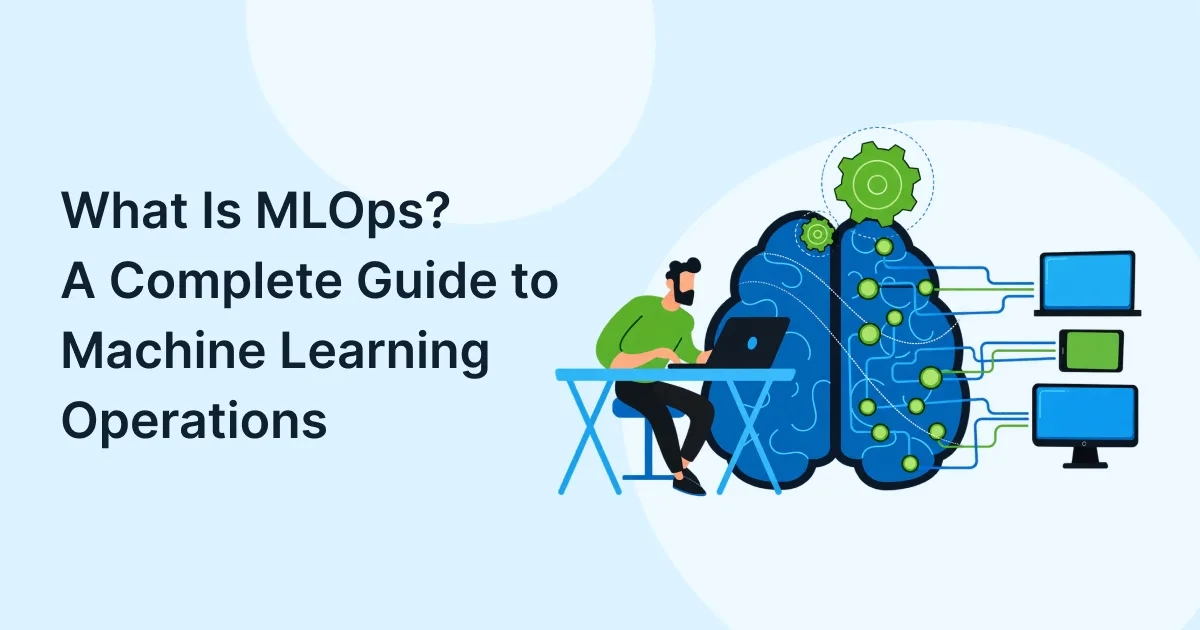
MLOps, short for machine learning operations, refers to the practices used to develop, deploy, monitor, and maintain machine learning models throughout their lifecycle.
For enterprises exploring AI, understanding MLOps is an important step toward building intelligent operations with technology.
What Does MLOps Mean in Machine Learning?
MLOps combines machine learning, software development, data engineering, and IT operations. Its purpose is to make machine learning workflows repeatable, manageable, and suitable for production environments.
Traditional software usually follows defined rules written by developers. Machine learning models, however, learn patterns from data. Their performance can change when new data differs from the information used during training.
For example, a retailer might use machine learning to forecast product demand. Seasonal changes, customer preferences, and supply disruptions can affect prediction accuracy. The model therefore needs monitoring, evaluation, and potentially retraining.
MLOps helps teams manage these changes through version control, automated workflows, testing, and performance monitoring.

How does MLOps work?
MLOps establishes a repeatable workflow for preparing data, training and testing models, deploying them into production, monitoring results, and improving them when necessary.
Why Is MLOps Important for Businesses Using AI?
Machine learning can support forecasting, recommendations, quality control, and risk assessment. However, developing a successful model does not automatically make it reliable in production.
MLOps helps address several operational challenges:
- Consistent releases: Standardized workflows reduce differences between development and production environments.
- Reliable performance: Monitoring helps teams identify declining model quality and unexpected behavior.
- Scalability: Automation makes it easier to manage multiple models and recurring releases.
- Governance: Version histories and documented processes improve traceability.
- Continuous improvement: Teams can evaluate new data and update models when business conditions change.
The need to manage AI beyond experimentation is becoming more pressing. McKinsey’s 2025 State of AI research found that nearly two-thirds of respondents said their organizations had not yet begun scaling AI across the enterprise.
This highlights an important distinction. Adopting AI tools is not the same as embedding AI into business operations. MLOps provides a structured approach to managing machine learning systems as they move toward broader use.
Why is MLOps important for enterprise AI adoption?
MLOps helps organizations manage the deployment, reliability, monitoring, and maintenance of machine learning models. These practices support more consistent operations as AI uses expands across business functions.
What Are the Stages of the MLOps Lifecycle?
The MLOps lifecycle covers the processes required to move a model from an initial business problem into production and ongoing improvement. The stages form a feedback loop rather than a strictly one-way sequence.
AWS outlines the broader machine learning lifecycle through data processing, model development, deployment, and monitoring in its Machine Learning Lens documentation.
1. Data Collection and Preparation
Teams gather relevant data, remove inconsistencies, address missing values, and prepare datasets for training. They may also engineer features that help models identify useful patterns.
Data quality matters because incomplete or unrepresentative data can affect model performance.
2. Model Training and Evaluation
Data scientists select suitable algorithms, train models, and test their performance against defined criteria. They compare experiments and record parameters, datasets, and results.
Evaluation helps determine whether a model meets the requirements of its intended business use.
3. Testing and Deployment
Before release, teams validate the model, check dependencies, and test its integration with the surrounding application.
Once approved, the model is deployed to a production environment. It may serve predictions through an API or operate within an existing business application.
4. Production Monitoring
After deployment, teams monitor model performance and operational indicators such as response time, errors, and resource usage.
They may also track data drift, which occurs when incoming data changes compared with the data used during training. Monitoring helps teams identify when further investigation is needed.
5. Retraining and Continuous Improvement
When monitoring reveals performance changes or new data becomes available, teams can evaluate whether retraining is necessary. They retrain and test the model before releasing an updated version.
Not every change requires automatic retraining. Business rules, validation results, and approval requirements should guide release decisions.
What are the stages of the MLOps lifecycle?
The main stages are data preparation, model training and evaluation, testing and deployment, production monitoring, and retraining. These stages work together as a continuous cycle that helps teams maintain machine learning systems over time.
How Is MLOps Different from DevOps?
MLOps builds on DevOps principles but addresses the additional requirements of machine learning systems.
| Aspect | DevOps | MLOps |
| Primary Focus | Software development and delivery | Machine learning development and operations |
| Testing Scope | Tests code and application behavior | Tests code, data, and model performance |
| Monitoring | Monitors application health and reliability | Also monitors prediction quality and data drift |
| Updates & Release | Releases software updates | Manages code, data, and model updates |
Both approaches encourage automation, collaboration, testing, and reliable releases. However, MLOps must account for changing data and model behavior, not just software changes.
Is MLOps the same as DevOps?
No. MLOps applies DevOps principles to machine learning workflows while adding practices for data validation, model evaluation, model versioning, and ongoing performance monitoring.
Where Can Enterprises Apply MLOps?
MLOps can support machine learning applications across industries, particularly where predictions need regular evaluation and updates.
- Consumer packaged goods and retail: Forecast demand, anticipate inventory requirements, and improve product recommendations.
- Life sciences: Support research workflows and selected predictive applications, subject to appropriate validation and regulatory requirements.
- Manufacturing: Monitor predictive maintenance models and identify patterns associated with equipment issues.
- Wholesale distribution and supply chains: Improve demand forecasting and help teams respond to changing supply conditions.
These applications depend on appropriate data, suitable models, and effective operational controls.
For enterprises, the wider challenge is connecting AI capabilities with existing systems, workflows, and business objectives. Enterprise software solutions and digital transformation services can help organizations address the technology and integration requirements surrounding these initiatives.

What Should Organizations Consider Before Adopting MLOps?
Organizations do not need to automate every stage immediately. A practical starting point is to establish clear processes for a priority machine learning use case.
Consider these four areas:
- Business objectives: Define the problem and establish measurable success criteria.
- Data readiness: Assess data quality, availability, access, and ownership.
- Team responsibilities: Clarify how data scientists, engineers, and operations teams will work together.
- Monitoring and governance: Establish performance checks, access controls, documentation, and approval processes.
Risk management should also remain part of the process. The NIST AI Risk Management Framework provides guidance for incorporating trustworthiness considerations into the design, development, use, and evaluation of AI systems.
Organizations can begin with version control and repeatable deployment, then introduce automated testing, monitoring, and retraining as their needs mature.
Conclusion
MLOps helps organizations manage machine learning beyond the initial model-building stage. Through structured workflows, testing, monitoring, and continuous improvement, teams can maintain models as data and business requirements change.
For enterprises building intelligent capabilities, the objective is not simply to deploy more models. It is to connect technology with reliable operations and meaningful business outcomes.
Katalyst Software Services Limited helps enterprises build intelligent capabilities through its AI, Enterprise Application, and Professional Services offerings. By connecting technology initiatives with existing business systems and workflows, Katalyst supports organizations working to improve data-driven decision-making and advance their digital transformation goals.