
Costly handoffs, data silos, and unplanned downtime remain major obstacles for many enterprise IT departments, draining budgets and delaying strategic initiatives. Fortunately, modern automation technology offers a smarter solution: transforming disconnected workflows into enterprise-wide, constantly operating processes that deliver quantifiable results. As evidence, the global business process automation market is projected to jump from $14.87 billion in 2024 to $16.46 billion in 2025, growing at an impressive 10.7% CAGR . Over the next few minutes, you will learn about emerging business process automation trends, which technologies to prioritize, and how to maintain control over project scope while achieving lasting value, at a fraction of the cost of full-scale platform replacement.
Why Process Automation Is Gaining Executive Focus
The pressure to stay flexible, preserve profit margins, and gain executive approval has pushed process automation trends back into the spotlight. CIOs regularly cite three key challenges:
- Tolerance for delays and budget overruns is shrinking, increasing pressure on project delivery.
- Skill shortages limit the ability to develop custom coding and maintain legacy systems effectively.
- Security threats are increasing in a complex multi-vendor environment, making governance more critical.
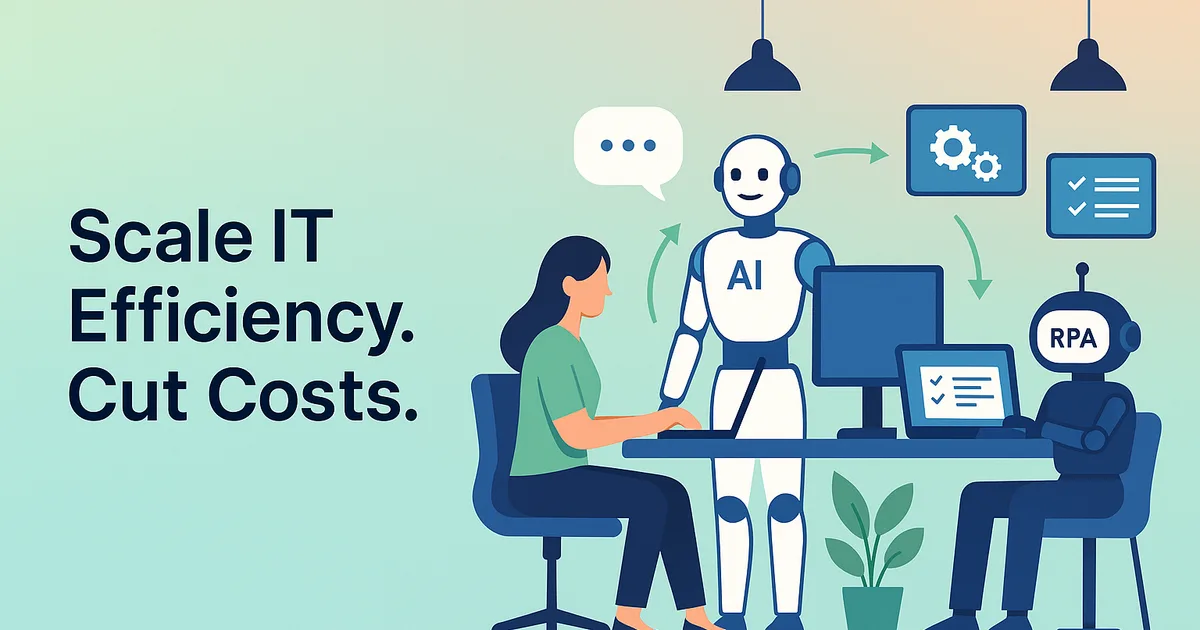
Integrating Robotic Process Automation (RPA), Business Process Management (BPM), and AI technologies reduces overhead costs without disruptive legacy system overhauls, enabling smoother enterprise-spanning automation. These insights align closely with rapidly evolving process automation trends 2025 that demand more resilience and adaptability.

Market Snapshot: Why the Time to Act Is Now
Leadership teams require data-driven insights to guide their enterprise automation strategy. The table below highlights the urgency of moving beyond pilot projects to enterprise-wide implementation:
| Market Segment | 2024 Size | 2025 Projection | 2030 Outlook | CAGR | Source |
| Business Process Automation (BPA) | $14.87 B | $16.46 B | — | 10.7% | Codewave, 2024 |
| Robotic Process Automation (RPA) | $3.79 B | — | $30.85 B | 43.9% | doit.software, 2024 |
| Intelligent Process Automation (IPA) | $14.55 B | — | $44.74 B | 22.6% | doit.software, 2024 |
Key takeaways:
- RPA alone will be insufficient to meet future demand; AI-driven and intelligent automation solutions continue to climb rapidly.
- Investment follows proven results; 46% of processes are predicted to be automated by 2025, with digital workflow automation expanding fast.
From RPA Bots to Agentic AI: The New Automation Stack
RPA: Efficient but Limited
Robotic Process Automation (RPA) excels at automating repetitive, rule-based tasks such as data extraction from legacy systems, invoice reconciliation, or ERP field population. However, when business rules change, RPA bots require reconfiguration, causing maintenance burdens and delays. This demonstrates why future business process automation solutions must include adaptive technologies.
Agentic AI: Adaptive and Context-Aware
Next-gen “AI agents” observe employees’ workflow and dynamically redesign processes. Because they learn and adapt, rather than follow static, coded scripts, these AI-powered agents can withstand system updates and reduce unplanned downtime across complex supply chains. These reflect major process automation trends 2025 focusing on resilience and continuous learning.
Process Mining: From Insights to Forecasts
Process mining tools analyze system logs to identify hidden inefficiencies. When combined with predictive analytics, this technology can detect scope creep early, allowing IT teams to course-correct proactively and stay within budget. It plays a key role in business process automation solutions that scale across departments.
Automation Technology Comparison Table
| Capability | RPA | AI Agents | Low-Code Platforms |
| Required Skills | Technical, rule design | Data science, AI ops | Citizen developers |
| Resilience to Change | Low | High | Medium |
| Speed to Value | Fast pilot | Rapid learning | Very rapid prototyping |
| Best Use Case | High-volume repetitive tasks | Dynamic workflows | Department-level apps |
Note: Combining these technologies unlocks transformative outcomes, such as using low-code business process automation to orchestrate AI agents and trigger RPA bots, enabling scalable, enterprise-wide automation rather than isolated fixes.
BPM and Low-Code: Marrying Governance with Speed
Traditional Business Process Management (BPM) involved long design cycles that couldn’t keep pace with market demands. Today’s cloud-native BPM suites now embed low-code business process automation capabilities that accelerate development while retaining governance:
- Create once, deploy anywhere: Drag-and-drop workflow designers enable near-instant updates.
- Built-in compliance: Full audit trails help satisfy regulatory requirements.
- API-first design: Eliminates manual data re-entry and reduces data silos.
These advancements enable manufacturers to shift from static workflows to predictive maintenance, minimizing downtime and supporting business process automation trends for 2025 and beyond.
Implementation Roadmap: From Plan to Real Results
Follow this proven framework to convert automation concepts into enterprise-wide success while aligning with modern process automation trends:
Discovery and Prioritization
Interview process owners, locate data silos, and measure downtime caused by manual tasks. Rank potential automation projects based on ROI and complexity.
Proof of Value
Build a small pilot using low-code frameworks combined with a simple RPA bot to demonstrate measurable success within four weeks. Garner executive support using these real metrics.
Scaled Rollout
Expand the program to adjacent workflows and use AI-powered agents to manage exceptions. Our hybrid delivery approach combines your subject matter experts with our automation architects to overcome skill gaps without increasing personnel costs.
Continuous Optimization
Use process mining dashboards to spot shifting bottlenecks, while governance teams control change requests and prevent project scope from expanding beyond original plans.
Important: Be sensitive to staff concerns about job displacement. Engage teams early, delegate repetitive work to bots, and retrain employees for higher-value analytics roles to mitigate resistance.

Industry Cases: Neutral Examples Across Sectors
- Manufacturing: A global auto-parts supplier replaced spreadsheet scheduling with an AI-powered BPM solution, reducing line changeover time. Predictive maintenance algorithms consequently slashed unplanned downtime.
- Financial Services: A regional bank deployed RPA to automate Know-Your-Customer (KYC) and compliance workflows on its legacy core systems. As a result, turnaround times dropped from several days to just a few hours, improving the client onboarding experience without replacing core technology.
- Healthcare: A hospital network used low-code platforms to automate discharge documents. By allowing clinicians to enter data once, errors declined and staff were able to focus more on patient care.
These examples highlight how integrated business process automation solutions deliver efficiency across sectors.
Framework: Choose Your Automation Path with Confidence
Use this matrix to prioritize workflows based on impact and complexity:
| Impact vs Complexity | Low | Medium | High |
| High Impact | Quick-win RPA bots | BPM + RPA | AI agents + predictive analytics |
| Medium Impact | Low-code forms | Low-code + API | BPM + process mining |
| Low Impact | Defer | Defer | Defer |
Start with high-impact and low-complexity tasks to accelerate momentum.
How Katalyst Delivers Best-in-Class Results
Our clients shorten project delivery times by up to 40% by leveraging a combined stack of RPA, Low-code BPM, and intelligent AI technology through a hybrid delivery model. Our approach aligns onshore solution architects with offshore development teams, enabling faster delivery of enterprise-wide projects at a fraction of traditional costs, without requiring expensive system rebuilds.
Closing Thoughts & Next Steps
The future of enterprise automation depends on combining Robotic Process Automation (RPA), modern Business Process Management (BPM), and intelligent automation into unified business process automation solutions. With nearly half of workflows moving toward full automation, organizations must embrace these process automation trends to remain competitive.
Katalyst guides businesses through selecting, deploying, and scaling the right automation tools tailored to their multi-vendor environments.
If you’re ready to streamline operations, eliminate data silos, and achieve measurable ROI, let’s build a customized enterprise automation plan, Contact us at: sales@katalysttech.com