
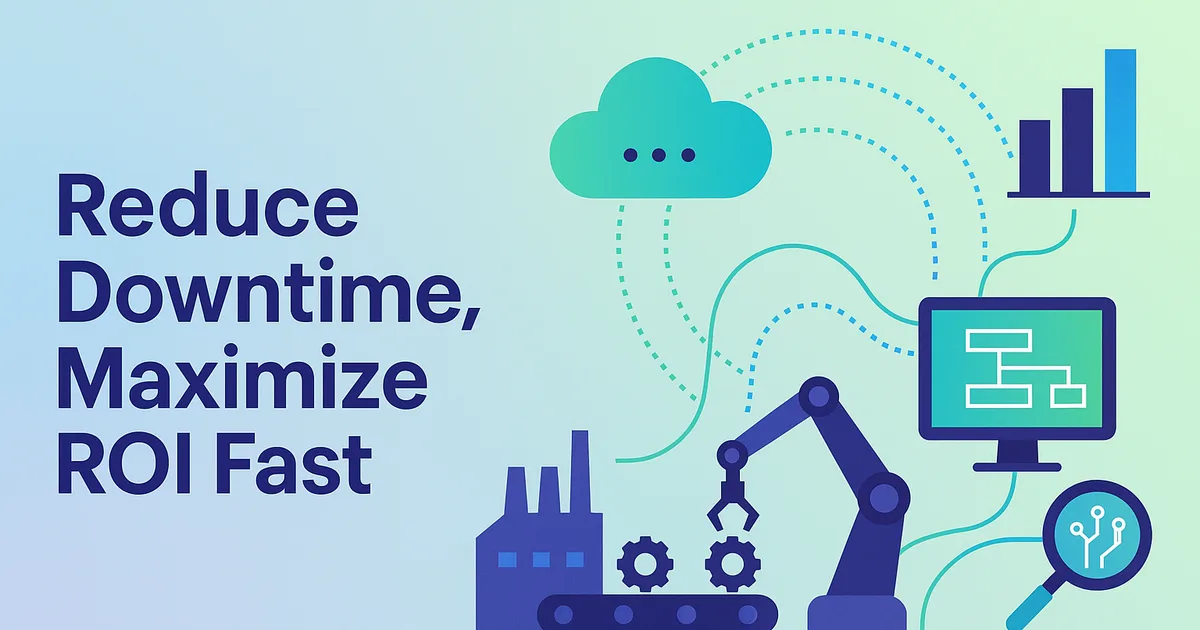
Production managers are tired of paying threefold when projects run over time and budget, only to see data sit idle in disconnected dashboards. A modern data fabric offers a single, trusted view that drives faster, smarter decisions across all plants and business units. With 65% of enterprise data never analyzed, an enterprise data architecture that integrates a data fabric can weave existing systems into one intelligent layer, shrink unplanned downtime, and create tangible value, without ripping and replacing what already works.
Why Traditional Enterprise Data Architecture Is Holding You Back
Legacy systems, point integrations, and department-grown databases seemed manageable when projects were small. Today, they form a tangled, multi-vendor ecosystem that:
- Fragments information into data silos, slowing time-to-insight
- Inflates overhead as every analytics use case demands custom connectors
- Raises security concerns with inconsistent policy enforcement
- Triggers employee resistance to yet another tool
With increasing demands for predictive maintenance and real-time quality checks, a modern enterprise data architecture must simplify, not complicate, the landscape.
What Is a Data Fabric and Why It Matters
A data fabric acts as an always-on nervous system connecting every data source, edge devices, MES, ERP, and cloud lakes, through metadata-driven automation. Unlike hub-and-spoke models, a data fabric:
- Virtualizes access so teams query once while the platform handles retrieval
- Uses active metadata to govern quality, lineage, and security end-to-end
- Supports hybrid delivery models, integrating on-prem and cloud systems cost-effectively
- Feeds AI-driven analytics continuously, eliminating batch delays and unplanned downtime
Gartner reports that enterprises deploying a data fabric, wide data integration reduce time-to-insight by 30% compared with traditional architectures, tightening production schedules and improving operational outcomes.

Intelligence Layer: Turning Integrated Data into Action
A fabric alone unifies information; embedded intelligence transforms it into actionable insights. Modern platforms integrate machine learning, auto ML, MLOps, and feature stores, directly into the fabric, scaling analytics without creating new silos. This improves enterprise analytics efficiency by:
- Predicting maintenance events to reduce unplanned downtime
- Optimizing supply-chain, inventory, and energy usage in real time
- Delivering self-service dashboards that provide line-of-business experts with answers in minutes
Pro Tip: Start with one asset class or KPI, achieve early wins, then scale.
Building a Best-in-Class Enterprise Data Architecture: 5-Step Roadmap
- Discover & Catalog – Map all structured, unstructured, and streaming data; tag for lineage, sensitivity, and ownership
- Design the Data Fabric – Choose standards-based connectors and align security early
- Activate Intelligence – Deploy AI-driven analytics for predictive maintenance, quality checks, and operational insights
- Operationalize & Monitor – Track latency, drift, and cost against real-time SLAs
- Expand & Optimize – Add sites or business functions after stabilizing initial KPIs
Overcoming Real-World Barriers
Employee resistance: Use role-based portals and familiar tools, like Excel connectors, to increase adoption.
Skills gap & resources: Leverage managed services or hybrid delivery models for faster deployment.
Security concerns: Implement zero-trust policies and centralized governance across all systems.
Slow ROI expectations: Tie early use cases to measurable savings; predictive analytics can reduce unplanned downtime by 45%.
Calculating Tangible Value and ROI
Frame value in operational terms:
| Metric | Current | Target | Financial Impact |
| Downtime hours/yr | 120 | 66 | $2.1M saved |
| Analyst hours/wk | 40 | 10 | $150K saved |
| Inventory holding cost | $18M | $15M | $3M saved |
Case in Point: Katalyst’s Enterprise-Spanning Solution
A Fortune 500 firm struggled with 17 overlapping data marts. Katalyst implemented:
- A centralized catalog in eight weeks, ending duplicate pulls
- AI-powered forecasting, revealing $4M in hidden margin
- Predictive maintenance models across five plants, reducing calendar-based maintenance by 22%
With 18 years of digital transformation experience, the project delivered measurable results on schedule and under budget, proving impactful change doesn’t require full system replacement.
Putting It All Together
A data fabric for enterprise analytics is no longer a vision, it’s a practical framework that simplifies fragmented ecosystems, breaks down silos, and powers AI-driven analytics to improve enterprise analytics efficiency. By following a clear roadmap, ensuring robust governance, and focusing on high-impact areas like predictive maintenance, organizations can unlock measurable value and stay agile in today’s fast-paced market.
Ready to modernize your enterprise data architecture and deploy a data fabric for enterprise wide data integration?
Schedule a strategic blueprint session with Katalyst to connect, govern, and activate your data end-to-end.