
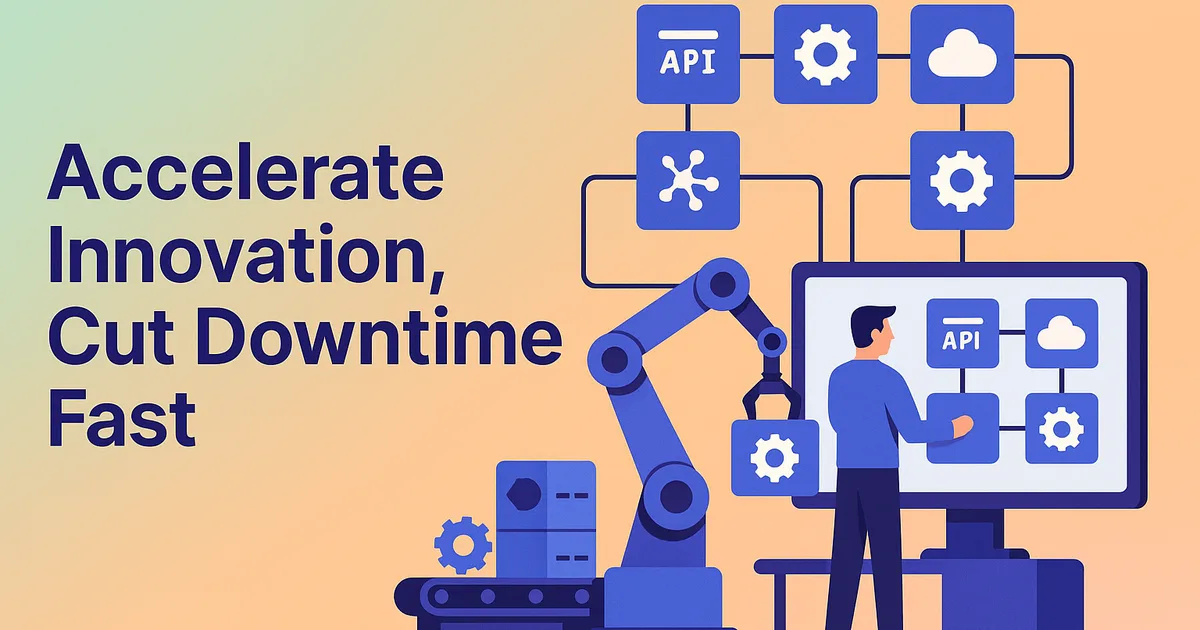
You’ve likely experienced projects running over time and budget, data trapped in departments, and legacy integrations that fail under change, creating costly friction that slows decision-making and production. Imagine instead an environment where new capabilities slot in like building blocks, downtime shrinks, and innovation cycles accelerate. Gartner predicts that 60% of large enterprises will adopt the composable enterprise architecture benefits, for agility by 2024 to boost digital innovation by 80%. This modern architecture transforms traditional IT constraints into modular, API-driven systems that accelerate business agility.
Traditional architectures hold you back with rising integration overhead, siloed data, and security blind spots. Each upgrade demands custom code and retesting, risking costly downtime. By contrast, composable architecture’s modular approach reduces integration complexity and data silos, empowering teams with autonomy and faster innovation. Learn how Katalyst Engineering’s strategic consulting and hybrid delivery model enable businesses to adopt composable IT systems confidently, minimizing risk and accelerating time-to-value.
Why Traditional Architectures Hold You Back
Legacy systems weren’t designed for today’s multi-vendor ecosystem. Each upgrade demands custom code, and every interface can become a single point of failure. The result:
- Rising integration overhead: Every new application forces costly retesting across brittle connections.
- Data silos that slow analytics: Operational, quality, and financial data live separately, hindering predictive insights.
- Employee resistance: Staff fear that new projects mean disruptive migrations.
- Security blind spots: Patch cycles across multiple stacks leave gaps that attackers can exploit.
When every change feels like open-heart surgery, agility disappears and competitors pass you by.

What Is Composable Enterprise Architecture?
Composable enterprise architecture is a modern digital transformation architecture approach that treats business capabilities as interchangeable, API-based modules. Each module, order management, production scheduling, or predictive maintenance analytics, exposes standard interfaces, allowing it to be added, replaced, or upgraded without rewriting the entire stack. Think of it as Lego bricks: small, self-contained, and designed to fit seamlessly.
Core Principles
- Modularity: Capabilities are packaged as discrete, reusable services.
- Autonomy: Each service manages its own data and logic, reducing cross-dependencies.
- Discoverability: A centralized catalog makes components easy to find and reuse.
- Orchestration over integration: Low-code workflows link modules in days, not months.
Five High-Impact Business Outcomes
Implementing modular enterprise systems delivers measurable results that resonate across finance and operations:
- Faster feature delivery: Release cycles shrink from quarters to weeks using pre-certified modules and hybrid delivery models.
- Reduced unplanned downtime: IDC reports manufacturers using modular enterprise systems cut downtime by 23% within two years.
- Lower integration costs: Standard APIs reduce point-to-point coding, saving enterprise-wide integration expenses.
- Improved security posture: Isolated services limit potential risk, with embedded zero-trust controls.
- Tangible value in months, not years: Clear roadmaps align investments with ROI milestones, easing executive buy-in.
Modular Enterprise Systems in Action
- Production Planning: Replace calendar-based scheduling with AI-driven predictive maintenance modules.
- Quality Control: Plug a computer-vision defect detection service into your MES without rewriting core applications.
- Finance: Add real-time cost-to-serve analytics that unify data from multiple departments via APIs.
Modules are version-controlled and containerized, enabling upgrades during standard release windows and preventing late-night emergencies.
Pro Tip: Start with a visible, non-critical capability, such as reporting, for quick wins and reduced resistance.
Roadmap: How Enterprises Can Adopt Composable IT Systems
Follow this proven, five-step adoption sequence to minimize risk:
- Capability Mapping: Rank business capabilities by strategic value and pain points. Identify redundancies and opportunities for modularization.
- Reference Architecture Design: Build a standards-based blueprint for APIs, data models, and security patterns.
- Pilot & Prove: Deploy one high-value module with container orchestration and automated tests. Track adoption, uptime, and deployment effort.
- Scale with Governance: Create a composable platform team to approve new modules, enforce versioning, and manage shared services.
- Continuous Optimization: Use telemetry to monitor module performance and enable rolling upgrades, moving from reactive fixes to proactive innovation.
Risk Mitigation and Security Considerations
- Unified identity and access: Single sign-on across modules eliminates password sprawl.
- API gateways: Centralized policy enforcement reduces attack surfaces.
- Automated compliance checks: Infrastructure-as-code ensures deployments meet regulatory standards without manual review.
Addressing these early reassures CISOs that additional services don’t necessarily add risk.
Measuring Success
Track these KPIs to validate composable enterprise architecture benefits:
- Mean Time to Integrate (MTTI): From idea to live API connection.
- Release Frequency: Number of production deployments per month.
- Downtime Hours per Quarter: Should trend downward as hot-swap capability matures.
- Feature Adoption Rate: Tracks employee engagement and reduces change-resistance myths.
Regular reviews align teams from operations to finance on progress and ROI expectations.
Securing Executive Buy-In
Executives approve what they understand. Link modular capabilities to revenue or cost-avoidance. Present phased investment plans aligned with incremental value delivery. Highlight industry proof points like Gartner and IDC statistics to demonstrate feasibility.
Where Katalyst Fits
With 18 years of transformation experience, Katalyst Software Services Limited provides strategic guidance plus hands-on engineering:
- Hybrid delivery model: Onshore architects shape roadmaps; near-shore teams build fast and cost-effectively.
- Pre-built integration accelerators: A catalog of vetted modules accelerates deployment timelines.
- Outcome-aligned governance: KPIs are defined upfront and tracked until targets are met, no “install and forget.”
Conclusion & Next Steps
Composable enterprise architecture transforms technology from a bottleneck into a growth engine. By adopting modular enterprise systems, aligning with a clear digital transformation architecture, and following a disciplined roadmap, organizations gain responsiveness, cost control, and a competitive edge.
Ready to explore how enterprises can adopt composable IT systems without the usual overruns? Schedule a strategy session with Katalyst to map quick-win capabilities, outline measurable milestones, and modernize confidently while staying agile.