
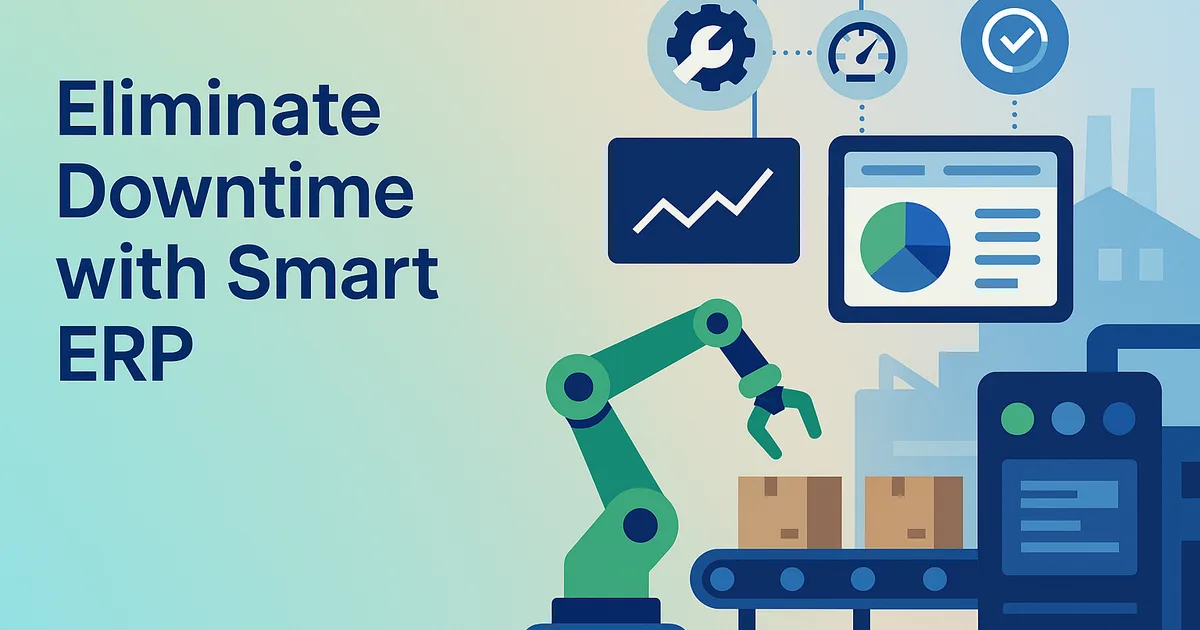
The gulf between the shop floor and the back office drains profit every day. Manual hand-offs, duplicate data entry, and unplanned machine failures create costly friction that shows up as missed ship dates and overtime labor.
Now imagine a future where a modern ERP system for manufacturing synchronizes production planning, quality management, and finance so precisely that weeks of backlog disappear and capacity improves without adding headcount.
More than seven in ten manufacturers cite legacy ERP systems as their single biggest obstacle to reaching this future. That’s why evaluating manufacturing ERP features carefully is critical. In this blog, we’ll explore:
- The top ERP software modules manufacturers should prioritize.
- How to build an ERP features checklist for manufacturers to prevent delays and scope creep.
- What separates best-in-class ERP software for discrete manufacturing from “good enough” tools?
Why Modern ERP Demands a Fresh Look
Legacy ERP software was built for yesterday’s predictable demand and calendar-based maintenance cycles. But today’s environment, global competition, labor shortages, and digital-first supply chains demand smarter manufacturing ERP solutions.
A modern ERP software for discrete manufacturing must be:
- Connected: Breaking down data silos so production, engineering, and finance share one version of the truth.
- Intelligent: Using predictive maintenance analytics and AI to cut unplanned downtime.
- Flexible: Delivered via on-premises, hybrid, or cloud ERP solutions for manufacturers, depending on ROI timelines and security needs.
Without these capabilities, digital transformation stalls, employee resistance grows, and executive buy-in fades.

Ten Core Manufacturing ERP Features That Protect Margins
Here’s the structured roadmap Katalyst uses when evaluating ERP software modules for both process and discrete manufacturing. Use this as your own ERP features checklist for manufacturers to spot gaps quickly.
1. Integrated Production Planning ERP Engine
Native production planning ERP recalculates material requirements, labor capacity, and vendor lead times in real time. When IoT data is integrated, demand forecast accuracy can improve by ±5%.
2. Advanced Scheduling with Constraint Optimization
Finite scheduling respects machine, tooling, and labor constraints. Best-in-class ERP lets planners run “what-if” simulations without expensive bolt-ons.
3. Real-Time Shop-Floor Data Collection
Barcode, RFID, and PLC integrations feed cycle counts, scrap, and downtime into a single dashboard, shrinking defect resolution times.
4. Embedded Quality Management
Closed-loop workflows inside the ERP reduce duplicate master data and speed compliance approvals.
5. Predictive Maintenance Analytics
Moving from time-based to condition-based alerts can cut downtime by 30%.
6. Flexible Costing Models
Side-by-side costing (standard, actual, activity-based) gives better insight into product-line profitability.
7. Lot & Serial Traceability
Traceability across multi-vendor ecosystems makes recalls easier and supports regulatory mandates. Cloud ERP solutions for manufacturers should securely expose trace data to suppliers.
8. Configurable Dashboards and KPIs
Drag-and-drop dashboards deliver OEE, backlog, and delivery metrics to shop-floor tablets, improving adoption and decision-making.
9. Low-Code Integration Framework
REST APIs and pre-built connectors allow modular upgrades—preventing costly custom-code lock-ins.
10. Cybersecurity and Compliance
Role-based access, zero-trust models, and vulnerability scanning protect intellectual property across hybrid ERP environments.

Implementation: Turning ERP Software Modules into Tangible Value
Even perfect software underdelivers if the rollout stumbles. Here’s our proven approach:
1. Discovery & Alignment:
We start by mapping current processes, highlighting data silos, and quantifying unplanned downtime costs. This builds a common language for executive buy-in and sets realistic ROI timelines.
2. Phased Hybrid Delivery Model:
Rather than a risky “big bang,” we deploy core finance and inventory first, then layer production, quality, and predictive maintenance. Each phase closes a measurable gap, keeping project overruns in check.
3. Change Enablement & Upskilling:
Targeted training sessions and digital adoption platforms combat the skills gap. We help you retain tribal knowledge while modernizing workflows.
4. Continuous Improvement Loop:
Post-go-live analytics flag scope creep early. Quarterly value-realization reviews compare promised versus achieved KPIs, ensuring the ERP system for manufacturing keeps pace with market shifts.
Pro Tip: Tie the maintenance module pilot to one high-impact machine cell. Early wins, like a 12-hour reduction in line stoppages, build momentum and silence results-focused skeptics.
ERP Features Checklist for Manufacturers
Use this quick-scan grid during ERP demos:
| Feature | Why It Matters | Must-Have? |
| Integrated production planning | Eliminates manual MRP imports | ☐ |
| Constraint-based scheduling | Prevents overload and overtime | ☐ |
| Real-time shop-floor data | Speeds defect response | ☐ |
| Embedded quality | Streamlines audits | ☐ |
| Predictive maintenance | Cuts downtime | ☐ |
| Advanced costing models | Refines pricing | ☐ |
| Lot & serial traceability | Compliance & recall speed | ☐ |
| Low-code APIs | Future-proof integration | ☐ |
| Configurable dashboards | Boosts adoption | ☐ |
| Cybersecurity | Protects IP & data | ☐ |
Cloud vs On-Prem vs Hybrid ERP
Not every manufacturer is ready for full SaaS. Consider:
- Latency & Control: High-speed motion control may favor on-prem, while finance can move to cloud ERP.
- CapEx vs OpEx: Cloud shifts costs but requires new approval workflows.
- Compliance Needs: Some regulations demand hybrid ERP deployments for sensitive design files.
Where Katalyst Adds Value
With 18+ years of ERP expertise, Katalyst Software Services Limited delivers tailored manufacturing ERP software that integrates predictive maintenance, production planning ERP, and compliance in under 90 days. Our clients consistently reduce unplanned downtime and project overruns with measurable ROI.
Next Steps
Projects don’t fail for lack of ERP software; they fail for lack of clarity. Use this ERP features checklist for manufacturers to score your current system, then compare it against the ten manufacturing ERP features outlined above.
When you’re ready for a trusted partner, Katalyst ensures you make the right ERP choice the first time – de-risking scope creep and accelerating tangible business outcomes.
By focusing on these core manufacturing ERP features today, you’ll reduce downtime, collapse silos, and future-proof operations.