
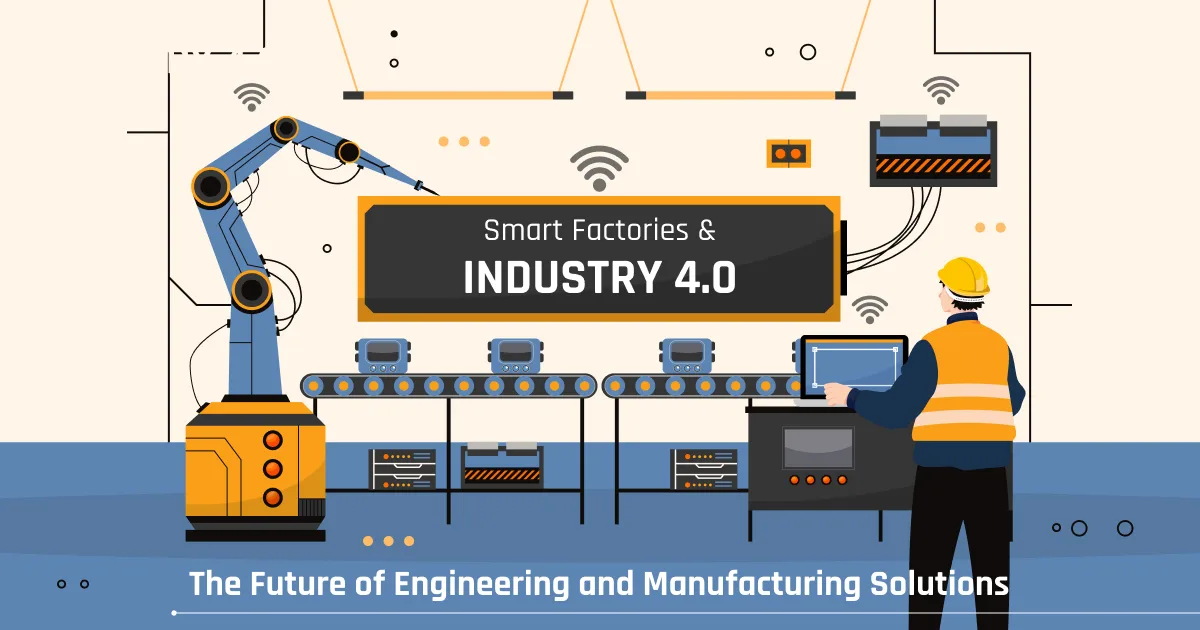
The manufacturing industry is undergoing a profound transformation with Industry 4.0 and the emergence of smart factories. Businesses leveraging engineering and manufacturing solutions are gaining a competitive edge through automation, AI, IoT, and other digital innovations.
This blog explores how design & manufacturing services are evolving, the key technologies driving this shift, real-world applications, and the future of manufacturing engineering services.
Understanding Industry 4.0
Industry 4.0 marks the fourth industrial revolution, integrating digital technologies into manufacturing. Key elements include:
- IoT (Internet of Things) connects machines, sensors, and devices, allowing them to exchange data in real time. This connectivity enhances operational visibility and efficiency, enabling predictive maintenance and optimized production workflows.
- AI & Machine Learning analyze vast amounts of manufacturing data to optimize production processes, detect anomalies, and predict maintenance needs. This ensures continuous operations while reducing downtime and costs.
- Cloud Computing centralizes data storage and analytics, providing manufacturers with scalable and secure access to crucial insights. It enables smarter decision-making by integrating data from different sources for improved resource management.
- Robotics & Automation streamline manufacturing by performing repetitive tasks with precision and consistency. These technologies reduce human intervention in manual processes, improving efficiency, safety, and product quality
These advancements are revolutionizing design and manufacturing engineering, making production faster, more efficient, and highly adaptive.
The Rise of Smart Factories
Smart factories utilize interconnected systems to automate and optimize production. Unlike traditional setups, they rely on:
- Real-time monitoring involves IoT-enabled sensors embedded in machinery, continuously tracking performance and detecting potential issues before they escalate. This proactive approach minimizes unplanned downtime, enhances productivity, and ensures smooth operations.
- Self-optimizing systems leverage AI and machine learning to adjust workflows dynamically. By analyzing real-time data, these systems identify inefficiencies and automatically fine-tune processes to maximize output, reduce waste, and optimize production speed.
- Digital supply chains integrate advanced technologies to streamline communication between suppliers, manufacturers, and logistics teams. With real-time tracking and automated coordination, businesses can improve inventory management, reduce delays, and enhance overall supply chain efficiency.
By adopting engineering innovation design & consulting, manufacturers can transition from rigid assembly lines to flexible, data-driven production hubs.
Engineering Solutions Powering Industry 4.0
Several cutting-edge technologies are enabling the transition to smart factories:
- Digital Twins create virtual replicas of physical systems, allowing manufacturers to simulate, analyze, and optimize operations before implementing changes. This reduces risks and enhances efficiency.
- CAD/CAM Integration bridges product design and manufacturing by enabling seamless digital modeling and automated production processes. It accelerates development and ensures precision in manufacturing.
- Predictive Maintenance uses AI-driven analytics to monitor equipment health in real time, predicting failures before they occur. This minimizes downtime, reduces repair costs, and improves reliability.
- Smart Material Handling leverages AGVs and robotics to automate logistics, improving inventory movement, reducing manual labor, and ensuring faster, more efficient supply chain operations.
These manufacturing engineering services enhance precision, minimize waste, and accelerate time-to-market.
Real-World Applications in Manufacturing
Leading companies Katalyst Technologies are already implementing Industry 4.0 solutions:
BMW’s Smart Factory
BMW has revolutionized automotive manufacturing by integrating AI-driven robotics and IoT-enabled assembly lines. Instead of relying solely on traditional automated processes, the factory continuously adapts to customer demands, enabling precise customization for each vehicle. AI-powered machines analyze real-time production data, adjusting workflows dynamically. This level of intelligent automation has helped BMW reduce production time by 30%, ensuring faster delivery while maintaining high-quality standards.
Siemens’ MindSphere
Siemens developed MindSphere, a cloud-based industrial IoT operating system, to connect machines and optimize factory performance. Through predictive analytics, MindSphere collects and processes real-time data from industrial equipment, identifying potential failures before they happen. This proactive approach reduces unexpected downtime and optimizes energy consumption, making factories more efficient. Many manufacturers use this system to monitor production operations remotely and improve overall productivity.
GE’s Predix Platform
GE’s Predix platform leverages big data analytics to enhance industrial equipment performance. By gathering insights from sensors embedded in machinery, Predix predicts maintenance needs, preventing costly breakdowns. With 20% reduction in unplanned downtime, businesses see improvements in reliability, efficiency, and profitability. This system is widely used in sectors like energy, healthcare, and aviation, helping manufacturers extend equipment lifespan and lower operational costs.
These examples highlight how engineering and manufacturing solutions are transforming industries through automation, data-driven decision-making, and AI-powered optimization.
Key Benefits of Industry 4.0 for Modern Manufacturing
- Increased Efficiency: Automation reduces cycle times and human errors.
- Predictive Analytics: Prevents costly breakdowns through proactive maintenance.
- Energy Savings: Smart systems optimize power consumption.
- Enhanced Product Quality: AI-driven inspections ensure higher precision.
Challenges and Considerations
Despite its immense potential, businesses must navigate:
Data Security: Protecting sensitive manufacturing data from cyber threats.
Legacy System Integration: Upgrading existing machinery for IoT connectivity.
Workforce Training: Upskilling employees to manage advanced technologies.
Initial Investment: High upfront costs for automation and digital transformation.
The Future of Manufacturing Engineering Services
The next phase of engineering innovation design & consulting will focus on:
Digital Threads: End-to-end data integration across product lifecycles.
Edge Computing: Faster data processing at the source (e.g., factory floor).
Autonomous Systems: Self-learning machines improving without human input.
Final Thoughts
Industry 4.0 and smart factories are reshaping manufacturing, driving efficiency, precision, and agility. Businesses that embrace engineering and manufacturing solutions today will gain a competitive edge through automation, AI, and IoT-driven optimizations.
While the transition requires investment in technology, workforce training, and data security, the long-term benefits—cost savings, improved quality, and faster production cycles—make it a strategic necessity.
The future of manufacturing engineering services will focus on autonomous systems, real-time data integration, and edge computing, enabling even smarter and more adaptive production.
Is your business ready to embrace digital transformation? Contact us today to accelerate your Industry 4.0 journey!