
Despite years of automation efforts, production can still stall, employees juggle multiple screens, and projects often run over time and budget. The good news is that a well-designed hyperautomation strategy can transform these costly pain points into a seamless, enterprise-wide solution, delivering measurable value in just weeks instead of months. Companies that have already embraced hyperautomation report productivity improvements of up to 40%, proving that the future of AI-powered automation is here today.
In the next few minutes, learn exactly how to build, launch, and scale a real-time hyperautomation strategy, powered by generative AI and agentic automation that operates on a cloud-native architecture, transforming fragmented workflows into an engine of hyperautomation.
Why Hyperautomation Strategies Fail: Common Pain Points Decoded
Even with the best intentions, enterprise automation solutions can falter amid the complexities of multi-vendor ecosystems. The root cause usually traces back to seven recurring friction points:
- Siloed Data Limits Insight: Production, quality, and supply data often reside in department-specific systems that don’t communicate with each other, causing automation scripts to fail or produce incomplete results.
- Project Overruns and Scope Creep: Teams frequently underestimate the complexity of integrating legacy systems, which can extend project timelines and inflate budgets considerably.
- Unplanned Downtime: Monitoring systems are often disconnected, preventing early detection of issues, leading to reactive, calendar-based maintenance schedules rather than predictive maintenance automation.
- Skills Gaps and Resource Strain: Automation experts are scarce and stretched thin, while frontline teams can be hesitant to adopt bots they don’t fully understand.
- Security and Compliance Risk: Piecemeal automation, especially when combined with unregulated shadow IT, significantly enlarges the enterprise’s attack surface.
- Slow ROI Perception: Executives may see hyperautomation as just another drawn-out initiative, failing to recognise quick, tangible wins.
- Change Fatigue: Following waves of digital transformation, employees may have lost trust in new automation “silver bullets.”
Recognising these challenges upfront is critical. Instead of a technology shopping list, build a risk-aware blueprint that anticipates barriers and drives results.

How to Build a Best-in-Class Hyperautomation Strategy
Turn fragmented scripts and siloed efforts into a fully governed, AI-powered engine of hyperautomation strategy with this structured, step-by-step framework:
Establish Business Outcomes First
Define clear, non-negotiable metrics such as reducing unplanned downtime, improving first-pass yield, or optimising the order-to-cash cycle. Connect every metric directly to financial outcomes, ensuring every stakeholder can see how automated workflows translate into measurable savings.
Map the Current Process and Data Landscape
Conduct a thorough audit of every workflow, interface, and data source. This should include OT equipment, cloud applications, and legacy systems. Document all failure points, manual hand-offs, and compliance-related constraints.
Prioritise High-Value, Low-Complexity Use Cases
Use a scoring matrix that evaluates business impact, technical feasibility, and change complexity. For many manufacturers, predictive maintenance, automated quality inspections, and dynamic scheduling consistently rank highest in terms of intelligent automation potential.
Architect for Cloud-Native Resilience
Migrate orchestration, event streaming, and AI analytics to a cloud-native architecture. Containerisation and microservices enable rapid scaling, allowing you to deploy new automations without rewriting core systems.
Add the Intelligence Layer
Generative AI turns diverse data types, such as work orders, PDFs, and images, into structured, actionable insights.
Agentic automation converts those insights into autonomous, goal-oriented actions, whether creating purchase orders, scheduling maintenance, or adjusting product flows, without the need for ongoing script updates.
Orchestrate End-to-End Automation
Combine RPA, workflow management, machine vision, and AI models under a unified governance layer. This engine of hyperautomation enforces security, version control, and full visibility across multi-vendor ecosystems. Effective workflow orchestration here is key.
Drive Change Management and Executive Buy-In
Establish an internal Centre of Excellence to empower citizen developers with clear guardrails. Communicate early wins, such as a 50% reduction in unplanned downtime on a crucial production line, to build momentum for broader deployment. This is central to any successful digital transformation initiative.
Pro Tip:
Incorporate “freeze gates” at the end of each stage to ensure that no initiative advances to the next phase without a proven, measurable KPI. This approach safeguards against scope creep and keeps your automation strategy on track.
Future-Proof Your Program: Generative AI, Cloud-Native Architecture, and Agentic Automation
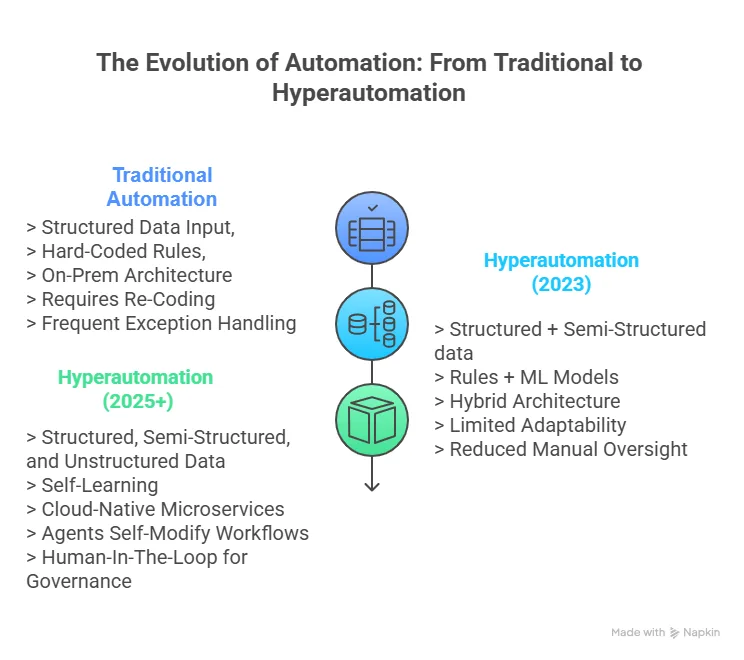
Modern hyperautomation evolves beyond traditional automation through added intelligence, adaptability, and resilience. The table below highlights the capabilities of traditional RPA, current hyperautomation, and the future state incorporating generative AI and agentic automation.
| Capability | Traditional Automation | Hyperautomation (2023) | Hyperautomation (2025+ with Generative AI & Agentic Automation) |
| Data Input | Structured only | Structured + some semi-structured | Structured, semi-structured, and unstructured (text, images, sensor feeds) |
| Decision Logic | Hard-coded rules | Rules + ML models | Self-learning, generative reasoning, and dynamic goal seeking |
| Architecture | On-prem, brittle | Hybrid architecture | Cloud-native microservices for elastic scale |
| Adaptability | Requires re-coding | Limited adaptability to change | Agents self-modify workflows in real time |
| Human Involvement | Frequent exception handling | Reduced but manual oversight | Human-in-the-loop for governance, not daily tasks |
Why Generative AI Adds Real-Time Insight
Consider a maintenance technician’s note in a ticketing system: “motor hotter than usual.” This critical information usually goes unnoticed. Generative AI can extract this phrase, correlate it with real-time sensor data, and automatically trigger an agent to schedule an inspection before the production line even stops. This application showcases the true potential of AI-powered automation beyond simple chatbots, rather, forming an integrated part of your engine of hyperautomation.
The Importance of Cloud-Native Architecture
Cloud-native services allow data processing to happen near the source, whether in an edge computing device or a regional data centre. This results in low-latency, real-time decision loops, reducing the need for expensive legacy system upgrades. Embracing cloud-native architecture ensures scalability and resilience across your enterprise automation solutions.
Agentic Automation: Empowering Autonomy in Automation
Agentic automation uses proactive, goal-driven “agents” that coordinate among themselves to manage tasks. These agents can order parts, update ERP systems, and send alerts to supervisors without needing new scripts for every unique challenge. This autonomy forms the core of hyperautomation, enabling the strategy to scale from a single production cell to the entire enterprise seamlessly.
Proof That Pays Off: Business Outcomes and Industry Benchmarks
Skeptical executives often ask, “Where’s the evidence?” Here are the facts:
- Smart-factory adoption is growing at a rate of 13% annually and is forecasted to surpass $244 billion by 2025.
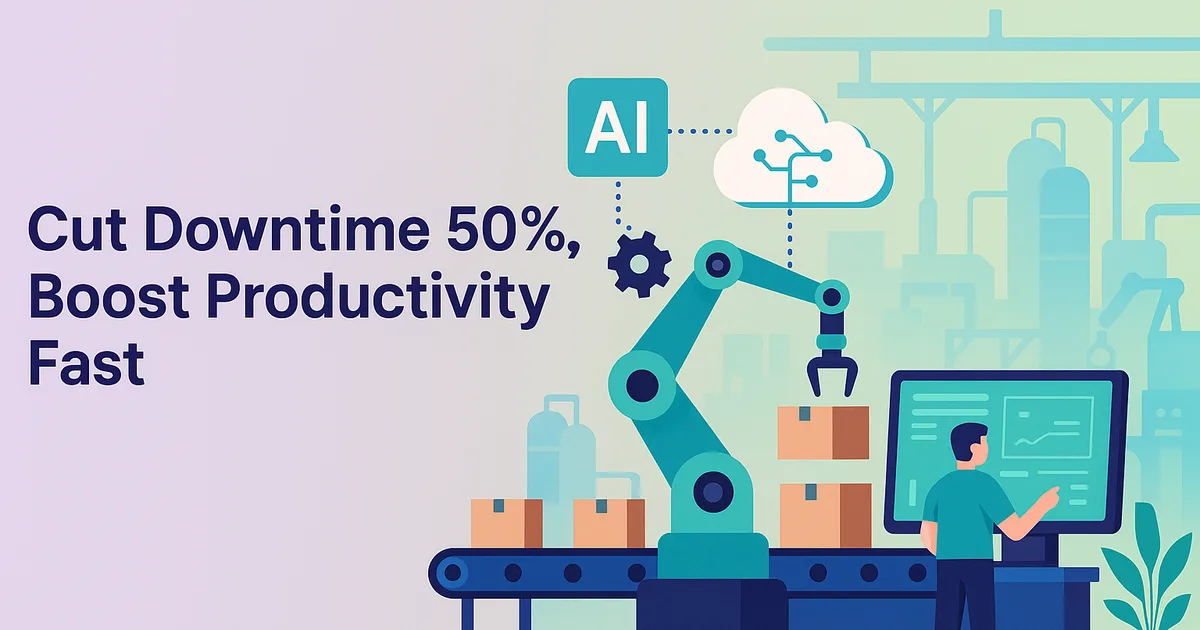
- Predictive maintenance, a flagship use-case in hyperautomation, can reduce maintenance costs by 20% and unplanned downtime by as much as 50%.
- Case in point: Adidas Speedfactory integrated AI-powered automation across design, planning, and production pipelines. This enabled a 50% reduction in customised shoe lead-times while simultaneously lowering production costs. The key takeaway: by leveraging cloud-native architecture orchestration, Adidas was able to continuously innovate without shutting down lines, proving the concept works at scale.
Neutral Perspective
Whether you choose to partner with a specialist or build internal expertise, the pattern is consistent: focusing on business-aligned use-cases and layering intelligence-driven solutions delivers measurable returns, usually at a fraction of the cost of comprehensive system overhauls.

Action Plan: Activate Your Enterprise-Wide Engine Within 90 Days
Now that you have a detailed blueprint, follow these steps to unlock value quickly and efficiently:
Conduct a two-week readiness assessment:
Measure data maturity, establish baseline KPIs, and identify any legacy system constraints.
Launch a pilot project on a high-impact use case:
Choose predictive maintenance. Aim to move from design to live production within 30 days.
Validate the pilot’s ROI quickly:
Track metrics like downtime reduction, defect elimination, and labour-hour savings.
Roll out the programme using a hybrid delivery model:
Combine your internal Centre of Excellence with specialised external partners to bridge any skills gaps.
At Katalyst, we ensure this process happens without common pitfalls like project overruns. Backed by 18 years of industry experience and a cloud-native accelerator toolkit, our multi-vendor orchestration solutions reduce risk and simplify the complexity of your automation projects.
Ready to explore? Book a 30-minute strategy session with us, no slides, just a custom roadmap designed to accelerate your business outcomes.
Conclusion
A well-designed, governed hyperautomation strategy, anchored firmly in generative AI, cloud-native architecture, and agentic automation, turns isolated automation attempts into a connected, intelligent engine of hyperautomation, capable of driving enterprise-wide digital transformation. Start with clearly defined outcomes, validate quickly through operational KPIs, and scale confidently as your business moves from fragmented solutions into strategic enterprise automation solutions.
At Katalyst, we guarantee you’ll achieve streamlined enterprise workflows through AI-powered automation, enabling you to stay competitive and agile in today’s dynamic real-time business environment.
Frequently Asked Questions
How does hyperautomation reduce unplanned downtime and project overruns?
By unifying real-time sensor data, predictive analytics, and autonomous agentic workflows, potential machine failures are detected early, while controlled “freeze gates” prevent scope-creep before it impacts project timelines.
How do generative AI and agentic automation improve traditional automation?
Generative AI unlocks insights from unstructured data, turning it into actionable intelligence, while agentic automation executes that intelligence autonomously, reducing the need for manual rule updates.
What are the biggest mistakes to avoid when integrating hyperautomation with legacy systems or multi-vendor ecosystems?
Skipping the vital data audit, underestimating effective change management practices, and ignoring the benefits of cloud-native architecture integration layers.
How do you calculate the true ROI and pay-back period for a hyperautomation strategy?
Start by defining specific, measurable KPIs such as downtime or cycle-time improvement. Assign direct financial value per unit of measurement, and then compare this benefit against the total cost of implementation, including change-management.
What are the best strategies for securing executive buy-in and leading change?
Align each pilot with clear financial benefits, emphasise early wins, and communicate all results and plans in business terms rather than technical jargon.