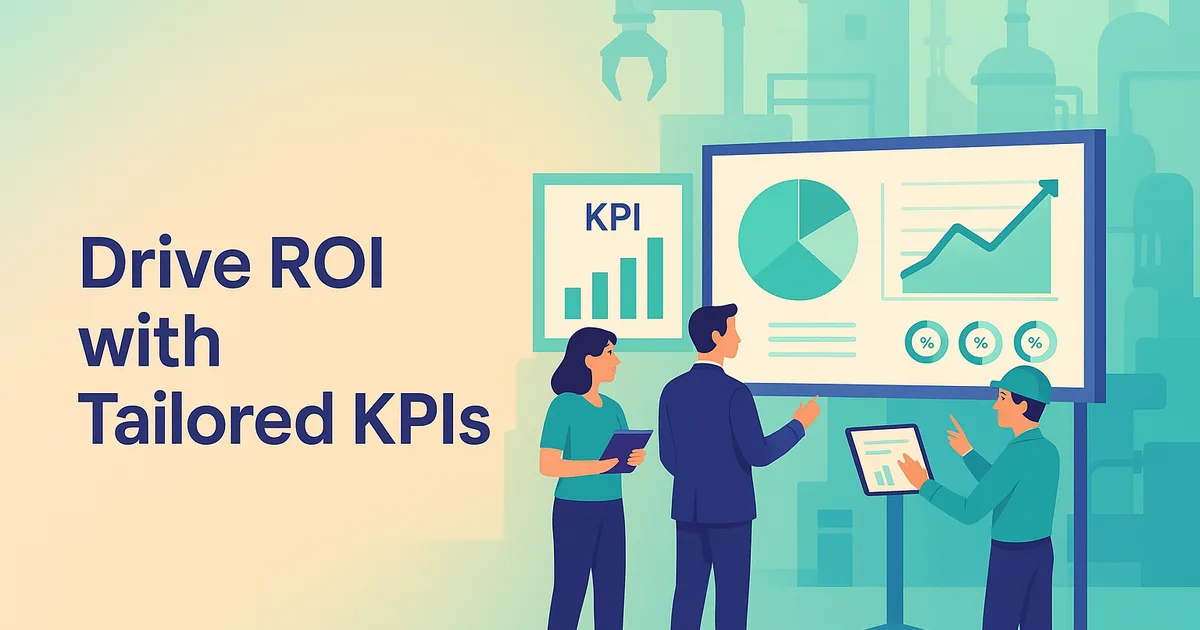
Costly friction shows up everywhere: projects running over time and budget, data silos blocking insight, and legacy systems driving unplanned downtime. Yet the future can look very different when you track the right digital transformation KPIs and act on them. In fact, 65% of manufacturers admit they lack clear KPIs for their digital initiatives, a gap tied directly to stalled ROI of digital transformation.
In this blog, you’ll learn which digital transformation metrics matter most, how to set them up effectively, and the best KPI dashboard tools to keep your digital journey on track.
Why KPIs Matter for Digital Transformation ROI
Digital transformation metrics are not just numbers on a dashboard. They are the early-warning system that rings before scope creep, the proof that earns executive buy-in, and the roadmap toward measurable business performance indicators.
Without clear KPIs, teams scramble, often spending three times the resources on avoidable rework while still struggling to demonstrate tangible value.
The benefits of tracking top KPIs for digital transformation success include:
- Guardrails against overruns – Clear metrics spotlight when multi-vendor integrations drift, enabling early course correction.
- Faster payback – Companies tracking ROI in the first 12 months see 30% higher project success.
- Cultural alignment – When frontline teams see measurable improvements, like fewer downtimes or faster release cycles, resistance turns into advocacy.
Reimagine business operations and accelerate growth
Katalyst Technologies’ solutions simplify IT, ERP, and supply chain management
so teams can act faster and scale smarter can help.
The Five Categories of Must-Track KPIs
Digital transformation KPIs for enterprises cluster into five logical groups. Together, they cover operational health, financial returns, and organizational maturity.
1. Operational Efficiency:
These indicators focus on streamlining daily work and removing friction.
- Mean Time Between Failures (MTBF) vs. unplanned downtime hours, critical for predictive maintenance programs.
- Cycle-time reduction across legacy systems and new digital workflows.
- Automation coverage rate: percent of processes shifted from manual or calendar-based maintenance to sensor-driven triggers.
2. Financial Impact:
Stakeholders care about the ROI of digital transformation. Track:
- Percentage revenue from digitally enabled products or channels.
- Cost-to-serve reduction: savings from process automation and self-service portals.
- Payback period per initiative, calendar time from launch to positive cash flow.
3. Customer & Supplier Experience:
Manufacturers now operate in experience-driven supply chains.
- On-time delivery rate after system upgrades.
- Self-service adoption by distributors reduces support tickets.
- Net Promoter Score (NPS) trends post-deployment.
4. Workforce Enablement:
Skills gaps and change fatigue can derail projects.
- Digital skills index: percent of workforce completing upskilling programs.
- User adoption rate within 90 days for new applications.
- Employee engagement scores segmented by site to flag resistance hotspots.
5. Digital Maturity Assessment:
A snapshot of enterprise-spanning capabilities.
- Data availability score: ratio of integrated systems vs. isolated data silos.
- AI-ready data volume: percent of data mapped to a governed model.
- Security compliance index across cloud and on-prem assets.
Building a KPI Framework That Sticks
A one-off dashboard won’t survive the next disruption. Instead, design a framework that connects KPIs to outcomes.
- Define Business Outcomes:
Gather executive sponsors and plant managers in the same room. Agree on best-in-class outcomes; fewer recalls, faster design-to-manufacture cycles, before debating numbers. This prevents vanity metrics and secures executive buy-in early.
- Map Metrics to Outcomes:
Translate outcomes into specific digital transformation KPIs. Example: “Reduce warranty claims 20 %” aligns with “First-pass yield” and “Customer return rate.” Clear mapping avoids scope creep once budgets tighten.
- Establish Data Sources:
Identify which systems, ERP, MES, and IoT sensors generate each metric. Document data owners to eliminate finger-pointing later. Address multi-vendor ecosystem gaps by assigning one integration lead.
- Set Baselines and Targets:
Capture a four-to-six-week baseline from current operations. Then set quarterly targets, balancing ambition with realistic ROI of digital transformation timelines. Communicate that some gains, like predictive maintenance benefits, build over 12–18 months.
- Choose the Right Visualization:
Select the best KPI dashboard tools for transformation that integrate across cloud and on-premise. Evaluate ease of drill-down, mobile access for line supervisors, and automated alerts. A hybrid delivery model, cloud analytics with on-site edge gateways, often balances speed with security.
- Review and Iterate:
Schedule monthly reviews. If a metric stalls, ask why: skills gap, data quality, or vendor delay? Continuous improvement keeps the framework relevant.
Selecting the Best KPI Dashboard Tools
Choosing the right tools is critical for accurate tracking and adoption. Look for:
Dashboard Evaluation Cheat-Sheet
| Evaluation Area | Why It Matters | What Best-in-Class Looks Like |
|---|---|---|
| Real-Time Data Ingestion | Predictive maintenance needs immediate sensor feeds | Sub-second streaming with built-in anomaly detection |
| Cross-Platform Integration | Breaks data silos across ERP, PLM, CRM | 50+ pre-built connectors plus open APIs |
| Governance & Security | Protects IP in multi-system environments | Role-based access, audit trails, SOC 2 compliance |
| User Experience | Drives adoption, reduces skills gap strain | Drag-and-drop visuals, natural-language queries |
| Cost Structure | Avoids overhead expenses | Modular pricing that scales by user or data volume |
Note: Always pilot with a single production line before enterprise rollout. This reveals hidden legacy system constraints and builds trust fast.
Common KPI Pitfalls to Avoid
Tracking Too Many Metrics:
Teams drown in numbers and miss the signal. Limit each initiative to ten or fewer critical performance metrics for digital projects.
Ignoring Data Quality:
Dirty data quietly kills ROI. Establish a weekly data-quality audit, flagging mismatched units, null values, and latency issues.
Overlooking Change Management:
Even perfect metrics fail without people. Pair every new KPI with a communication plan that explains why it matters to technicians, not just executives.
Where Katalyst Fits In
At Katalyst, we bring 18+ years of transformation expertise to help organizations define and execute effective digital transformation KPIs for enterprises. Our approach includes:
- Rapid KPI blueprint workshops aligning IT and OT leaders.
- Hybrid delivery models, cloud analytics + on-premise edge nodes.
- Embedded coaches to close skill gaps and sustain momentum.

Success Snapshot
A global equipment manufacturer reduced unplanned downtime by 45% in nine months by tracking just three focused KPIs: MTBF, maintenance cost per asset, and schedule compliance. This accelerated their ROI of digital transformation and paid back ahead of schedule.
Next Steps
Digital transformation KPIs are the compass that keeps your strategy aligned to business outcomes. Start measuring what matters, and watch operational efficiency, employee adoption, and digital maturity assessment compound into a competitive advantage.
Book a KPI alignment session with Katalyst’s advisory team today and get a clear roadmap for sustainable ROI.
FAQs on Digital Transformation KPIs
Q: How soon should we see results?
A: Operational metrics like cycle time may improve in weeks. Financial ROI often appears in 9-18 months, depending on project scope.
Q: Do KPIs differ between plants and headquarters?
A: Core categories stay the same, but plant-level measures often emphasize throughput and downtime, while HQ focuses on revenue and margin.
Q: How do we keep dashboards secure?
A: Use role-based access, encrypt data in transit, and audit login activity. Select tools that offer multi-factor authentication and granular permissions.