
The Reality of IT Support Has Changed
Most organizations don’t struggle because they lack IT support.
They struggle because their support model no longer reflects how IT is consumed.
Some days require only routine assistance. Other days demand advanced troubleshooting, cloud expertise, or architectural decisions, often without warning. Traditional fixed contracts were never designed for this variability.
This shift is driving enterprises toward a more adaptive approach one that aligns cost, capacity, and expertise with real operational demand.
At Katalyst Software Solutions Limited, this approach is delivered through a structured framework designed for modern, cloud-driven environments.
Why Traditional Managed IT Support Is No Longer Enough
Conventional Managed IT Support agreements are built around fixed retainers, predefined scopes, and long-term commitments. While effective in stable environments, they often create inefficiencies when workloads fluctuate.
Today’s IT teams must manage:
- Cloud migrations and optimization initiatives
- Security and compliance-driven changes
- Hybrid and remote workforce requirements
- Short-term projects that require senior engineering expertise
In these scenarios, rigid contracts often result in unused capacity during quiet periods and limited flexibility during peak demand.

The Shift to On-Demand Managed IT Services
On-demand managed IT services replace static agreements with a consumption-based engagement. Instead of paying for constant availability, organizations use support only when it is required.
This model allows teams to:
- Control spends without sacrificing responsiveness
- Scale support during projects or peak periods
- Access multiple levels of expertise through a single framework
- Reduce contractual and administrative overhead
At the center of this approach is a prepaid structure designed for transparency and control.
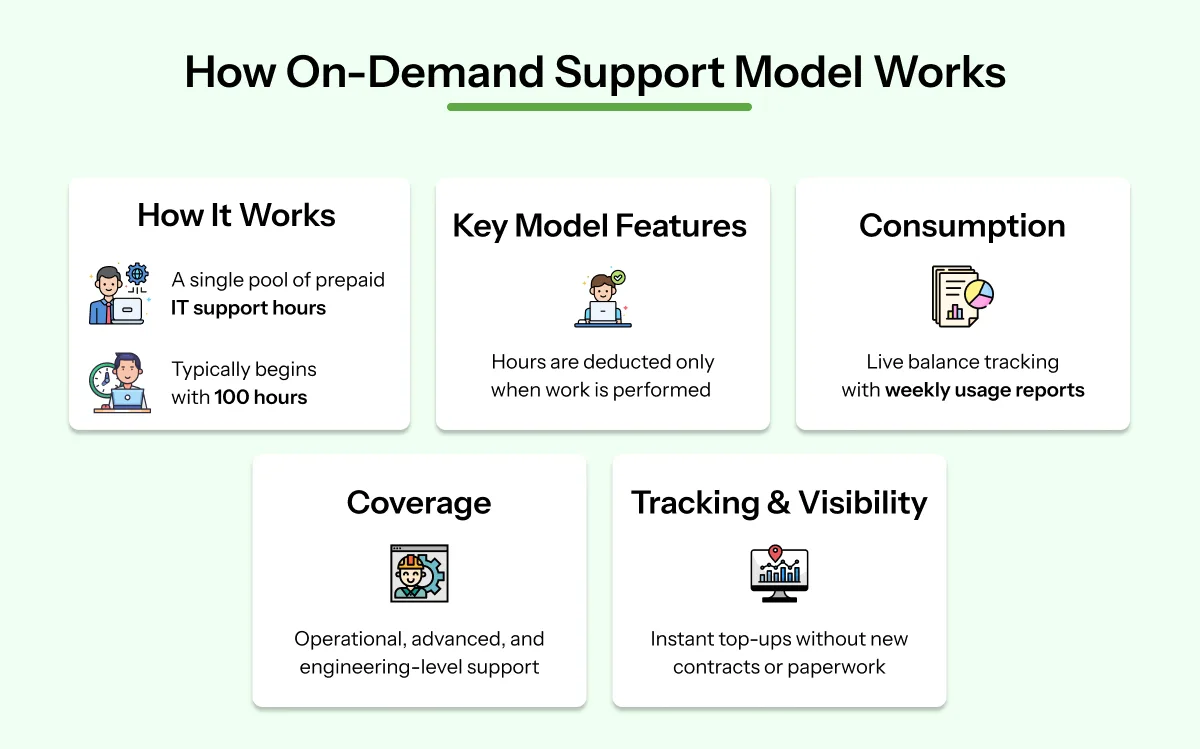
How the On-Demand Support Model Works
| Component | Description |
| Support Structure | A single pool of Prepaid IT support hours |
| Starting Point | Typically begins with 100 hours |
| Coverage | Operational, advanced, and engineering-level support |
| Consumption Model | Hours are deducted only when work is performed |
| Tracking & Visibility | Live balance tracking with weekly usage reports |
| Flexibility | Instant top-ups without new contracts or paperwork |
This structure ensures access to expertise without locking organizations into unnecessary fixed costs.
Multi-Level Remote Support from a Single Engagement
A key advantage of this model is unified access to support across operational, technical, and strategic layers without switching vendors or contracts.
Operational & Helpdesk Support
Focused on day-to-day productivity:
- User access management and authentication support
- Microsoft 365 and collaboration tools
- VPN and connectivity troubleshooting
- Ticket triage and escalation
Advanced Technical Support
Designed for deeper technical needs:
- Windows and macOS troubleshooting
- Network and firewall configuration changes
- Endpoint security and patching
- Performance tuning and platform administration
Engineering & Architecture
Senior expertise for complex initiatives:
- Cloud architecture and infrastructure design
- AWS and Azure environments
- Core routing and resilience planning
- Disaster recovery testing and security hardening
All services are delivered remotely and consumed from the same prepaid pool.
Did You Know?
Many organizations only require senior engineering expertise during specific events, such as migrations, audits, outages, or major rollouts. A flexible support model makes it possible to access that expertise when needed, without carrying the cost year-round.
What’s Included in on-demand managed IT services
| Support Area | Coverage |
| Enterprise IT support services | Systems, networks, security, and core platforms |
| Cloud managed services | Design, optimization, and administration |
| Platform support | Microsoft 365 support services and collaboration tools |
| Delivery approach | Remote IT support services for distributed teams |
| Infrastructure focus | Security, resilience, and Cloud infrastructure support |
This consolidated structure reduces complexity while improving response times and service clarity.
Cloud Services in an On-Demand Framework
As cloud adoption accelerates, many organizations find that they need intermittent high-level expertise rather than continuous administration.
An on-demand framework is particularly effective for:
- Architecture reviews and optimization
- Performance tuning and scalability planning
- Security posture alignment
Teams can consume cloud expertise as required and stay agile without overcommitting resources.
Supporting Growth Without Fixed Overhead
Permanent staffing and long-term retainers are not always practical for growing or project-driven teams. A flexible delivery model provides access to enterprise-grade expertise while keeping operational overhead under control.
This approach works especially well for:
- Digital transformation initiatives
- ERP and CRM programs
- Infrastructure modernization
- Temporary increases in support demand
Support capacity scales with activity—not headcount.

Regional Coverage and Business-Hour Alignment
For organizations operating across regions, responsiveness and time-zone alignment are critical. Support models that align to defined business hours, while retaining the ability to extend coverage when required, maintain service consistency without onsite dependency.
For teams operating in the UAE, this balance supports faster response, predictable costs, and access to global engineering expertise.
Governance, Transparency, and Predictability
Effective delivery depends on clear governance. Best-practice frameworks include:
- Defined response targets by priority
- Single communication and escalation paths
- Weekly usage reporting
- Clear scope definitions and exclusions
These controls ensure accountability while keeping engagement simple and measurable.
Key Takeaways
- Support demand is rarely consistent across time or projects
- Fixed contracts often create waste or inflexibility
- A single engagement model can support multiple levels of expertise
- Usage-based consumption improves cost visibility and control
- Flexible delivery works well for both operations and transformation initiatives
Conclusion
Modern IT environments require a support approach that adapts as quickly as technology itself. Usage-based models provide a practical way to access the right expertise at the right time without the limitations of rigid contracts or unnecessary overhead.
By focusing on transparency, scalability, and access to deep technical skills, organizations can build a more resilient and responsive IT foundation.
If you are exploring a more flexible way to manage IT support, Katalyst Software Solutions Limited offers an engagement model designed to align with real operational and project-driven needs.
Learn how a prepaid, on-demand approach can support your IT environment with clarity, control, and enterprise-grade expertise.
Frequently Asked Questions
Your most common questions, answered with precision and insight