
The retail and apparel supply chains are consistently challenged by demand variability, seasonal peaks, and rising fulfillment expectations. Traditional warehouse approaches often lead to delays, inventory inaccuracies, and operational inefficiencies. These challenges directly impact customer satisfaction, operational costs, and overall supply chain performance. A Warehouse Management System (WMS) addresses these challenges by managing core warehouse responsibilities such as inventory tracking, order processing, space utilization, and real-time coordination across warehouse operations, enabling warehouses to function as efficient execution centers that resolve these critical issues.
This blog will discuss the role of digitally connected processes in enhancing the warehouse management infrastructure, inventory, labor management, and the efficiency of operations. Data warehouses are always faster and more precise than manual operations and can be used to offer a scalable solution to retailers managing complex omnichannel fulfillment.
1. Higher Labor Productivity Without Increasing Headcount
Labor efficiency in warehouses directly impacts margins. A systematic Warehouse Management System (WMS) replaces inefficient task assignments with directed execution. Employees are directed through optimal routes and step-by-step execution, thereby increasing productivity and improving training effectiveness. Seasonal staff are readily integrated into the system to handle high seasons.
The system proves the advantages of warehouse management software by enabling the processing of higher order volumes without a corresponding increase in the workforce.
Drive Efficiency. Realize Potential
Cut through technical complexity with Katalyst.
We build streamlined, powerful solutions that automate processes and integrate data, freeing you to focus on strategic growth
2. Faster Fulfillment Across Omnichannel Operations
A good Warehouse Management System (WMS) makes order processing faster across all sales channels. The system assists in picking tasks, packing, and shipping to work in harmony without delays and errors and maintaining the service levels at a constant supply in peak seasons.
Key operational points:
- Better Picking: Products are organized to minimize the movement and accelerate the process.
- Reduced Complexity: Packing workflows can be simplified by reducing the likelihood of errors.
- Faster Shipping: Shipping orders are faster, placing less wait time
- Uniform Service: The store, online, and marketplace orders are delivered by the same quality service.
These are improvements that are brought about by a powerful warehouse management system.
3. Inventory Accuracy That Prevents Revenue Leakage
Good inventory data is crucial for smooth retail operations. A modern Warehouse Management System WMS records stock movement in real time and ensures these system records match with actual warehouse stock. The clothes warehouse houses many stock-keeping units differentiated by sizes, colors, and seasons. Manual tracking is prone to errors leading to stockouts and loss of sales.
Organized warehouse and inventory management facilitate restocking, avoid stockouts, and ensure readiness for audits. The well-managed warehouse manages inventory accuracy , which avoids overstocking, reduces costs, and prevents loss of revenue.
4. Scalable Operations That Support Business Growth
A strong warehouse management infrastructure allows retail operations to scale smoothly across the supply chain. Flexible workflows enable businesses to handle peak periods and new product introductions without disruption. Scalability becomes an integral part of daily supply chain operations, rather than a reactive effort to resolve issues as they arise.
Some key things to know about scalability:
- Volume Handling:Peak seasons and promotions are handled with ease.
- SKU Integration:Inclusion of new products is done in the least time and without delays.
- Multi-location Consistency:The same processes are followed for allwarehouses.
- Process Configuration:Changes may be affected without work stoppage.
The long-term benefits of Warehouse Management System are reflected by these features.
5. Data Visibility That Improves Operational Decisions
While picking, storage, and dispatching form the bulk of operationally generated data in a warehouse; a modern Warehouse Management System (WMS) converts this into actionable insights through dashboards and reports. Bottlenecks become visible, enabling proactive interventions and higher operational reliability.
Structured warehouse and inventory management amplifies planning and performance evaluation. Data-driven warehouses can achieve improved forecast accuracy and reduced fulfillment variability, enabling scalability of business and customer satisfaction.
6. Compliance, Traceability, and Operational Control
There are more regulations and checks to be followed in the retail and clothing chains. A good Warehouse Management System ensures the same processes, and all transactions are recorded. Serial numbers in the items to be tracked are an aid to monitoring the incoming and outgoing items.
Strong warehouse management infrastructure helps ensure rules are followed, leading to better performance in all locations and with partners. Being ready for audits gets easier, while risks and mistakes go down.
7. Cost Optimization Through Automation and Control
Manual warehouse processes introduce hidden inefficiencies over time. One of the strongest advantages of warehouse management software is automation-led optimization. Automated replenishment, slotting, and space utilization reduce handling errors and rework.
These improvements deliver measurable advantages of Warehouse Management Systems, lowering operational costs while maintaining service quality and efficiency.
Snapshot of Operational Improvements
The operational improvements achieved through a Warehouse Management System (WMS) can be measured across key performance indicators throughout the supply chain. The table below highlights key warehouse metrics that measure inventory accuracy, order processing speed, labor productivity, and overall supply chain and operational efficiency.
| Operational Area | Improvement Range |
| Inventory Accuracy | Up to 99% |
| Order Processing Speed | 25–30% faster |
| Labor Productivity | ~20% improvement |
| Operating Costs | 10–15% reduction |
These figures highlight the quantifiable benefits of Warehouse Management Systems, demonstrating how system-driven operations translate directly into cost savings, efficiency gains, and improved customer service.
Additional Operational Advantages
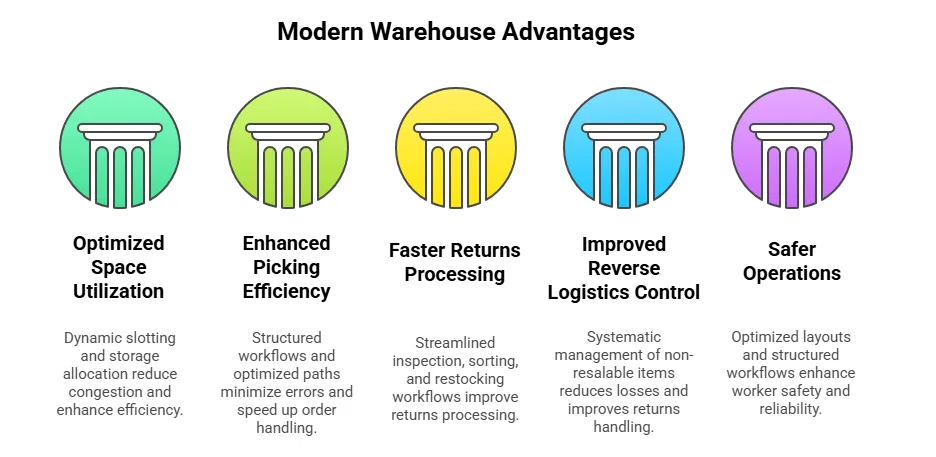
Modern Warehouse Management Systems (WMS) provide operational improvements beyond the core benefits, enabling warehouses to operate smarter, safer, and more efficiently.
Optimized Space Utilization
Space utilization and storage optimization are improved with dynamic slotting and storage allocation, reducing congestion and enhancing warehouse efficiency.
Enhanced Picking Efficiency
Structured warehouse workflows and optimized picking paths minimize errors and speed up order handling.
Faster Returns Processing
Returns processing and resale recovery are streamlined with efficient inspection, sorting, and restocking workflows.
Improved Reverse Logistics Control
Reverse logistics and systematic management of non-resalable items reduce operational losses and improve returns handling.
Safer and More Accessible Operations
Optimized layouts and structured workflows enhance worker safety and overall operational reliability.
These advantages show how structured warehouse and inventory management, powered by WMS, transforms warehouses into strategic hubs that maximize efficiency and business growth.
Katalyst Technology’s Strategy for Scalable Warehouses
Alignment of systems and operations is needed for warehouse transformation. Katalyst Technology has been involved in the design of scalable warehouse management infrastructure suitable for complex retail operations. Solutions focus on long-term accuracy, adaptability, and resilience.
Process standardization, performance tracking, and scalability are emphasized in every WMS implementation. This way, the warehouses remain capable of sustaining increased operational demands.
Reimagine business operations and accelerate growth
Katalyst Technologies’ solutions simplify IT, ERP, and supply chain management
so teams can act faster and scale smarter can help.
Transforming Warehouses into Growth Drivers
Operating excellence is the key to retail success, and the role of modern warehouses in it can in no way be underestimated. The benefits associated with Warehouse Management Systems go far beyond merely delivering higher speed and accuracy. They also encompass cost effectiveness, transparency, and optimized processes.
Book a demo with Katalyst Technologies to learn how your warehouse operations can be leveraged as a strength. Organized warehouse operations make it possible to complete more fulfillments faster, make better business decisions, and manage growth. Warehouses are now not just functional facilities in support of business, but drivers of profitability.
Frequently Asked Questions
Your most common questions, answered with precision and insight