
By Katalyst Software Services Limited – Updated for 2025
Discover how modern warehouses leverage data, automation, and AI to improve accuracy, reduce costs, and deliver at speed.
Warehouse Management System (WMS) is the structured process of receiving, storing, tracking, auditing, and managing goods within a warehouse. It also involves staff coordination, storage optimization, and cost control all designed to enhance operational efficiency and accuracy.
Why WMS Is Critical for Business Success
Warehouse operations are central to modern supply chains. Inefficient inventory management can cause ripple effects across order fulfillment, logistics, and customer satisfaction.
According to the IHL Group, retailers lose nearly $1.8 trillion annually to stockouts, overstocks, and returns.
When implemented effectively, WIM delivers:
- Accurate Order Fulfillment: Minimizes mis-picks and late deliveries.
- Increased Productivity: Automation and workflow optimization reduce manual effort.
- Faster Shipping: Efficient warehouse processes shorten delivery cycles.
- Higher Customer Retention: Reliable and on-time deliveries improve satisfaction.
Drive Efficiency. Realize Potential
Cut through technical complexity with Katalyst.
We build streamlined, powerful solutions that automate processes and integrate data, freeing you to focus on strategic growth
Inventory Management vs. Warehouse Management
While often used interchangeably, Inventory Management (IM) and Warehouse Management (WM) functions:
| Aspect | Inventory Management | Warehouse Management |
| Focus | Stock levels and movement | Physical handling and workflow |
| Key Activities | Forecasting, ordering, replenishment | Storing, picking, packing, shipping |
| Objective | Avoid stockouts/overstocks | Improve operational speed and accuracy |
In short: IM focuses on what and how much to store; WM focuses on where and how to move it.
Core WIM Processes: The Operational Cycle
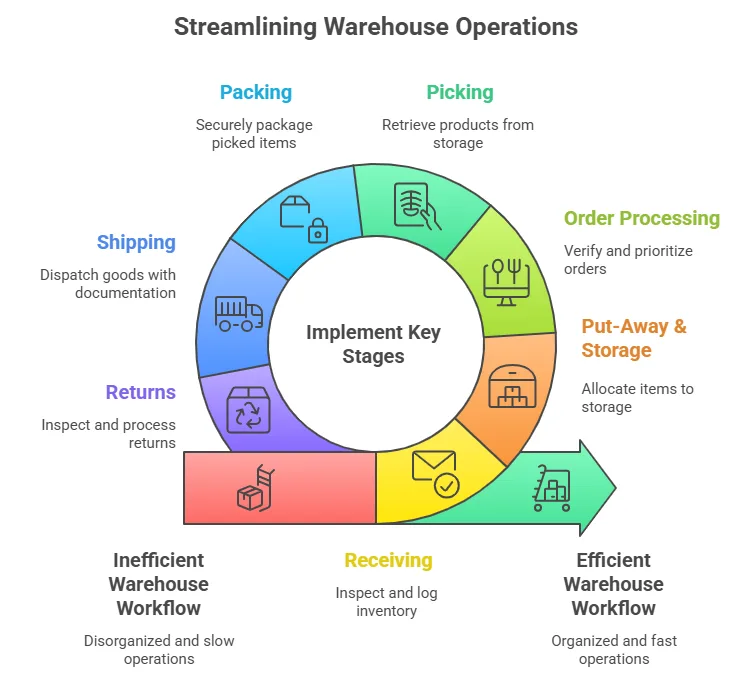
Every warehouse operates through seven core processes that ensure smooth, efficient flow from inbound to outbound logistics:
- Receiving: Inspect and log incoming inventory by verifying quantity and condition.
- Put-Away & Storage: Allocate items to designated slots—store fast-moving SKUs near dispatch zones.
- Order Processing: Verify, prioritize, and queue customer orders for picking.
- Picking: Retrieve products using systems like barcode scanning or voice picking for accuracy.
- Packing: Securely package items with labels and tracking codes.
- Shipping: Dispatch goods with complete documentation and tracking integration.
- Returns: Inspect, restock, or recycle items, ensuring accurate record updates.
Warehouses that implement barcode or RFID-based receiving reduce entry errors by up to 70%.
Proven WMS Best Practices for Optimization
1. Strategic Organization and Layout
- Optimize Floor Space: Use vertical racking and multi-tier shelving to increase capacity without expanding footprint.
- Implement Warehouse Slotting: Store items based on demand, size, and weight to streamline picker routes.
- Prioritize Fast-Movers: Strategic placement of high-demand items near packing areas can cut walking distance by up to 30%.
2. Inventory Control and Accuracy
- Cycle Counting: Replace full physical counts with rolling checks. Count Category A items monthly and Category C items semiannually.
- Leverage Technology: Use RFID, IoT sensors, and barcode systems to track movements in real-time and minimize human error.
- Audit for Variance: Set alerts for discrepancies above 2–3% to quickly identify systemic issues.
3. Demand, Quality, and Staff Management
- Forecast Demand: Analyze seasonal patterns to predict fluctuations and plan purchases.
- Monitor Expiration Dates: Implement early clearance strategies to prevent losses.
- Standardize Quality Control: Use checklists for every inbound and outbound shipment.
- Train Staff Continuously: Upskill teams in software use, safety, and best practices.
- Collaborate with Suppliers: Share demand forecasts to reduce supply chain disruptions.
Warehouses that integrate data-driven forecasting and automation improve labor productivity by up to 25%.
Inventory Management Techniques and Models
| Technique | Primary Purpose | Ideal For | Key Benefit |
| ABC Analysis | Classify inventory by value and frequency | All warehouses | Focus on high-value SKUs |
| Economic Order Quantity (EOQ) | Optimize order size to minimize total cost | Cost-sensitive operations | Reduces holding cost |
| Just-in-Time (JIT) | Order stock only when needed | Fast-moving goods | Minimizes dead stock |
| Safety Stock | Maintain reserve buffer | High-demand volatility | Prevents stockouts |
| FIFO / LIFO | Manage stock rotation | Perishable / tax-sensitive industries | Keeps stock fresh or adjusts COGS |
| Perpetual Inventory | Real-time tracking with automation | RFID / ERP-integrated systems | 24/7 visibility |
| Batch Tracking | Monitor item groups by lot | Pharma, food, cosmetics | Enables traceability |
| Dropshipping | Ship directly from suppliers | E-commerce businesses | Eliminates storage costs |
Pick Path Optimization (Minimizing Travel)
A. Core Concept and Significance
Pick Path Optimization determines the shortest and most efficient route for warehouse pickers to follow when fulfilling orders. Since travel time can consume up to 55–70% of the picking process, optimizing routes has a substantial effect on cost and speed.
B. Key Algorithms and Logic
- Traveling Salesman Problem (TSP): Identifies the shortest route visiting all required locations once.
- Shortest Path Problem: Finds the minimal distance between two or more specific points.
- Dijkstra’s Algorithm: Calculates the most efficient single-path route.
- A* Algorithm: Builds on Dijkstra’s by factoring in estimated distance and cost, producing faster, more accurate results.
C. Optimized Picking Strategies
Pick path algorithms can be applied across multiple strategies:
- Zone Picking: Assign pickers to fixed areas to reduce congestion.
- Batch Picking: Combine multiple orders into a single picking round.
- Wave Picking: Schedule picks based on order type or dispatch timing.
D. Performance Measurement (KPIs)
| KPI | Ideal Direction | Purpose |
| Picks per Hour | ↑ Increase | Measures picker efficiency |
| Travel Distance | ↓ Decrease | Evaluates routing optimization |
| Order Accuracy | >99% | Reflects fulfillment quality |
| Labor Utilization Rate | 85–90% | Indicates workforce efficiency |
Companies implementing AI-based pick path algorithms have reduced picker travel time by up to 25%.
Technology and Automation: The Modern Warehouse Advantage
A. Lean Warehousing Principles
Implementing Lean Warehousing through the 5S methodology Sort, Set in Order, Shine, Standardize, Sustain creates cleaner and more efficient workplaces.
Warehouses that implement 5S improve throughput by up to 20%.
B. The Central Role of the Warehouse Management System (WMS)
A Warehouse Management System (WMS) integrates all warehouse activities—receiving, storage, picking, and shipping into a single intelligent platform.
Core Benefits:
- Real-time stock visibility and accuracy
- Automated route optimization
- Predictive workload balancing
- Seamless ERP/OMS integration
C. Automation and Smart Infrastructure
Modern WMS systems integrate with automation technologies to enhance speed and reliability:
- Automated Storage & Retrieval Systems (AS/RS): Reduce manual handling and space utilization by up to 90%.
- Autonomous Mobile Robots (AMRs): Handle repetitive internal transport efficiently.
- Put-to-Light and Voice Picking Systems: Improve picking accuracy and reduce labor fatigue.
Celero WMS: AI-Driven Optimization for Next-Gen Warehouses
Celero WMS, developed by Katalyst Software Services Limited, leverages advanced algorithms for real-time pick path optimization.
Compared to heuristic models like the S-shaped or Largest Gap method, Celero WMS consistently reduces traversal cost and time, improving throughput and minimizing labor expenditure.
Its AI-driven design supports:
- Dynamic route reconfiguration
- Zone, batch, and wave picking flexibility
- Real-time inventory synchronization
- Configurable dashboards for KPI tracking
By automating routine processes and optimizing complex layouts, Celero WMS helps businesses to optimization warehouse workflow by transform warehouses into intelligent, revenue-generating hubs.
Conclusion and Final Thoughts
Key Takeaways
- Automation and AI are critical for scaling modern warehouse operations.
- Data-driven forecasting and slotting maintain accuracy and reduce costs.
- Continuous optimization ensures adaptability in fluctuating markets.
“A warehouse’s true value lies not in its storage capacity, but in how intelligently it operates.” – Katalyst Software Services Limited
By integrating intelligent solutions like Celero WMS, organizations can minimize travel time, boost efficiency, and turn their warehouse from a cost center into a strategic growth driver.