Laravel continues to stand as one of the most powerful and enterprise-ready PHP frameworks in 2026. Its elegant syntax, structured MVC architecture, built-in security features, and scalability capabilities make it a preferred choice for SaaS platforms, enterprise portals, digital commerce ecosystems, and API-driven applications. However, as adoption grows, so does the variation in developer expertise. Not every developer who lists Laravel on a résumé possesses the architectural depth required for modern enterprise systems.
Hiring the right Laravel developer today requires a structured, business-focused evaluation process. Organizations must look beyond coding ability and assess system design thinking, cloud readiness, performance optimization skills, and long-term maintainability planning.
Understanding the Business Impact of Laravel Hiring Decisions
Modern Laravel applications rarely function as standalone systems. They integrate with ERP platforms, CRM tools, payment gateways, logistics providers, analytics engines, and AI-powered automation layers. When backend architecture is poorly designed, the consequences extend beyond code quality. Businesses experience performance bottlenecks, slow response times during traffic spikes, inefficient database queries, security vulnerabilities, increased infrastructure costs, and expensive rework.
For companies building platforms aligned with cloud-powered eCommerce growth strategies, backend scalability directly impacts revenue generation and user experience. A well-architected Laravel system supports business expansion, while a poorly designed one becomes a constraint.
Drive Efficiency. Realize Potential
Cut through technical complexity with Katalyst.
We build streamlined, powerful solutions that automate processes and integrate data, freeing you to focus on strategic growth
Start With Strategic Requirement Clarity
Before beginning the Laravel developer evaluation process, clearly define your project’s technical and business context. Determine whether the application is a greenfield build or part of legacy system migration and modernization frameworks. Identify expected traffic volumes, concurrency levels, integration requirements, compliance standards, and deployment environments.
If the application will operate within hybrid IT governance and on-demand infrastructure models, developers must understand how backend systems interact with cloud infrastructure. Defining these parameters early ensures you evaluate candidates against real project demands rather than generic skill checklists.
Evaluate Deep Laravel Framework Mastery
A top-tier Laravel developer must demonstrate mastery beyond controller-level coding. They should confidently explain:
- Service container and dependency injection
- Middleware execution flow
- Request lifecycle processing
- Event broadcasting
- Queue management
- Eloquent ORM optimization
- RESTful API structuring
- Authentication systems such as Sanctum or Passport
Ask candidates to walk through how Laravel handles an incoming request from routing to response. Developers with real expertise can explain internal architecture clearly and logically.
Assess Architectural Thinking and Scalability Planning
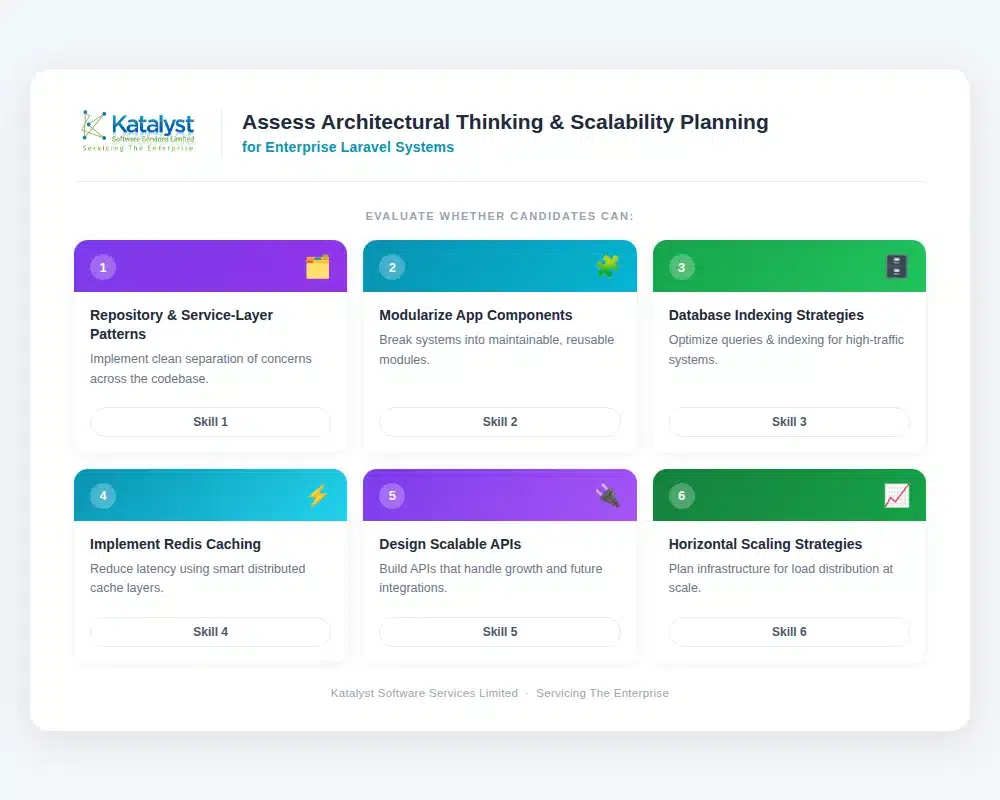
Enterprise Laravel systems must handle scale and future expansion. Evaluate whether candidates can:
- Implement repository and service-layer patterns
- Modularize application components
- Optimize database indexing strategies
- Implement Redis caching
- Design scalable APIs
- Plan horizontal scaling strategies
Developers building platforms that integrate AI-driven retail automation and intelligent commerce systems must understand concurrency management, queue optimization, and real-time broadcasting mechanisms. Their architectural approach should demonstrate foresight, not reactive patchwork solutions. Security and Compliance Discipline Laravel offers strong built-in protection mechanisms, but correct implementation is essential.
Evaluate knowledge of:
- CSRF and XSS protection
- Secure hashing techniques
- Role-based access control
- Token-based API authentication
- Encryption standards
- Secure session management
Enterprise applications handling financial or personal data demand strict security awareness from day one.
| Did You Know? |
| A large share of Laravel project overruns are caused by architectural rework, not feature development. When database structure, service layers, and caching strategies are designed incorrectly early on, performance fixes later often require major refactoring across multiple modules. |
Cloud and DevOps Readiness in 2026
Laravel applications increasingly run in containerized, cloud-native environments. Developers should demonstrate experience with AWS or Azure deployments, Docker containerization, CI/CD pipeline integration, Git workflows, load balancing strategies, and monitoring solutions.
Understanding infrastructure scalability is crucial. Applications deployed within hybrid IT governance and on-demand infrastructure models demand close coordination between development and operations. A Laravel developer must be comfortable working within DevOps ecosystems rather than treating infrastructure as an afterthought.
Practical Evaluation Techniques
Traditional algorithm tests are not enough. Instead:
Conduct a Code Refactoring Exercise
Provide poorly structured Laravel code with inefficient queries and mixed business logic. Evaluate how candidates improve:
- Separation of concerns
- Query efficiency
- Maintainability
- Documentation
Use Architecture-Based Scenarios
Present a high-concurrency SaaS scenario and assess how they approach:
- Database scaling
- Caching strategies
- Queue management
- Infrastructure deployment
Strong developers explain trade-offs clearly rather than listing tools.
Business Alignment and Communication Skills
Technical knowledge alone does not ensure project success. Laravel developers must understand business goals and translate them into scalable architecture.
They should:
- Identify performance risks early
- Recommend long-term optimization strategies
- Communicate trade-offs clearly
- Document architectural decisions
At Katalyst Software Solutions Limited, Laravel hiring frameworks emphasize governance, scalability planning, and alignment with digital transformation objectives. The focus is on building sustainable systems rather than short-term feature delivery.
Choosing the Right Engagement Model
When exploring Hire Laravel developer options, evaluate the engagement structure carefully.
Freelancers may offer flexibility for small builds but often lack enterprise governance experience.
Development agencies provide structured processes, architectural oversight, and multi-skill access.
Dedicated Laravel teams offer long-term continuity and scalability alignment for growing digital ecosystems.
Enterprise-grade platforms typically benefit from structured team models rather than isolated contributors.
Red Flags to Watch During Evaluation
Be cautious if a candidate:
- Cannot explain dependency injection
- Overuses controllers for business logic
- Ignores database indexing
- Avoids discussing scaling challenges
- Lacks familiarity with testing frameworks
- Shows weak Git workflow knowledge
Senior developers naturally integrate discussions about scalability, security, and performance optimization into technical conversations.
Laravel Development Trends Shaping Hiring in 2026
Modern Laravel projects increasingly require:
- API-first architecture
- Headless backend systems
- Real-time broadcasting
- AI integrations
- Multi-tenant SaaS structuring
- Cloud-native deployment
Your hiring process must align with these realities to ensure long-term technical relevance
Reimagine business operations and accelerate growth
Katalyst Technologies’ solutions simplify IT, ERP, and supply chain management
so teams can act faster and scale smarter can help.
When to Partner With a Technology Solutions Provider
As Laravel applications become deeply integrated with ERP systems, commerce ecosystems, and cloud platforms, evaluation complexity increases.
Organizations often collaborate with experienced partners like Katalyst to:
- Define technical standards
- Conduct structured developer vetting
- Design scalable architecture frameworks
- Ensure secure cloud deployment
- Align backend systems with enterprise growth strategies
This structured approach reduces hiring risk and accelerates implementation timelines.
Key Takeaways
Hiring top-tier Laravel developers in 2026 requires:
- Strategic project clarity
- Structured evaluation methods
- Architectural capability assessment
- Security validation
- Cloud readiness verification
- Strong business alignment
The right developer builds scalable foundations. The wrong hire creates technical debt.
Frequently Asked Questions
Your most common questions, answered with precision and insight