
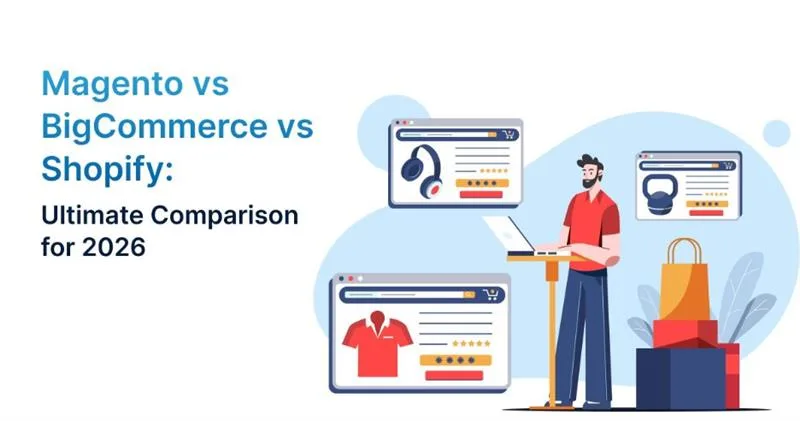
The eCommerce landscape in 2026 is evolving rapidly due to advanced technology, rising customer expectations, and the need for scalable platforms. Choosing between magento vs shopify vs bigcommerce is no longer about cost or popularity alone. Platforms must support omnichannel sales, seamless integrations, and long-term efficiency. Many businesses are reassessing their platforms due to performance issues, high maintenance costs, and limited flexibility, making platform selection a strategic growth decision.
In this blog, we explore the key challenges businesses face when selecting eCommerce platforms in 2026, with insights drawn from the magento to shopify migration perspective. We examine how Magento, Shopify, and BigCommerce support growth, performance, security, and system integration to help leaders choose platforms aligned with long-term business goals rather than short-term convenience.
Platform Architecture Explained: Open Commerce vs SaaS Ecosystems
Platform architecture determines the level of control, flexibility, and responsibility a business manages. Magento follows an open-commerce model, offering deep customization and modular control, making it suitable for enterprises with complex workflows. Shopify uses a SaaS-first approach, focusing on speed, reliability, and ease of management. BigCommerce combines SaaS convenience with added native flexibility.
When comparing shopify vs magento for enterprise, architecture becomes a key decision factor. Open platforms enable greater innovation but require technical expertise, while SaaS platforms reduce operational effort with limited system access. Choosing the right architecture should align with internal capabilities and long-term growth goals.

Performance at Scale: How Each Platform Handles Growth and Traffic
Performance affects how customers feel and how much money a business makes. When comparing Magento vs Shopify, being able to handle a lot of visitors is very important. Magento can manage high traffic well if it has good hosting and caching, while Shopify can handle sudden spikes efficiently. For enterprises looking to handle high traffic and scale your e-Commerce business with Magento, it’s important to optimize infrastructure, caching, and content delivery to maintain speed and reliability.
BigCommerce provides steady performance with little setup, making it a good choice for medium-sized brands. Studies show that even a one-second delay in loading can lower sales by up to 7%. Shopify is fast right away, while Magento can be adjusted for better performance. BigCommerce gives good performance without needing a lot of technical work. By 2026, being able to handle traffic well will be essential for staying competitive.
Security and Governance Readiness in Enterprise Commerce Platforms
Security and governance are critical when selecting a platform, especially enterprises managing high transaction volumes and sensitive data. Choosing between magento vs shopify vs bigcommerce requires understanding differences in security ownership, compliance, and access control.
Security ownership
Shopify provides fully managed security. Magento offers deeper control with higher responsibility. BigCommerce balances both.
Compliance readiness
Magento supports custom compliance needs. Shopify includes built-in standards. BigCommerce covers core regulations with less complexity.
Access control
Magento enables advanced role-based access. Shopify limits system access to reduce risk. BigCommerce supports moderate governance.
Evaluating shopify vs magento security features ensures long-term stability, compliance confidence, and customer trust.
Feature Depth vs Simplicity: Where Each Platform Excels
Feature availability affects both daily operations and long-term scalability. Comparing bigcommerce vs shopify features highlights clear differences in platform focus. Shopify prioritizes simplicity and fast deployment through its app ecosystem, while BigCommerce offers more native functionality, reducing reliance on third-party tools.
Magento delivers deep flexibility but requires higher development effort, making it suitable for complex enterprise and B2B needs. Shopify works well for fast-growing D2C brands, while BigCommerce balances flexibility and ease of use.
The table below compares how Magento, Shopify, and BigCommerce differ across core feature areas impacting scalability and efficiency.
| Feature Area | Magento | Shopify | BigCommerce |
| Custom Workflows | Advanced | Limited | Moderate |
| Native B2B | Strong | Basic | Moderate |
| App Dependency | Low | High | Medium |
| Multi-Store | Extensive | Limited | Moderate |
Feature alignment should support future growth, not just current needs.
The Role of APIs in Future-Proofing eCommerce Platforms
APIs are essential for today’s online shopping systems. When looking at Shopify vs BigCommerce API integration, being flexible and able to grow is very important. Magento has advanced API features, making it great for new shopping models. Shopify has strong APIs but with set limits. BigCommerce also has good API support with fewer rules.
Businesses that use APIs can innovate faster and connect their systems better. The quality of APIs affects how well they work with tools like CRM, ERP, PIM, and analytics. By 2026, platforms need to easily connect with AI systems and various sales channels. Being ready with APIs is now a key part of business growth.
Platform Migration in 2026: Drivers, Risks, and Best Practices
Platform migration has become a strategic move in 2026 as businesses reassess scalability, cost efficiency, and integration flexibility. Replatforming decisions are now driven by long-term growth requirements rather than short-term operational challenges.
Key migration drivers
Brands pursue magento to shopify migration for speed and simplicity, while shopify migration from magento is common when customization and control become priorities.
Migration risks to manage
SEO performance drops, data integrity issues, and downtime remain primary risks. Poor planning often leads to traffic and revenue loss.
Best practices for successful migration
Phased execution, SEO-safe URL mapping, and early integration testing reduce disruption and ensure continuity.
Well-timed and well-planned migration enables businesses to future-proof their commerce stack without compromising performance or customer experience.
Matching Platform Strengths to Business Maturity
Knowing the good and bad points of Shopify and Magento helps you pick the right platform for your business’s growth stage. Magento gives you a lot of control but needs more technical skills. Shopify is fast and reliable but has limited options for changes. BigCommerce offers a mix of flexibility and ease of use.
Studies show that picking the wrong platform can raise costs by over 20%. Businesses should look at their skills, growth plans, and management needs before deciding. There isn’t one best platform, just the right one for each stage of your business. Choosing the right platform helps with growth, efficiency, and long-term profits.
Turning Platform Selection into a Competitive Advantage with Katalyst
At Katalyst Technologies, we see choosing a platform as a long-term base, not just a temporary fix. Companies need commerce platforms that work well with their other systems and allow for future growth. Smart platform choices affect customer experience, business strength, and profit growth. Increasingly, industry leaders depend on tech partners who know both commerce and business systems. The right platform paired with a good strategy gives a competitive edge instead of limitation.
Making a Future-Ready Platform Decision
Choosing the right platform, whether it’s Magento, Shopify, or BigCommerce, should be based on clear needs rather than trends. You should think about things like growth potential, safety, how well it connects with other tools, and your long-term business plans. Platforms that fit your business’s maturity and growth goals usually do better than those picked for quick fixes.
A good platform will help you adapt, work efficiently, and build trust with customers well into the future. If you need more help understanding which platform might be best for you, you can schedule a demo with Katalyst Technologies to see how these platforms work in a real business setting.
Frequently Asked Questions
Your most common questions, answered with precision and insight