
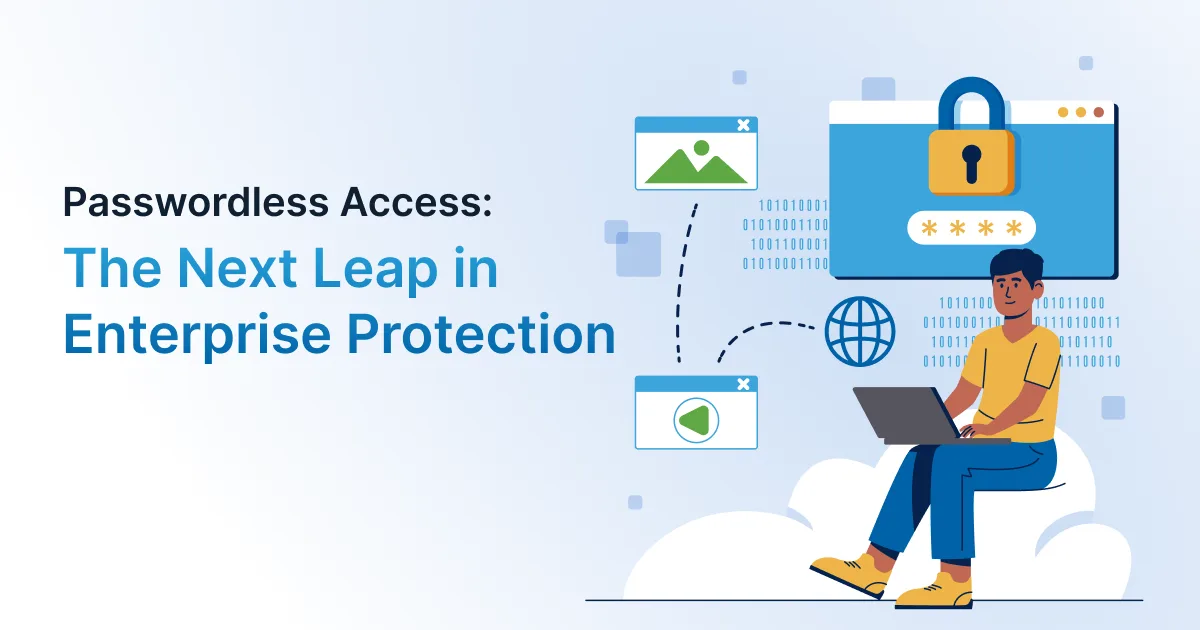
With the increase in security breaches in flexible work environments, businesses are reassessing legacy, password-based authentication. Many organizations are turning to password less authentication to mitigate risks and operational issues. As organizations expand across cloud applications, mobile, and hybrid environments, passwordless authentication for enterprises has become crucial. It ensures secure and seamless access.
This document examines the authentication of credentials that enterprises utilize. It discusses the effects of related technologies and Identity and Access Management (IAM) strategies. Additionally, it offers guidance on designing and implementing sustainable architecture. This architecture should integrate seamlessly with existing workflows.
Why Enterprises Are Rethinking Traditional Access Controls
Passwords have long served as the primary method of validating identity, but they now pose significant security risks. Attackers increasingly exploit weak, reused, or stolen credentials, making password-based systems vulnerable.
In today’s distributed work models, hybrid work, cloud, and Zero Trust frameworks demand authentication approaches that go beyond traditional passwords. These evolving challenges highlight why legacy password workflows are no longer sufficient for modern enterprises.
Passwords are a weak link:
Credentials that are easily guessed, reused, or stolen significantly raise the risk of breaches in password-based authentication.
Susceptible to attacks:
Password vulnerabilities are targeted by phishing, social engineering, and automated attacks.
Complex hybrid environments:
Managing passwords consistently is challenging with cloud, mobile, and remote workforces.
Zero Trust challenges:
Traditional passwords are not sufficient for continuous identity verification. Zero Trust frameworks require persistent authentication methods.
Operational inefficiency:
Frequent password resets and helpdesk tickets burden into IT teams.
Poor user experience:
Complex passwords and multi-step logins can hinder productivity and frustrate employees. Password less authentication offers a solution to these challenges.

Key Factors Driving Enterprise Adoption of Modern Authentication
Below is a simplified and concise table that highlights the primary reasons why enterprises are focusing on password less strategies.
| Enterprise Challenge | Passwordless Advantage |
| Credential theft and phishing risks | Removes passwords entirely, reducing attack surface |
| High IT workload due to resets | Minimizes dependence on password management system, lowering operational cost |
| Need for stronger MFA compliance | Enables phishing-resistant authentication |
| Complex access across hybrid environments | Works smoothly with cloud, mobile, and legacy ecosystems |
| Poor user experience with frequent logins | Provides fast, intuitive access using biometrics or devices |
| Zero Trust adoption | Supports continuous, context-aware identity verification |
Together, these benefits enhance security and streamline operations. Additionally, it provides a frictionless user experience. These advantages make it a strategic investment for enterprises.
How Passwordless Authentication Works in the Enterprise
A modern passwordless authentication system uses device-based credentials or biometric factors to verify identity. Users authenticate without typing passwords. They use secure and seamless methods instead.
Biometrics for Instant and Secure Identity Verification
Biometric authentication offers high assurance using facial recognition, fingerprint scanning, or iris scanning, without exposing sensitive information. When integrated with Identity and Access Management (IAM) policies, it ensures reliable governance and centralized control. This combination also supports compliance across enterprise systems.
Cryptographic Keys for Device-Bound Security
Public-key cryptography links a user’s identity to their device. The private key remains on the user’s device. Authentication is performed using a matching public key on the server. This method provides strong defense against phishing and credential replay attacks.
Hardware Security Keys
Hardware tokens provide the strongest protection for high-risk user groups like administrators and finance teams. These keys use challenge-response methods to verify identity. They cannot be phished or cloned.
Mobile-Based Push Approvals
Users can approve login attempts through an authenticated mobile app. This process reduces friction and eliminates the need for passwords. It also provides strong identity assurance.
The Critical Role of IAM in Passwordless Transformation
Updating authentication is more than a technology upgrade. It needs to align with the broader identity strategy of the enterprise. Incorporating passwordless methods into Identity and Access Management offers numerous benefits:
- Unified identity governance across hybrid applications
- Consistent policies for user lifecycle management
- Strong audit trails for compliance and security monitoring
- Adaptive authentication workflows based on risk signals
- Better user experiences with fewer support interactions
A strong IAM foundation is crucial. It enables passwordless authentication to integrate seamlessly into enterprise architecture. This approach is scalable and sustainable for businesses.
Where Enterprises Benefit Most from Passwordless Access
Here are the main benefits enterprises experience with passwordless authentication:
Workforce Access Across Multiple Platforms
Employees often move between cloud tools, VPNs, business applications, and collaboration platforms. Hybrid cloud environments can benefit from passwordless access. It minimizes delays and enhances productivity without compromising security.
Securing Privileged and Administrative Accounts
High-privilege accounts are common targets for attackers. Removing passwords greatly reduces the risk of credential-based attacks. This approach also supports Zero Trust enforcement.
Customer and Partner Portal Authentication
Streamlining login flows with passwordless experiences can enhance user satisfaction and engagement for organizations offering digital services.
Industry-Specific Regulatory Compliance
Industries such as finance, healthcare, logistics, and manufacturing gain significant advantages from adopting passwordless systems. This approach simplifies compliance processes.

Implementing Passwordless Security in Enterprise Environments
Achieving a successful rollout demands a methodical approach. It’s essential to balance security, usability, and system compatibility. Here are steps for implementing passwordless security:
Step 1: Evaluate Authentication Dependencies
Passwords can cause friction and pose risks in legacy systems, cloud applications, databases, and VPNs. They often act as barriers in these areas.
Step 2: Integrate Passwordless Capabilities into IAM and SSO
Authentication should be consistent throughout your identity ecosystem to ensure uniform governance. It also enhances auditability.
Step 3: Select Appropriate Authentication Methods
Select between biometrics, cryptographic keys, push verifications, or hardware tokens according to user roles and compliance requirements.
Step 4: Begin with High-Risk or High-Value User Groups
Roll out passwordless authentication initially to administrators, finance teams, remote workers, or developers.
Step 5: Expand Across the Organization
Once initial configurations are optimized, expand to all employees, partners, and customer-facing applications.
How Katalyst Technologies Strengthens Enterprise Access Security
Katalyst Technologies offers advanced identity solutions for businesses. With deep expertise in secure and seamless authentication models. It covers Identity and Access Management, digital modernization, and infrastructure migration. Katalyst ensures:
- Zero Trust-aligned passwordless deployment
- Phishing-resistant authentication for all user types
- Smooth integration across cloud, hybrid, and legacy systems
- compliance support for regulated industries
- Scalable IAM architecture tailored to meet business needs
We prioritize long-term resilience. We ensure operational efficiency. We simplify user experiences.
Your Next Step Toward Zero-Trust Ready Authentication
As organizations update their digital systems, password-based authentication becomes less viable. Switching to passwordless authentication boosts security. It also reduces operational issues and improves user productivity. By adopting passwordless solutions now, enterprises can create a secure and scalable future.
Partner with Katalyst Technologies to develop a secure, scalable, passwordless authentication strategy customized to your organization’s needs.