Stop Wrestling With Software Choices
Every week, we hear the same concern from operations and IT leaders: “We bought a ‘best-in-class’ package, yet half our team still works from spreadsheets, and the plant still suffers unplanned downtime.”
If that sounds familiar, you are not alone. The core question is straightforward: Should you invest in custom software development or rely on off-the-shelf software? The answer depends less on code and more on business fit, risk, and long-term value.
What Counts as Custom vs. Off-the-Shelf?
Before comparing options, it helps to define them:
- Custom software development: Purpose-built code designed for your specific workflows, data models, and security rules. You own the IP and control every feature.
- Off-the-shelf software (OTS): A pre-packaged platform, often cloud-based, sold to many companies under license or subscription.
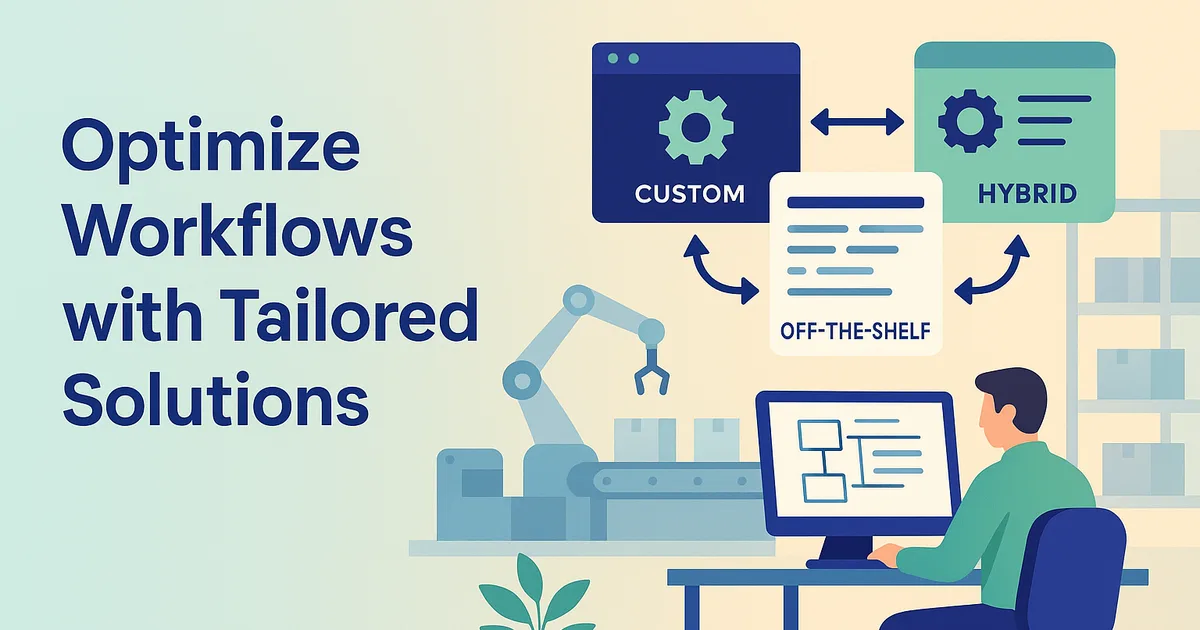
Most enterprises use a hybrid model: OTS systems for common needs (email, HR, CRM) and custom software development modules for strategic processes (shop-floor scheduling, regulatory reporting, proprietary analytics).
Quick Comparison at a Glance
The table below summarizes the five decision pillars most executives weigh when choosing between custom vs. off-the-shelf software.
| Decision Pillar | Custom Software Development | Off-the-Shelf Software |
| Up-front Cost | Highest (project funding) | Low to moderate (licenses) |
| Time-to-Value | 4–12 months typical | Days to weeks |
| Fit to Workflows | Exact, built around you | Limited to the vendor roadmap |
| Integration Effort | Lowest long-term (native APIs) | Often relies on adapters/middleware |
| Long-Term ROI | High when usage exceeds 5 years | Declines if features are underused |
Note: Studies show that average users access only about 10% of features in large OTS suites.
Reimagine business operations and accelerate growth
Katalyst Technologies’ solutions simplify IT, ERP, and supply chain management
so teams can act faster and scale smarter can help.
When Custom Software Development Wins
- Competitive Differentiation – If your process gives you an edge, such as predictive maintenance or proprietary quoting, owning the code protects that advantage.
- Complex Multi-Vendor Ecosystems – Manufacturers juggling MES, ERP, and IoT data face high integration costs. A custom middleware layer reduces duplication and unifies data.
- Strict Compliance & Security – Life sciences or CPG plants subject to FDA 21 CFR Part 11 or GS1 standards need audit trails that OTS tools rarely provide out of the box.
- Long-Term Cost Control – Subscription creep is common. One global distributor we worked with replaced 14 overlapping OTS tools with a single custom portal, cutting annual software spend by 32%.
- Future-Proof Flexibility – If you plan to add AI vision inspection or other technologies later, owning the codebase lets you control the roadmap.
When Off-the-Shelf Delivers More Value
- Standardized Processes – If the workflow is common across industries (payroll, email, CRM), proven OTS platforms save time and cost.
- Urgent Launch Deadlines – A retail startup preparing for peak season cannot wait months. A SaaS suite can go live in weeks.
- Limited Internal IT Bandwidth – No in-house development team? Managed SaaS takes care of patching, security, and uptime.
- Budget Constraints – Capital freezes happen. OTS shifts cost to operating expenses, easing CFO approval.
- Community & Ecosystem – Large suites like SAP or Microsoft Dynamics include add-ons, training, and a wide hiring pool, which supports scalability.
The Overlooked Middle Road: Hybrid Approaches
Many enterprises now combine low-code platforms or modular micro-services with niche OTS components. This model offers:
- Faster prototypes than full custom builds.
- Room to hard-code high-value functions later.
- A phased investment path that reduces executive-level risk.
Pro Tip: Start with a lightweight integration layer (API gateway or event bus) so both custom and OTS modules can plug in without rip-and-replace drama.
Real-World Snapshot: 18% Downtime Cut in 9 Months
A Midwest automotive supplier ran an off-the-shelf MES. Operators still recorded scrap on paper, causing data lags and surprise machine failures.
What we did:
- Built a custom software development shop-floor app tied into the existing MES via REST APIs.
- Added real-time sensor ingestion for predictive maintenance.
- Rolled out in three agile sprints, each under four weeks.
Results:
- Unplanned downtime dropped 18%.
- Scrap reporting latency fell from 24 hrs to 5 minutes.
- ROI payback hit in month 11, three months ahead of the board’s target.
Drive Efficiency. Realize Potential
Cut through technical complexity with Katalyst.
We build streamlined, powerful solutions that automate processes and integrate data, freeing you to focus on strategic growth
A Five-Step Framework to Decide
- Clarify Business Goals
Outline measurable outcomes: reduce downtime by 15 %, shorten the quote cycle by two days, and meet new compliance rules. - Map Current & Future Workflows
Identify gaps where existing software forces workarounds or manual re-entry. - Score Each Pillar (Cost, Time, Fit, Risk, Growth)
Use a simple 1–5 scale. Weight pillars by strategic priority. - Run a Total Cost of Ownership (TCO) Model
Include licenses, customization fees, integration labor, training, and 5-year maintenance. - Secure Cross-Functional Buy-In
Present a data-backed recommendation to executives, ops, and IT. Emphasize tangible value and realistic timelines.
Following this order keeps scope creep in check and builds the executive confidence needed to fund the project.
Common Pitfalls to Avoid
- Ignoring Hidden OTS Costs: Implementation partners, feature add-ons, and per-API fees inflate budgets fast.
- Underestimating Change Management: Even perfect software fails if users cling to old habits.
- Over-customizing an OTS Platform: Deep code tweaks void vendor support and trap you in upgrade purgatory. When modifications exceed 25% of core functions, pure custom software development is usually cheaper long-term.
- Skipping a Phase-Gate Approach: Big-bang rollouts risk production halts. Adopt phased pilots to uncover issues before enterprise-wide deployment.
The Bottom Line
Choosing between custom vs. off-the-shelf software is not a tech argument; it’s a business strategy decision. Use the five decision pillars, run a data-driven TCO, and pilot before you commit.
Katalyst Technologies help enterprises make that choice with confidence, delivering solutions that fit like a glove, often at a fraction of the cost of long-term license sprawl.
Ready to see which path unlocks tangible value for you? Let’s start the conversation.
Frequently Asked Questions
How much does custom software development really cost?
For mid-size enterprises, budgets range from $250k to $1.5M depending on scope, integrations, and security needs. The key is to benchmark against five-year OTS subscription and support costs, not year one alone.
What is the typical ROI timeline for custom vs. off-the-shelf software?
We see payback in 12–24 months for most manufacturing and logistics cases, driven by labor savings, downtime reduction, and license consolidation.
Can we start with off-the-shelf and migrate later to custom software?
Absolutely. Many clients use OTS to validate a process, then commission a custom software development build once volumes and requirements stabilize.
Will custom code lock us into a single vendor?
Only if you allow it. Insist on open standards (REST, OAuth, Docker) and full source-code escrow to preserve future flexibility.